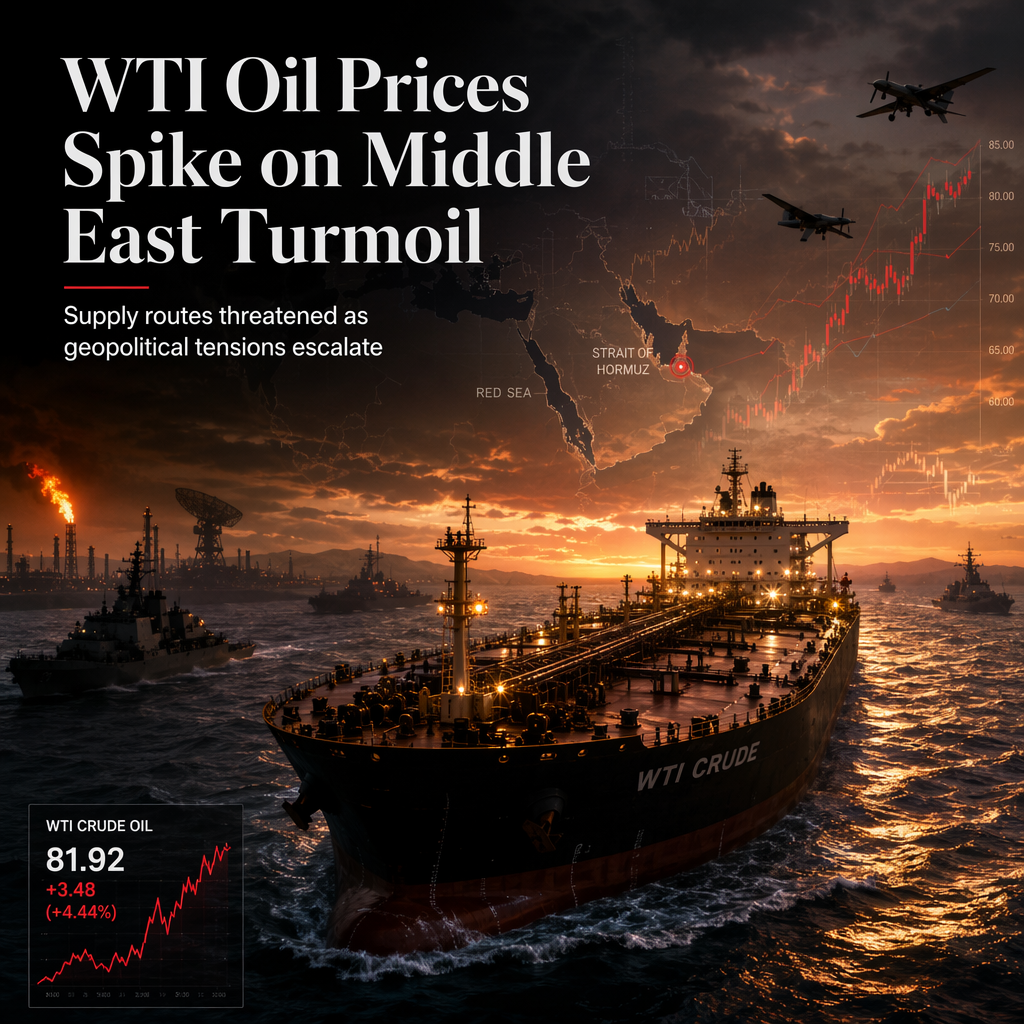
West Texas Intermediate (WTI), the US crude oil benchmark, traded around $87.50 during early European hours on Thursday, marking its highest level since June 11. This surge follows rising tensions in the Middle East, notably after a 12th consecutive night of strikes on Iran, which have caused significant disruptions to two of the world's key oil supply routes [1]. The escalation was further fueled by US President Donald Trump's threat to destroy Iranian infrastructure in response to attacks on ships in the Strait of Hormuz, a critical oil transit route. The Islamic Revolutionary Guard Corps (IRGC) declared that no tanker would enter or leave the waterway without coordination with Iran, underscoring the heightened risk to global oil flows [1].
Additionally, the Iran-backed Houthis in Yemen claimed responsibility for attacking two Saudi oil tankers, ENCELA and LAYLIA, in the Red Sea, alleging the vessels violated a naval blockade imposed earlier in the week. These incidents have contributed to increased volatility in oil markets, with analysts at Gelber & Associates noting that the price rise is not necessarily due to reduced production but rather the expectation of continued volatility, especially if Saudi oil exports to Asia or Red Sea shipping face further disruption [1].
Technical analysis indicates that WTI's near-term bias remains bearish, as prices are capped below the 100-day simple moving average (SMA) at $88.15. The Relative Strength Index (RSI) at 67.5 suggests strong upside momentum but signals that the market is approaching overbought territory. Key resistance is identified between the upper Bollinger Band at $88.10 and the 100-day SMA at $88.15, with a daily close above this zone potentially paving the way to the $90.00 psychological level. On the downside, support is seen at the Bollinger middle band near $75.55 and a deeper technical floor at $63.00 [1].
Rabobank’s energy strategists highlighted that geopolitical risks have intensified, citing the escalation between the US and Iran following the collapse of an interim peace deal, as well as intensifying strikes between Ukraine and Russia. These developments have driven broad-based price rallies across crude oil and refined products, reflecting the market's sensitivity to geopolitical disruptions [1].
CONCLUSION
WTI crude oil prices have surged to six-week highs amid escalating geopolitical tensions and supply route disruptions, with analysts expecting continued volatility. Technical indicators suggest strong momentum but warn of resistance ahead, while market strategists point to broad-based rallies across the energy complex. The ongoing instability in key transit routes is likely to keep oil prices elevated and markets on edge.