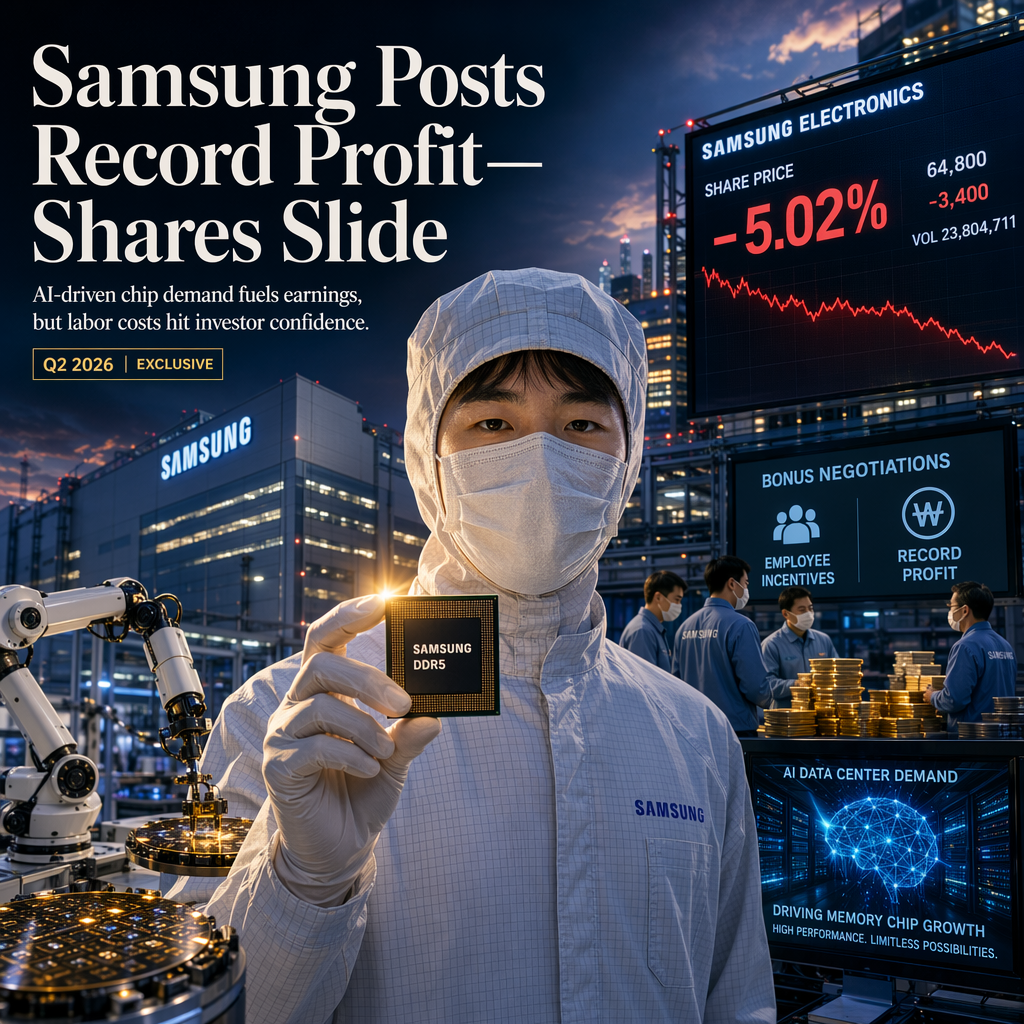
Samsung Electronics reported a record preliminary operating profit of 89.4 trillion won ($58.4 billion) for the second quarter of 2026, a figure that is more than 19 times higher than the same period a year ago, when operating profit stood at 4.7 trillion won [1][2]. This surge in profit is attributed to a continued shortage of memory chips driven by rising demand for artificial intelligence computing [1]. Revenue for the April-to-June period reached 171 trillion won, up from 133.9 trillion won in the previous quarter [2].
Despite the record-breaking profit, Samsung's shares opened nearly 5% lower on Tuesday [2]. Analysts noted that the results included deductions for one-off expenses related to employee bonus provisions, following recent labor negotiations [2]. Earlier in the year, Samsung agreed to remove its 1,000% base salary bonus cap and allocate 10.5% of its operating profit for bonuses, after a weeks-long labor union protest demanding a fairer share of company earnings [2].
In response to the ongoing AI boom and the resulting chip shortage, Samsung announced plans to build additional fabrication plants to meet the rising demand [1]. The company continues to benefit from the global surge in AI-related computing needs, which has significantly boosted its profitability [1].
No specific analyst opinions or forward-looking financial guidance were provided in the articles, but the company's expansion plans and labor agreements suggest ongoing adjustments to both capacity and cost structure [1][2].
CONCLUSION
Samsung Electronics delivered a record second-quarter profit, fueled by strong AI-driven demand for memory chips and ongoing supply shortages. However, the market reacted negatively, with shares falling nearly 5% despite the strong results, likely reflecting concerns over increased costs from labor agreements and bonus provisions. The company is responding to demand by planning new chip fabrication facilities.