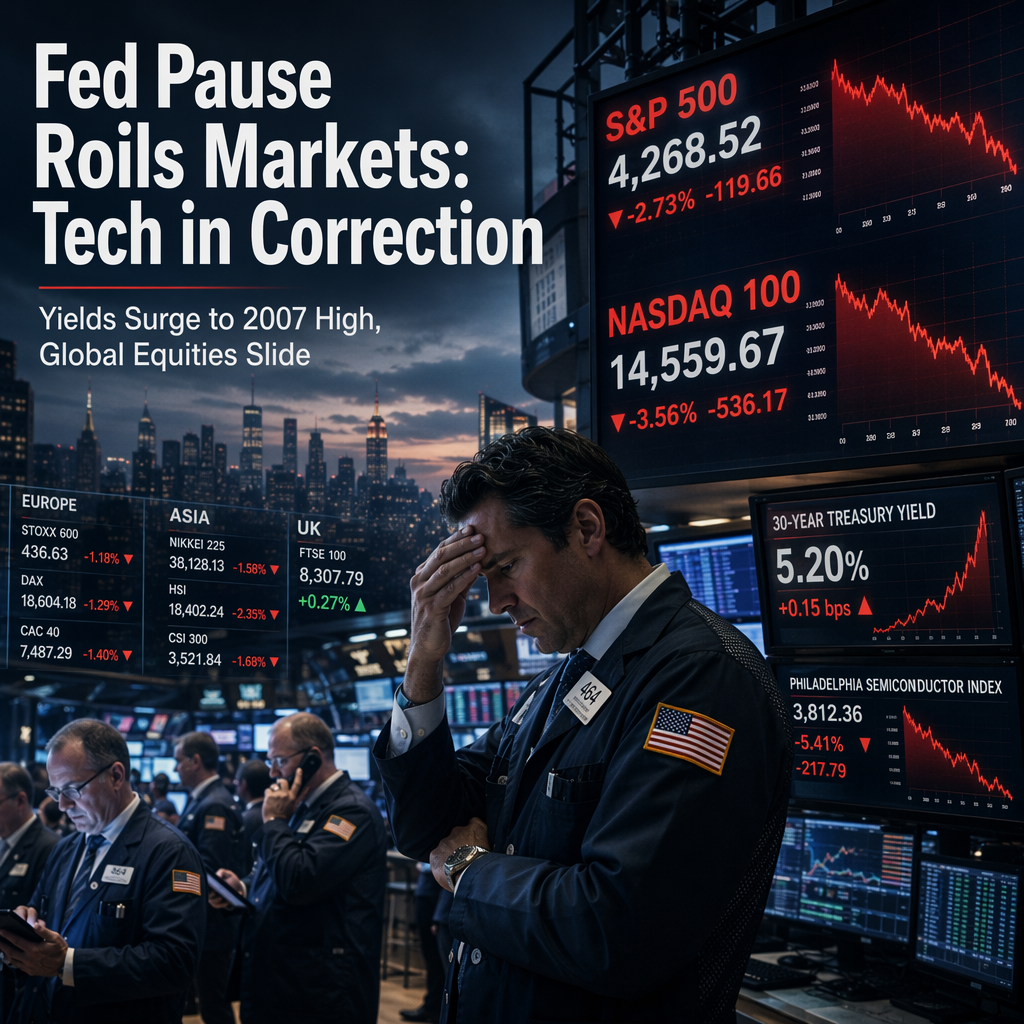
Deutsche Bank reports that the Federal Reserve's decision to keep rates on hold, combined with limited detail from Chair Warsh, led to a sharp steepening in the U.S. Treasury curve. The 30-year Treasury yield surged by 11.2 basis points to reach 5.20%, marking a post-2007 high and exerting significant downward pressure on equities [1]. The S&P 500 experienced its worst day in seven weeks, closing down 1.52% after volatile intraday swings. The index initially traded more than half a percent lower before briefly turning positive during Warsh's press conference, only to fall sharply in the final hour of trading [1].
Technology stocks were particularly hard hit, with the Philadelphia Semiconductor Index plunging 5.33%. This tech sector weakness dragged the NASDAQ 100 down by 2.06%, pushing it into technical correction territory as the index is now down 11.3% from its early June peak [1].
European equities also faced pressure, with the Stoxx 600 down 0.29%, the CAC falling 0.60%, and the FTSEMIB declining 0.49%. In contrast, the UK's FTSE 100 managed a gain of 0.34% [1].
Asian markets showed a mixed response. The Nikkei rebounded 0.75% after previous declines, while the KOSPI dropped 1.30% following a steep 5.98% fall the prior day. Notably, Korea's KOSPI index had surged as much as 5.50% earlier in the session before reversing gains, with Samsung shares falling about 2% after reporting Q2 earnings that included a more than 250-fold year-on-year increase in semiconductor profits [1].
CONCLUSION
The Federal Reserve's on-hold stance and the resulting spike in long-term yields triggered a broad sell-off in global equities, with U.S. tech stocks entering correction territory and mixed performances across Europe and Asia. Market sentiment remains negative, particularly for technology shares, as investors react to higher yields and ongoing uncertainty from central bank communications.