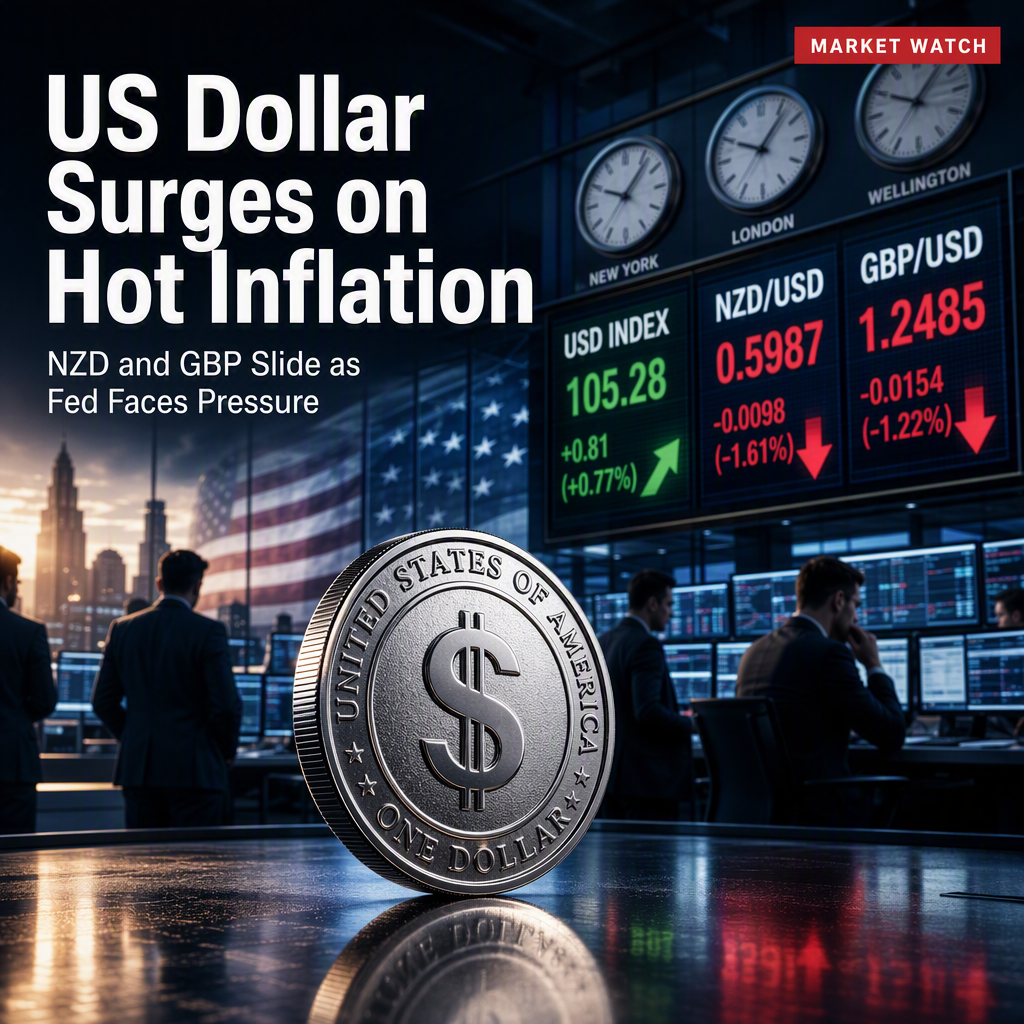
The US Dollar (USD) has strengthened against major currencies, including the New Zealand Dollar (NZD) and British Pound (GBP), following the release of hotter-than-expected US inflation data on Wednesday. The Personal Consumption Expenditures (PCE) Price Index accelerated beyond expectations in July, with the yearly rate steady at 3.7% and core PCE inflation at 3.3%, both well above the Federal Reserve’s 2% target rate [2]. This has renewed pressure on the US Federal Reserve (Fed) to consider hiking interest rates in the coming months, although market bets for a September rate hike remain unchanged at 36%, as measured by the CME’s FedWatch Tool [1][2].
The NZD/USD pair dipped below 0.5950, trading at 0.5944, marking its second consecutive day of losses as USD strength persists. NZD/USD bears are targeting the bottom of the weekly range around 0.5930, after rejection ahead of the 0.6000 area earlier in the week [1]. Technical analysis indicates that NZD/USD remains supported by an ascending trendline from late June lows, now around 0.5900, and the 200-day Simple Moving Average (SMA) at 0.5844. Momentum indicators are neutral-to-bullish, with the Relative Strength Index (14) around 60 and a mildly positive MACD reading, suggesting buyers still retain some control despite weakening traction [1].
Similarly, the GBP/USD pair has dropped to weekly lows below 1.3600, trading at 1.3675, more than 0.5% below Wednesday’s highs. The US Dollar was the strongest against the British Pound, with a daily percentage change of 0.10% [1][2]. ING strategists describe the US data releases as "a mixed bag, offering some support to the dollar but failing to solve the market's conundrum about the September FOMC (pricing now 9bp)" [2]. ING remains "reasonably confident" in their call for the Fed to hold rates on 16 September and, by extension, in a weaker Dollar, but cautions that the next three weeks will be critical as incoming US releases and policy communication could shift rate expectations [1][2].
Market participants are closely watching for clearer signals from the Fed regarding the September FOMC meeting. The current pricing leaves room for hike expectations to shift, depending on forthcoming economic data and Fed commentary [1][2].
CONCLUSION
Hot US inflation data has bolstered the US Dollar, pressuring both the NZD and GBP to multi-day lows. Despite increased speculation about a Fed rate hike, market expectations for September remain unchanged, with analysts emphasizing the importance of upcoming data and Fed communication. The market remains cautious, awaiting further clarity on the Fed's policy direction.