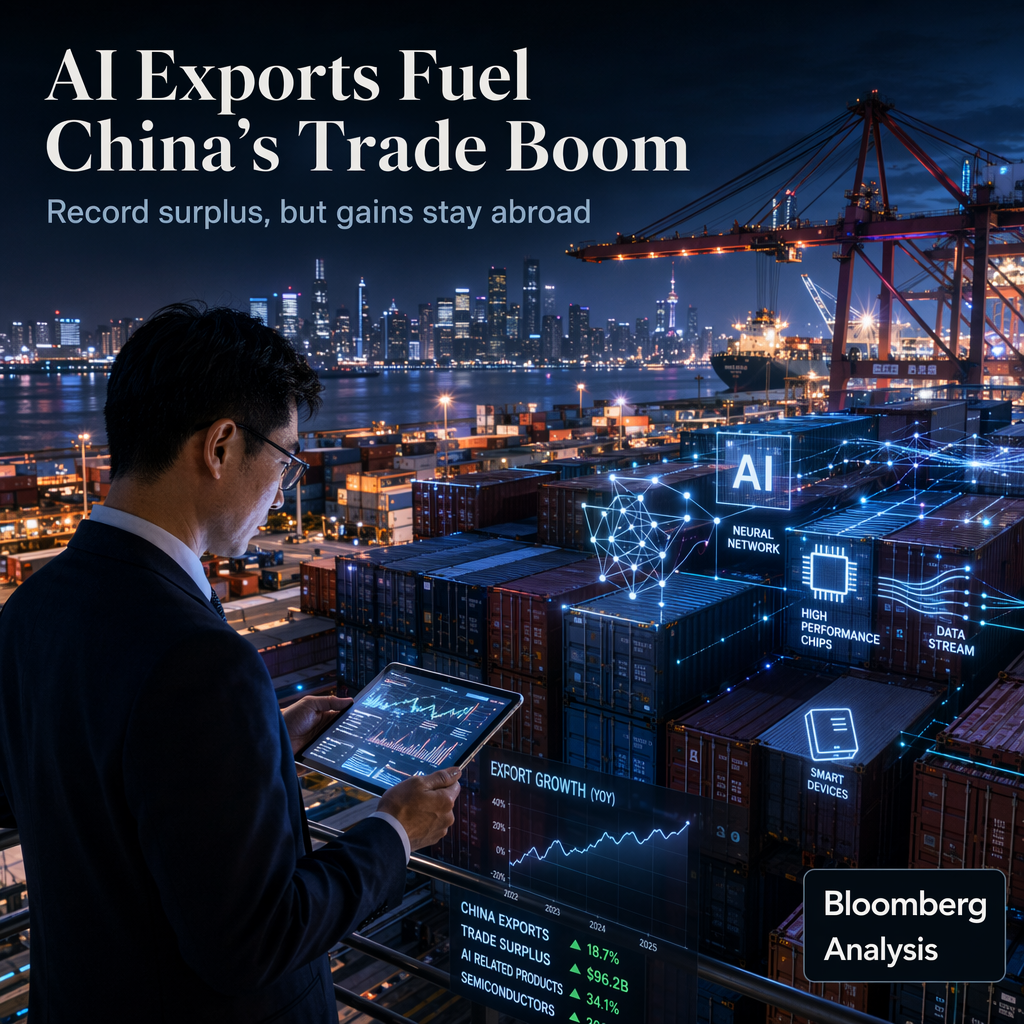
China recorded a trade surplus of $125.62 billion in June, marking the second largest on record, according to Societe Generale economists. This surplus was propelled by a 27% year-on-year increase in exports and a 36% rise in imports, with AI-related high-tech shipments surging by over 50% during the period [1].
The report highlights that the robust growth in AI-driven exports has reinforced a divergence between strong external demand for technology products and still-subdued domestic consumption in China. Similar trends are observed in Korea and Taiwan, where booming semiconductor and technology exports are fueling corporate profits and nominal GDP growth [1].
Despite the significant gains in trade and income, the impact on broader inflation, domestic demand, and currency appreciation has been muted. Societe Generale notes that much of the income generated from the AI export boom is being retained or invested abroad, rather than translating into domestic economic spillovers or upward pressure on the Chinese currency [1].
The muted transmission of AI-driven export gains to the broader economy suggests that, while the external sector is performing strongly, domestic economic momentum remains relatively weak. This dynamic may limit the immediate inflationary or currency effects typically associated with such large trade surpluses [1].
CONCLUSION
China's record trade surplus, driven by a surge in AI-related exports, underscores the strength of its external sector. However, the limited impact on domestic demand, inflation, and currency appreciation suggests that the benefits of the export boom are not yet translating into broader economic momentum.