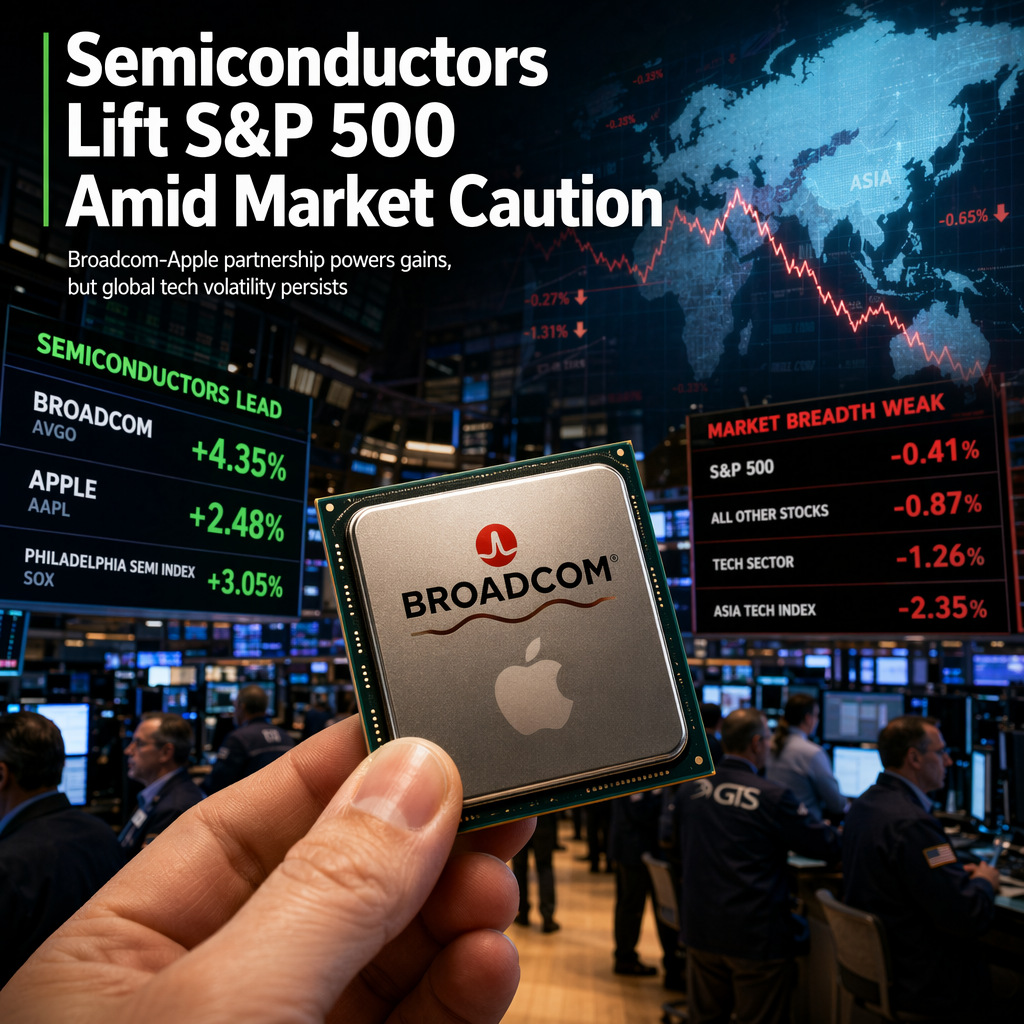
Deutsche Bank strategists observed that the S&P 500 reached a three-week high, rising by 0.72%, primarily driven by a rebound in semiconductor stocks. The Philly semiconductor index climbed 2.17%, recovering from last week's decline, with Broadcom gaining 3.73% after announcing an expanded partnership with Apple, which itself rose 1.31%. The new agreement between Broadcom and Apple involves developing custom chips and extends their collaboration through 2031 [1].
Despite the headline gains, the rally was narrow, as most S&P 500 constituents actually declined, indicating weak market breadth. The overall strength in US equities was partly attributed to a post-holiday catch-up, as European markets, which were open on Friday, saw the STOXX 600 fall by 0.35% and the 10-year bund yield rise by 1.3 basis points [1].
Asian technology stocks experienced renewed selling pressure, raising concerns about the sustainability of the US chip rally. The KOSPI index in South Korea dropped 8.03%, with Samsung Electronics falling 9.3% despite reporting a 19-fold increase in quarterly profit. SK Hynix also declined 10.0% following the official launch of its US listing marketing process. Other major Asian indices, including the Nikkei (-1.84%), CSI (-0.83%), Shanghai Composite (-1.04%), Hang Seng (-0.42%), and S&P/ASX 200 (-0.44%), traded lower as well. Nasdaq futures were down 1.03%, and S&P futures fell 0.30%, suggesting potential weakness ahead for US equities [1].
Deutsche Bank strategists highlighted the fragility of the semiconductor-led rally, noting that renewed selling in Asian tech stocks could increase the risk of a reversal in US markets [1].
CONCLUSION
While semiconductor stocks, led by Broadcom and Apple, drove the S&P 500 to a three-week high, the rally's narrow breadth and weakness in Asian tech markets signal caution. Deutsche Bank strategists warn that the chip rally's sustainability is uncertain, with market risks heightened by global tech sector volatility.