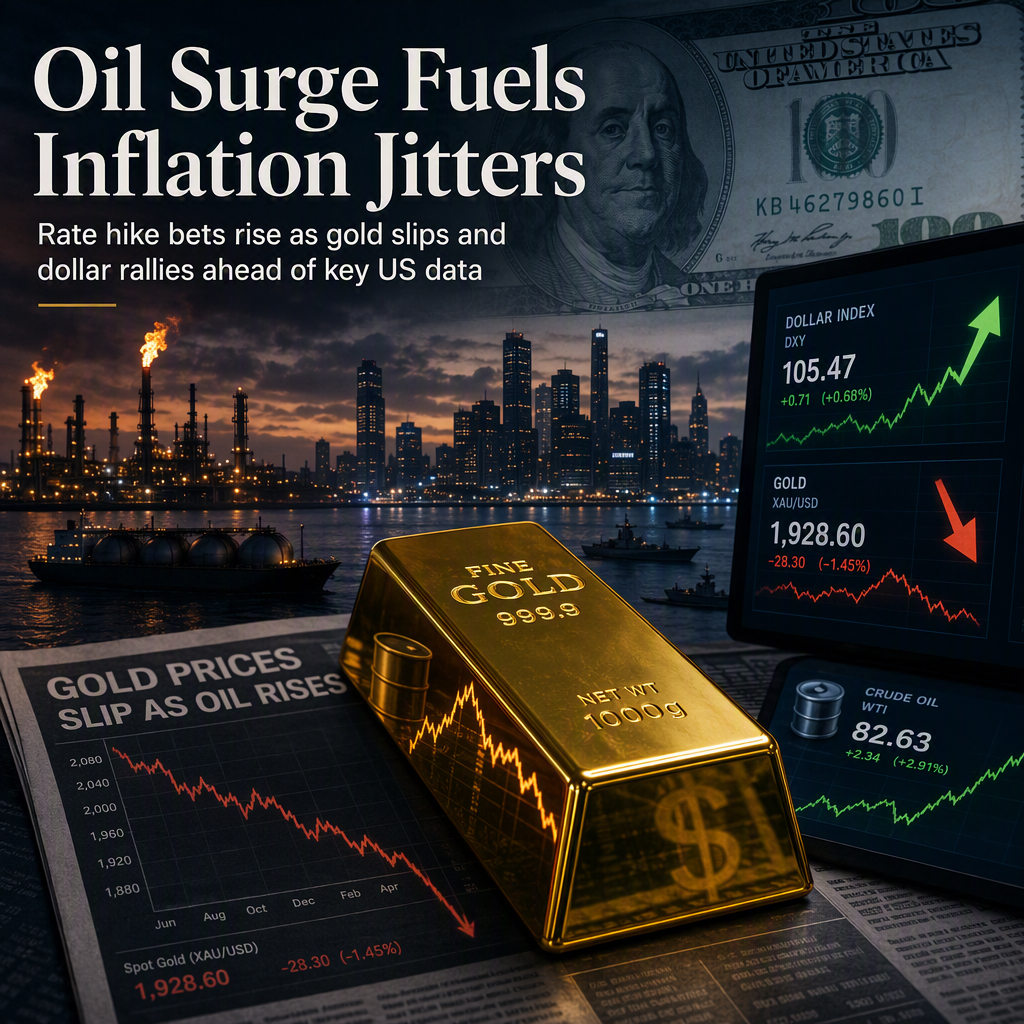
Gold prices (XAU/USD) fell to near $4,350 during the early Asian session on Wednesday, pressured by rising oil prices that have fueled inflation concerns and increased expectations for a Federal Reserve rate hike in September [1]. Escalating geopolitical tensions in the Middle East, including US strikes on Iranian tankers and explosions on Iran’s Kharg Island, as well as Houthi attacks halting operations at several Saudi Arabian energy facilities, have pushed oil prices higher and stoked fears of further interest rate increases [1][2].
Market participants are closely watching the upcoming US Producer Price Index (PPI) and Consumer Price Index (CPI) data, which are expected to significantly influence the Fed’s next policy move [1][2]. According to the CME FedWatch tool, traders have priced in an over 59.4% chance of a Federal Reserve rate increase this month [1], while Prime Terminal data shows a 63% probability of a 0.25% rate hike at the September 15-16 meeting [2]. Strategists at Commerzbank warn that gold remains highly sensitive to any surprises in the inflation data, with considerable scope for a correction in interest rate expectations if the data deviates from consensus [1].
The Australian Dollar (AUD/USD) finished Tuesday’s session flat, trading at 0.7219 after failing to sustain gains due to higher oil prices, which supported the US Dollar [2]. Geopolitical risks and the anticipation of US inflation data have revived demand for the Greenback, with most investors expecting a 0.25% Fed rate hike next week [2]. ANZ economists noted that another month of encouraging inflation data could give the FOMC confidence to hold rates steady in September, but ongoing geopolitical uncertainty may affect policymakers’ confidence [2]. If July’s CPI data surpasses expectations (forecasted at 0.4% MoM or 3.4% YoY, with core figures at 0.2% MoM and 2.4% YoY), it could prompt additional tightening measures and further strengthen the US Dollar [2].
Technically, gold retains a neutral tone in the near term, trading just above the 100-day simple moving average and below the 20-day Bollinger midline, with the Relative Strength Index around 47, indicating a lack of directional conviction after the recent pullback [1]. For AUD/USD, the pair maintains a constructive near-term bias above key moving averages, with the RSI near 68 suggesting upside momentum but also the potential for a pause or shallow consolidation [2].
CONCLUSION
Rising oil prices and heightened geopolitical tensions have intensified inflation fears, leading to increased expectations of a Federal Reserve rate hike in September. Both gold and the Australian Dollar are reacting to these developments, with market participants awaiting key US inflation data that could further influence Fed policy and market direction.