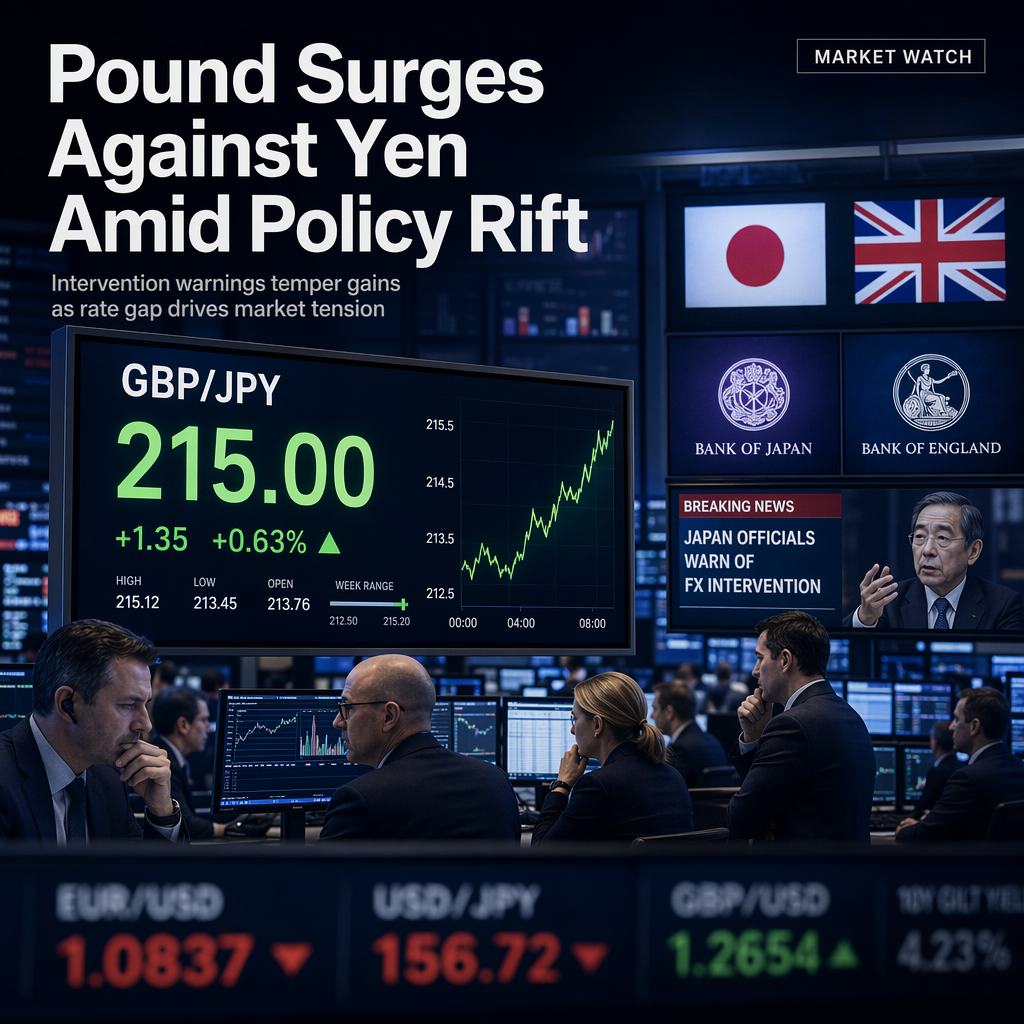
The British Pound (GBP) advanced against the Japanese Yen (JPY) for the second consecutive day, reaching a nearly two-week high during early European trading on Tuesday. Market participants are closely watching whether the GBP/JPY cross can sustain a move above the 215.00 psychological level, as expectations of possible intervention by Japanese authorities temper further gains [1].
Japanese officials have reiterated their readiness to act in the foreign exchange market. Chief Cabinet Secretary Minoru Kihara stated he is always prepared to take necessary action on forex, while Finance Minister Satsuki Katayama emphasized that the government will respond appropriately to currency moves as needed. These statements, combined with the Bank of Japan's (BoJ) hawkish outlook, have limited aggressive bearish bets on the JPY and capped the GBP/JPY rally [1].
The BoJ's June meeting summary revealed that policymakers discussed rising inflation risks, with some advocating for faster rate hikes to levels considered neutral for the economy. Recent signs of increasing inflation in Japan support the BoJ's tightening stance. However, the JPY continues to underperform due to Japan's lower borrowing costs compared to other G7 economies, including the UK. The Bank of England's base rate stands at 3.75%, while the BoJ's main policy rate is 1.00%—the highest in 31 years—resulting in a 275 basis point gap that sustains the carry trade and weighs on the JPY [1].
Despite these dynamics, increased demand for the US Dollar (USD) has limited further appreciation of the GBP/JPY cross. This week, the JPY was the strongest against the Canadian Dollar but showed weakness against the GBP, with a -0.64% change, reflecting the ongoing pressure on the Japanese currency [1].
CONCLUSION
The GBP/JPY pair's recent gains are constrained by Japanese authorities' intervention warnings and ongoing policy divergence between the BoE and BoJ. While inflation concerns and potential rate hikes in Japan offer some support for the JPY, the wide interest rate gap continues to favor the GBP. Market participants remain cautious, awaiting further signals from both central banks and potential government action.