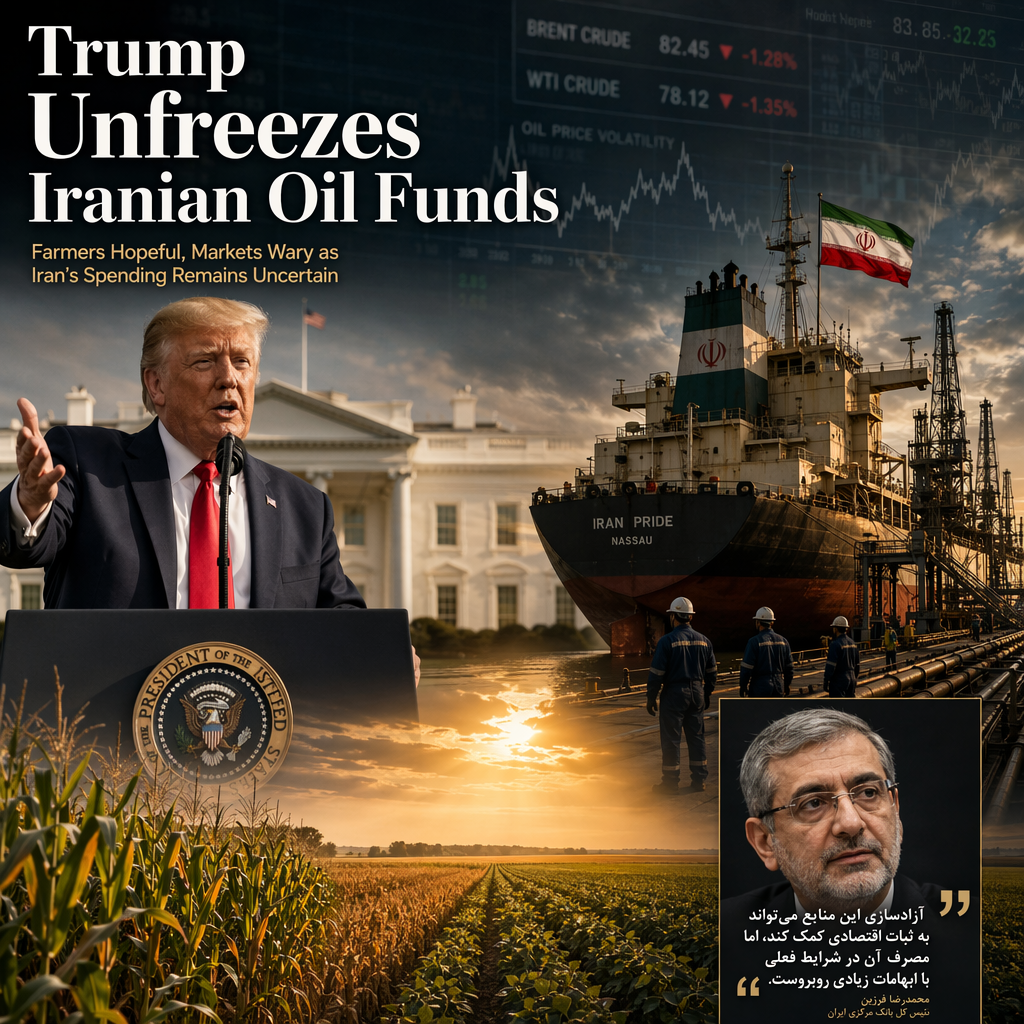
President Donald Trump announced that Iranian funds are being unfrozen as part of a memorandum of understanding between the U.S. and Iran, following productive peace talks in Switzerland. Trump stated that the money is expected to be used to buy food for the Iranian people, specifically American agricultural products such as corn and soybeans, and emphasized that U.S. farmers are 'very happy' about the arrangement [1]. However, when pressed on whether he could guarantee Iran would not use oil profits to rebuild its military, Trump hedged, saying, 'Well, they're not supposed to be doing that, so we'll see' [1].
The governor of Iran's central bank, Abdolnaser Hemmati, contradicted Trump's assertion, telling the Iranian news agency Tasnim that there is 'no obligation to buy agricultural inputs from the U.S.' and that purchases would depend on price and quality compared to other countries [1]. Hemmati clarified that, based on the signed notes, Iran is not required to purchase agricultural products exclusively from the U.S., though there is no block on buying American products if they are competitive [1].
Treasury Secretary Scott Bessent authorized the import of Iranian oil and refined products into the U.S. through at least August, marking a significant shift in policy. This follows the U.S. Navy's lifting of a blockade on Iran's ports and coastal areas last Thursday, which had previously slashed Iranian oil exports since April [1].
While Trump expressed optimism about the economic benefits for U.S. farmers, the ambiguity regarding Iran's use of oil profits and the lack of a binding obligation to purchase U.S. agricultural goods introduces uncertainty into the market. The developments signal a thaw in U.S.-Iran relations and could impact global oil and agricultural markets, but the ultimate direction depends on Iran's purchasing decisions and adherence to the memorandum [1].
CONCLUSION
The unfreezing of Iranian oil funds and authorization of imports into the U.S. represent a notable easing of tensions and could benefit American farmers. However, uncertainty remains over Iran's actual use of oil profits and its commitment to buying U.S. agricultural products, leaving the market cautiously optimistic but watchful for further developments.