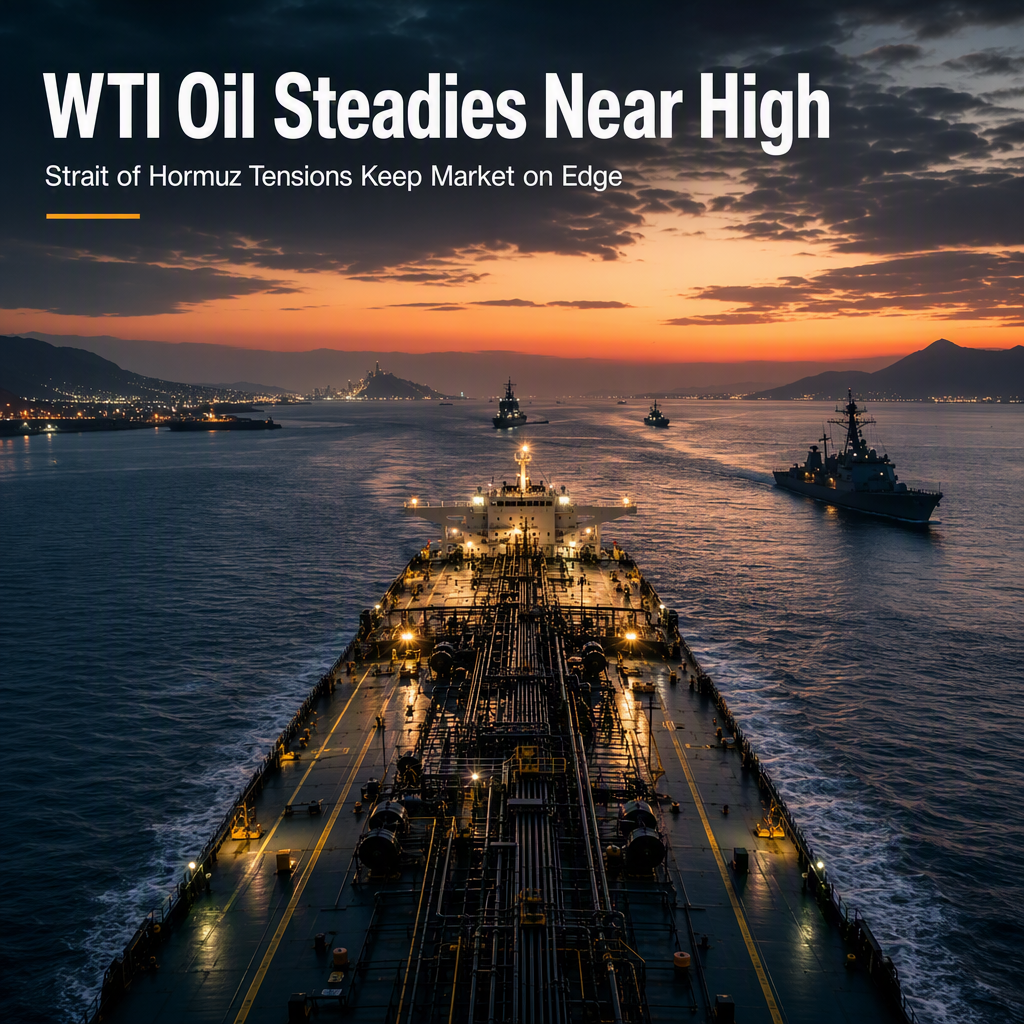
West Texas Intermediate (WTI) crude oil prices remained firm on Tuesday, trading around $84.47 per barrel, which is near the highest level in over two weeks after a nearly 3% jump the previous day [1]. The market is being influenced by ongoing geopolitical tensions surrounding the Strait of Hormuz, a critical energy chokepoint. US President Donald Trump stated via Truth Social that there are currently no talks or scheduled conversations with Iran and that the US naval blockade remains in effect. Trump also claimed that the Strait of Hormuz is open and all water mines have been removed or detonated. However, Iran’s top negotiator, Mohammad Bagher Qalibaf, contradicted this by asserting that the waterway would remain closed until the United States meets the conditions of the interim agreement, according to Iranian state media [1].
In addition to the US-Iran standoff, Iran and Oman are reportedly engaged in talks regarding joint management of the Strait, while Qatar’s Foreign Ministry indicated that mediators are awaiting a bilateral agreement between Iran and Oman before broader US-Iran negotiations can resume [1].
From a technical perspective, WTI is exhibiting a neutral near-term tone, with the price positioned between key moving averages. The Relative Strength Index (RSI) is near 56, suggesting moderately constructive momentum, and the MACD is positive, indicating a mild bullish bias. However, the Average Directional Index (ADX) is around 17, signaling weak trend strength. Key support levels are identified at the 50-day SMA around $78 and the 200-day SMA near $76, while resistance is at the 100-day SMA at $86. A daily close above this resistance could trigger a stronger recovery, whereas failure to break above it may keep WTI in a consolidative range [1].
No explicit analyst opinions or forward-looking statements beyond technical analysis are provided in the article.
CONCLUSION
WTI oil prices are being supported by geopolitical uncertainty and conflicting statements regarding the status of the Strait of Hormuz. Technical indicators suggest a mildly bullish bias, but trend strength remains weak. The market is likely to remain sensitive to further developments in US-Iran relations and negotiations involving regional stakeholders.