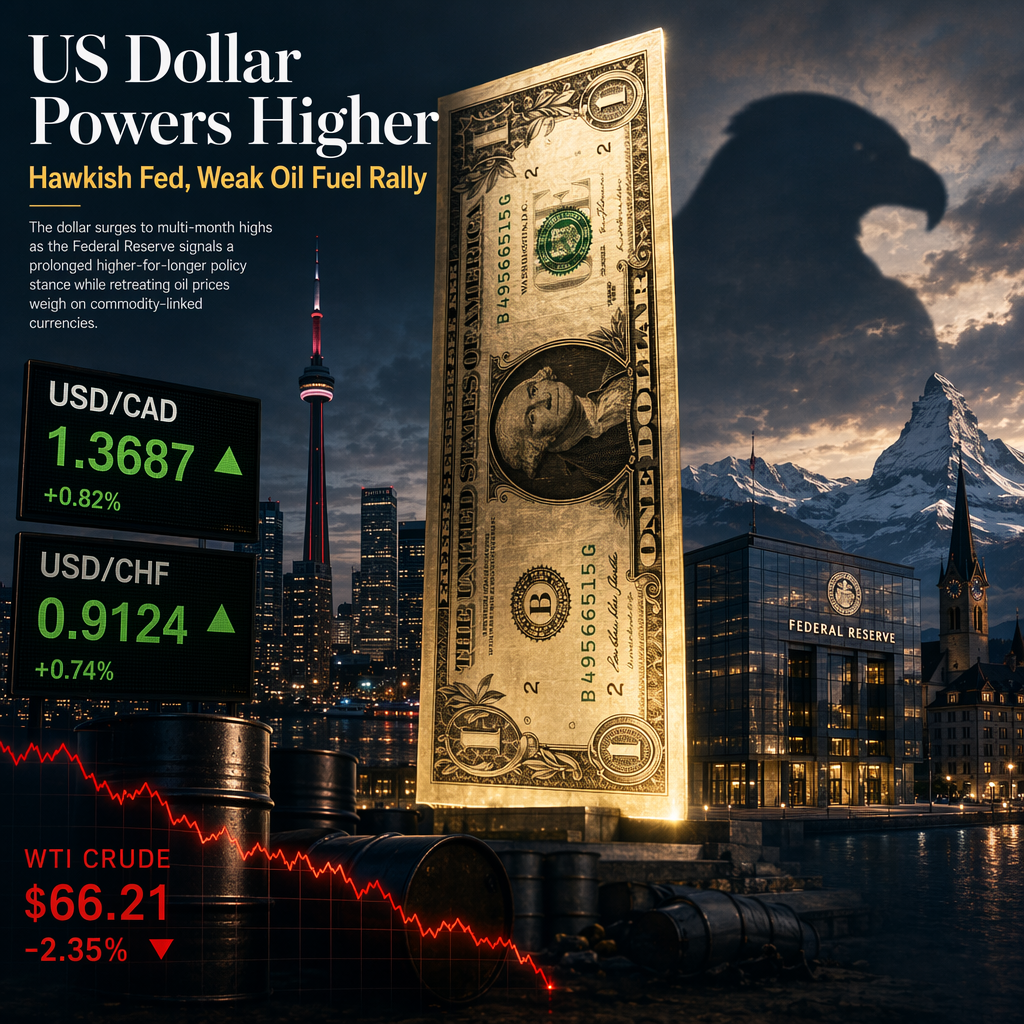
The US Dollar (USD) has surged to its highest levels since May 2025 against both the Canadian Dollar (CAD) and the Swiss Franc (CHF), driven by a hawkish Federal Reserve (Fed) outlook and diverging central bank policies [1][2]. USD/CAD traded around 1.4235, marking fresh highs since April 2025, while USD/CHF reached 0.8126, its weakest level in more than ten months for the Swiss Franc [1][2]. The US Dollar Index (DXY), which measures the Greenback against a basket of six major currencies, was reported at 101.64 by Source 1 and 101.36 by Source 2, both levels last seen in May 2025 [1][2].
The Fed's hawkish stance was underscored by Chair Kevin Warsh's commitment to restoring price stability and bringing inflation back to its 2% target, with a majority of policymakers signaling that a rate hike later this year may be needed to contain inflationary pressure [1][2]. US Consumer Price Index (CPI) accelerated to 4.2% in May, more than double the Fed's 2% target, and economists expect the core Personal Consumption Expenditures (PCE) Price Index to rise to 3.4% YoY in May from 3.3% in April [2]. Markets are currently pricing in roughly a 70% probability of a Fed rate hike in September, according to the CME FedWatch tool [2].
For USD/CAD, the Canadian Dollar faced additional pressure from declining Oil prices, with West Texas Intermediate (WTI) trading around $70.35, its lowest level since early March [1]. The retracement in Oil prices followed the gradual reopening of the Strait of Hormuz after last week's 60-day memorandum of understanding, erasing most of the US-Iran war-driven gains [1]. Technical analysis shows USD/CAD holding well above key moving averages, with the MACD histogram positive and elevated, but the Relative Strength Index (RSI) at 88 signals extreme overbought conditions, suggesting vulnerability to a corrective pullback [1]. Immediate resistance for USD/CAD is at 1.4300, with support at 1.4110 and 1.4000 [1].
Geopolitical risks remain in play, particularly regarding ongoing US-Iran talks. US President Donald Trump claimed Iran agreed to nuclear inspections, but Tehran denied any such commitments during the latest round of talks [2]. Until a final deal is reached, these risks are expected to lend additional support to the safe-haven US Dollar [2].
The divergence between the Fed's hawkish outlook and the Bank of Canada's steady policy stance suggests that USD/CAD is likely to remain supported in the near term [1].
CONCLUSION
The US Dollar's rally is underpinned by expectations of a Fed rate hike, strong inflation data, and geopolitical uncertainty, resulting in multi-month highs against both the CAD and CHF. Weak Oil prices and diverging central bank policies further pressure the Canadian Dollar. Market sentiment remains bullish for the USD, with technical and fundamental factors pointing to continued strength in the near term.