
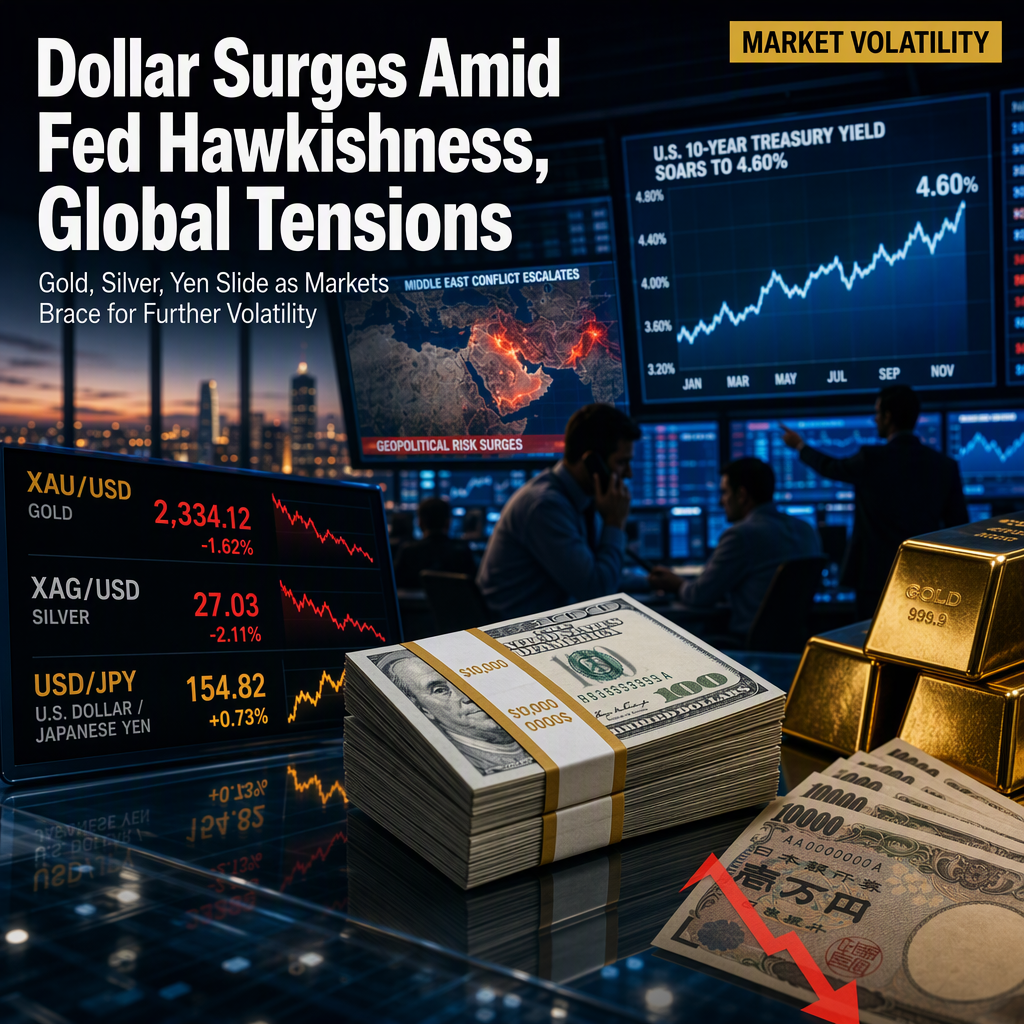
A hawkish outlook from the US Federal Reserve, combined with escalating geopolitical tensions in the Middle East, has triggered significant moves across major financial markets. Gold (XAU/USD) slumped below $4,200, marking its lowest level since early August and losing about 2.5% on the day, as investors responded to the prospect of further Fed rate hikes and risk-off sentiment fueled by Middle East conflict developments. US President Donald Trump rejected Iran's proposal to end the conflict and reopen the Strait of Hormuz, while Iranian officials signaled openness to diplomacy but readiness to confront US actions, adding to market uncertainty [1].
Silver (XAG/USD) also experienced sharp declines, falling 4.3% to near $61.50 during the European session. The drop was attributed to elevated US Treasury yields, which approached a 19-year high of 5.23% on Friday, and persistent concerns over global energy supply disruptions. Analysts at Deutsche Bank highlighted the resilience of US economic data, with weekly initial jobless claims at 197k (versus 200k expected) and the 4-week moving average at 202.25k, reinforcing expectations that the Fed has room to continue tightening. The CME FedWatch Tool indicated a 68-70% probability of a Fed rate hike in October, up from 55% the previous week [1][2]. Technical analysis for silver points to continued bearish pressure, with the metal trading below its 20-day EMA and a Relative Strength Index of 40.61, suggesting further downside risk toward $60.00 [2].
The US Dollar Index maintained moderate gains above 101.00, reflecting a risk-averse market environment [1]. In currency markets, the Japanese Yen (JPY) depreciated more than 1.5% against the US Dollar despite hawkish signals from the Bank of Japan (BoJ), which raised its benchmark rate by 25 basis points to a 31-year high of 1.25%. However, two BoJ policymakers voted to keep rates unchanged, casting doubt on the scope of further tightening. Intervention warnings from Japanese officials, including Finance Minister Satsuki Katayama, and US President Trump's expressed concerns about Yen weakness, contributed to volatility. The USD/JPY pair traded in a broad 156–159 range, with Dollar strength supported by Fed rate hike expectations but capped by intervention risk, as the pair retreated below 158.50 following official comments [3][4].
Looking ahead, markets are focused on upcoming US macroeconomic releases, including the Personal Consumption Expenditures (PCE) Price Index and September's Nonfarm Payrolls (NFP) report, which are expected to further influence Fed policy expectations and market direction [2][3].
CONCLUSION
The combination of a hawkish Fed outlook, strong US economic data, and geopolitical tensions has strengthened the US Dollar while pressuring gold, silver, and the Japanese Yen. Market participants are closely watching for further US data and central bank commentary, with intervention risks and upcoming economic releases likely to drive continued volatility across asset classes.