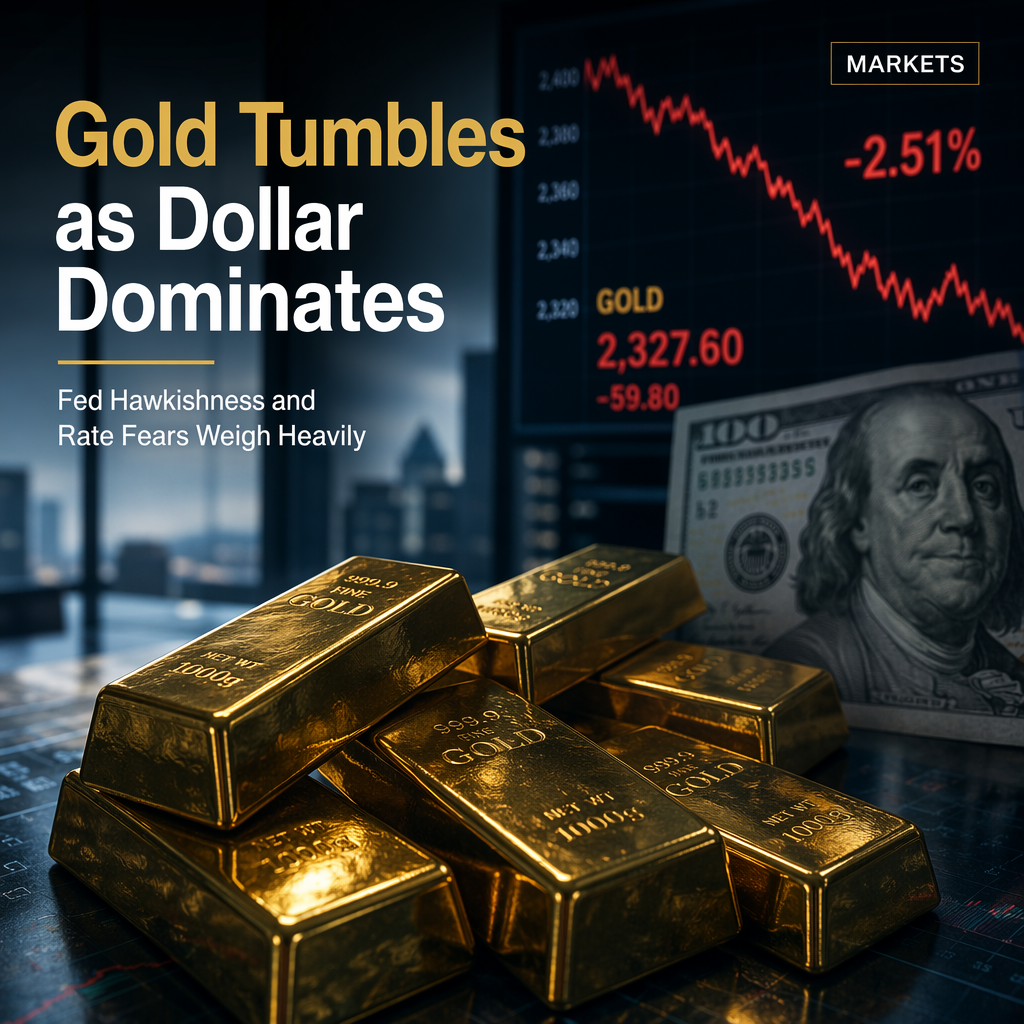
Gold prices have extended their losses into a fourth consecutive week, reaching their lowest level since mid-June, as a stronger US Dollar and expectations of a hawkish Federal Reserve continue to erode the metal's appeal as a safe-haven asset [1]. ING strategists and RoboForex analysts both emphasize that the prospect of higher-for-longer US interest rates has become the dominant headwind for gold, overtaking previous support from geopolitical tensions in the Middle East [1]. The resumption of energy flows through the Strait of Hormuz has eased supply fears, further undermining one of gold's key pillars of support, according to ING [1].
Goldman Sachs has responded to these developments by slashing its year-end price target for gold from $5,400 to $4,900 per ounce, signaling a shift in institutional sentiment and adding further selling pressure to the market [1]. RoboForex analysts note that this downgrade from a historically bullish institution reflects the reality of persistently elevated US rates and a resilient US Dollar [1].
The consensus among ING and RoboForex, citing Goldman Sachs, is that the short-term outlook for gold remains broadly bearish. The market is already pricing in a significant probability of further tightening by the Federal Reserve, and institutional forecasts are being revised lower [1]. Despite ongoing geopolitical risks, these factors are seen as providing only a limited floor for gold prices, leaving the metal vulnerable to additional downside unless there is a meaningful shift in Fed policy [1].
CONCLUSION
Gold's recent decline is driven primarily by expectations of sustained high US interest rates and a strong Dollar, with institutional sentiment turning more cautious as reflected in Goldman Sachs' lowered price target. Unless the Federal Reserve signals a change in its policy stance, gold is likely to remain under pressure in the near term.