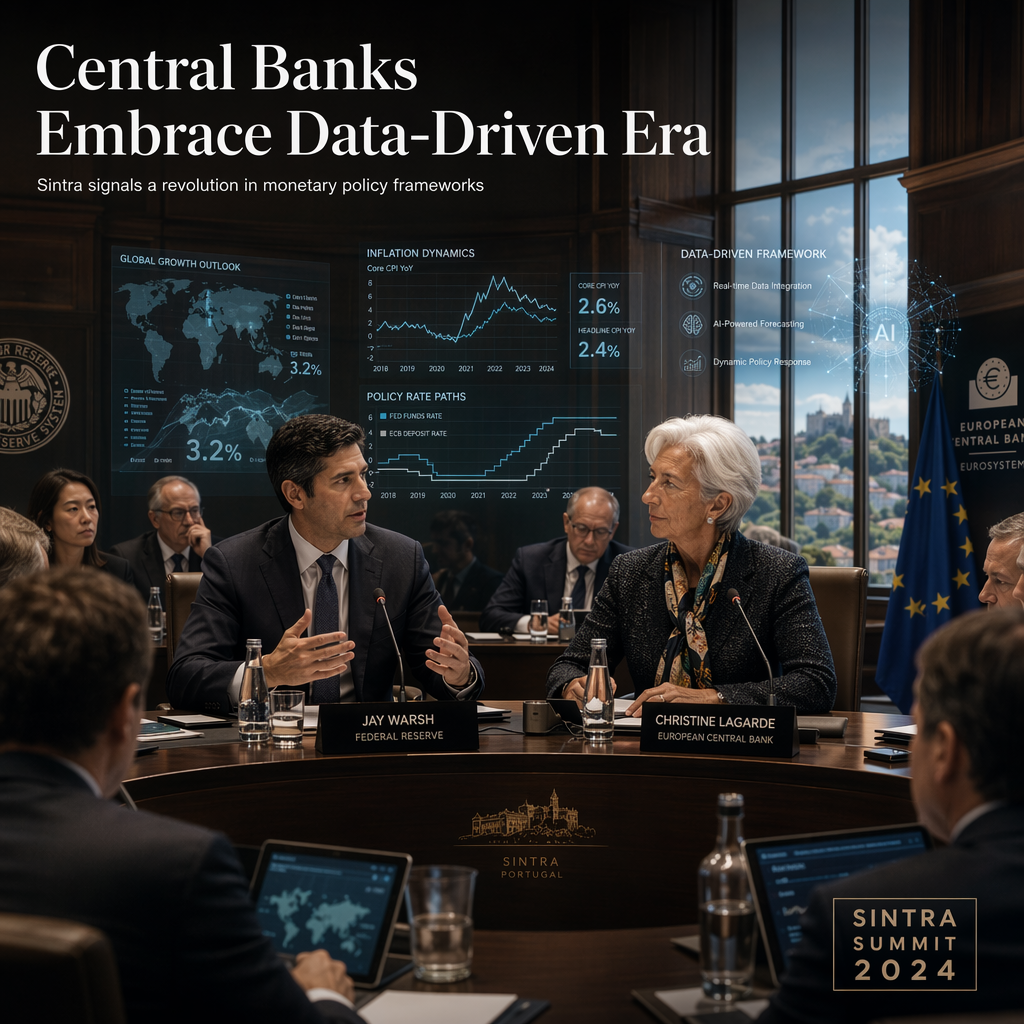
Rabobank strategist Michael Every reports that Fed Chair Warsh and other major central bankers at the Sintra conference are indicating a significant structural shift in monetary policy communication, moving away from traditional forward guidance towards a more data-driven 'framework guidance' approach [1]. Warsh emphasized the need for central banking to adapt structurally, advocating for the use of 'contemporaneous real-time' big data and AI monitoring to better capture economic conditions, rather than relying on outdated analogue surveys [1].
Every notes that this shift could also involve the adoption of new inflation measures, though it remains unclear whether these will result in higher or lower readings compared to current metrics, as the outcome depends on the methodology changes historically applied [1]. The European Central Bank's President Lagarde echoed this sentiment by suggesting a return to basics, moving away from heavy reliance on unconventional tools and complex forward guidance in favor of simpler policy frameworks [1].
The article underscores that these changes could fundamentally alter how central banking is conducted and how analysts interpret policy signals, with the potential for a 'revolution' in central bank communication and analysis [1]. Every cautions that these developments are being driven by the central banking establishment and will require market participants and analysts to adapt their approaches accordingly [1].
CONCLUSION
Central banks, led by figures such as Fed Chair Warsh and ECB President Lagarde, are signaling a move towards data-driven policy frameworks and away from traditional forward guidance. This structural shift is expected to reshape both central banking operations and market analysis, requiring adaptation from analysts and market participants.