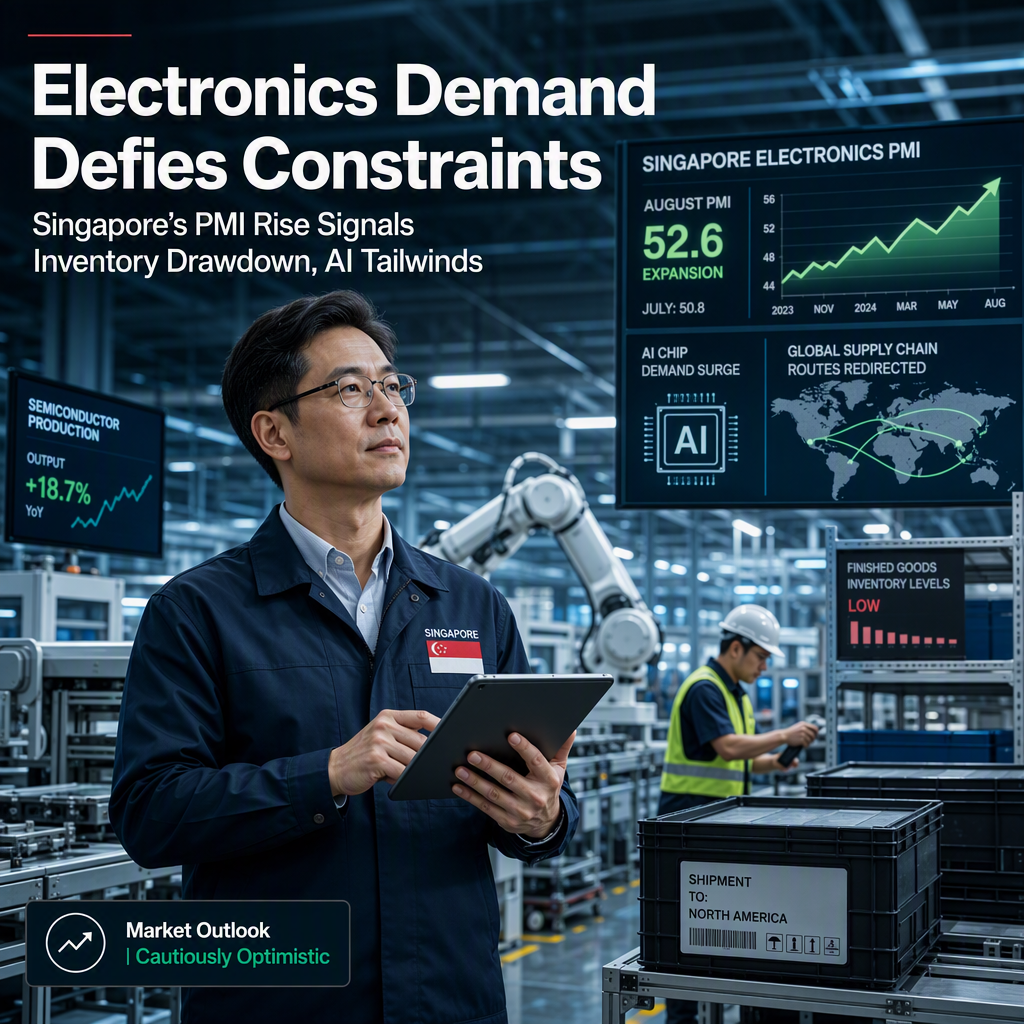
Singapore's electronics Purchasing Managers' Index (PMI) increased by 0.2 points to 52.6 in August, according to UOB economist Jester Koh, with broad-based gains observed in new export orders (August: 52.8, July: 52.6), output (August: 52.5, July: 52.2), stock of input purchases (August: 52.6, July: 52.4), and order backlogs (August: 52.8, July: 52.5) [1]. Koh attributes the recent softness in electronics Non-Oil Domestic Exports (NODX) and Industrial Production (IP) to capacity constraints rather than weaker end demand, as evidenced by the continued decline in the stocks of finished goods sub-index (August: 49.0, July: 49.3), indicating firms are drawing down inventories to meet rising demand [1].
The report highlights strengthening AI-related tailwinds amid a global agentic AI capital expenditure buildout, which is expected to support future electronics production. Koh suggests that inventory drawdowns and the eventual need for replenishment should bolster electronics IP in the coming months [1].
The re-escalation of conflict in the Middle East since July has led to further deterioration in the supplier deliveries subindex (overall: 47.5 from 47.8; electronics: 47.3 from 47.6), with longer lead times as some cargo shipments were diverted from the Suez Canal/Bab el-Mandeb Strait route to the Cape of Good Hope [1]. Additionally, input price sub-indices for both overall (August: 51.8, July: 51.6) and electronics PMI (August: 53.0, July: 52.7) increased, reflecting a surge in energy prices in August. The increase was more pronounced in electronics, likely due to tech-flation pressures associated with the global chip shortage [1].
CONCLUSION
Singapore's electronics sector shows signs of resilient demand, with PMI gains and inventory drawdowns pointing to capacity-driven, not demand-driven, weakness. AI-related tailwinds and the need for inventory replenishment are expected to support production, though supply chain disruptions and rising input costs remain risks. Overall, the outlook for electronics production in Singapore is cautiously optimistic, with medium market impact.