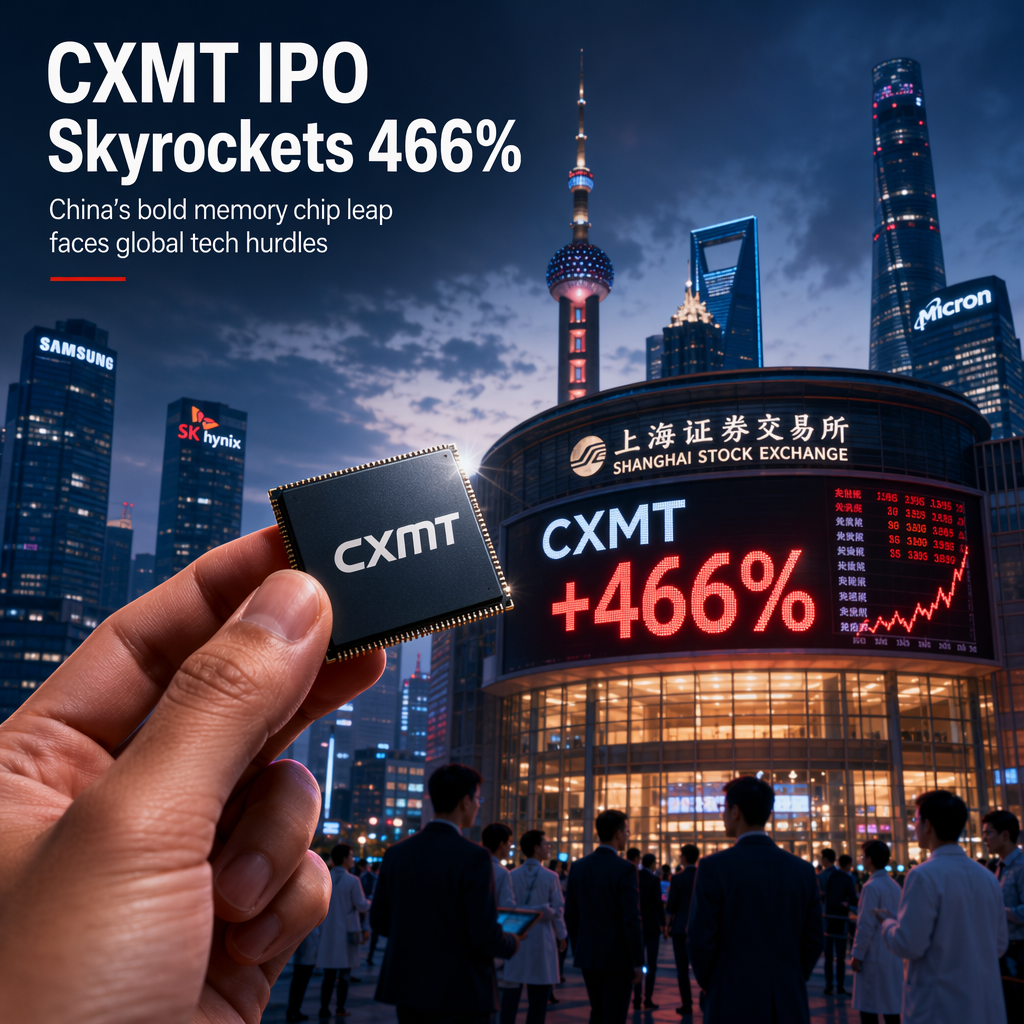
ChangXin Memory Technologies (CXMT), China's leading memory chipmaker, made a blockbuster debut on the Shanghai stock exchange, surging nearly 466% in its Monday market debut and raising up to $9.8 billion in its initial public offering [1]. This dramatic rise has fueled optimism about Beijing's efforts to build a self-sufficient semiconductor industry, particularly as the country seeks to bolster its position in the artificial intelligence race [1].
Despite the strong investor enthusiasm, analysts caution that CXMT faces significant challenges in closing the technology gap with global memory giants such as Samsung Electronics, SK Hynix, and Micron, especially in high-bandwidth memory (HBM)—a crucial technology powering the AI boom [1]. CXMT does not have access to the latest extreme ultraviolet (EUV) lithography machines due to U.S.-led export restrictions, which means it requires about 30% more wafers than its competitors to produce the same amount of memory chips, a disadvantage that is difficult to overcome [1].
According to MS Hwang, research director at Counterpoint Research, CXMT is targeting to produce HBM from the end of 2026, with its new Shanghai fab geared toward AI chips, including HBM. However, its initial products are likely to be HBM3E or HBM3, leaving it one to two generations behind competitors who are already moving toward HBM4 and HBM4E [1]. Samsung Electronics, for example, announced during its second-quarter earnings call that it had scaled up HBM4 sales and shipped the industry's first HBM4E samples to major customers [1].
David Gibson, senior analyst at MST Financial, noted that while domestic demand should continue to support CXMT's memory chips, the company will struggle with low yields and volumes compared to competitors who prioritize high capacity and high speed [1]. Ellie Wang, an analyst, confirmed that CXMT has been dedicating its research and development efforts to HBM technology for some time [1].
CONCLUSION
CXMT's explosive Shanghai IPO signals strong investor confidence and marks a milestone in China's semiconductor ambitions. However, persistent technology gaps and manufacturing challenges mean CXMT remains behind global leaders in advanced memory chips. The company's future success will depend on its ability to overcome these hurdles and catch up with industry standards.