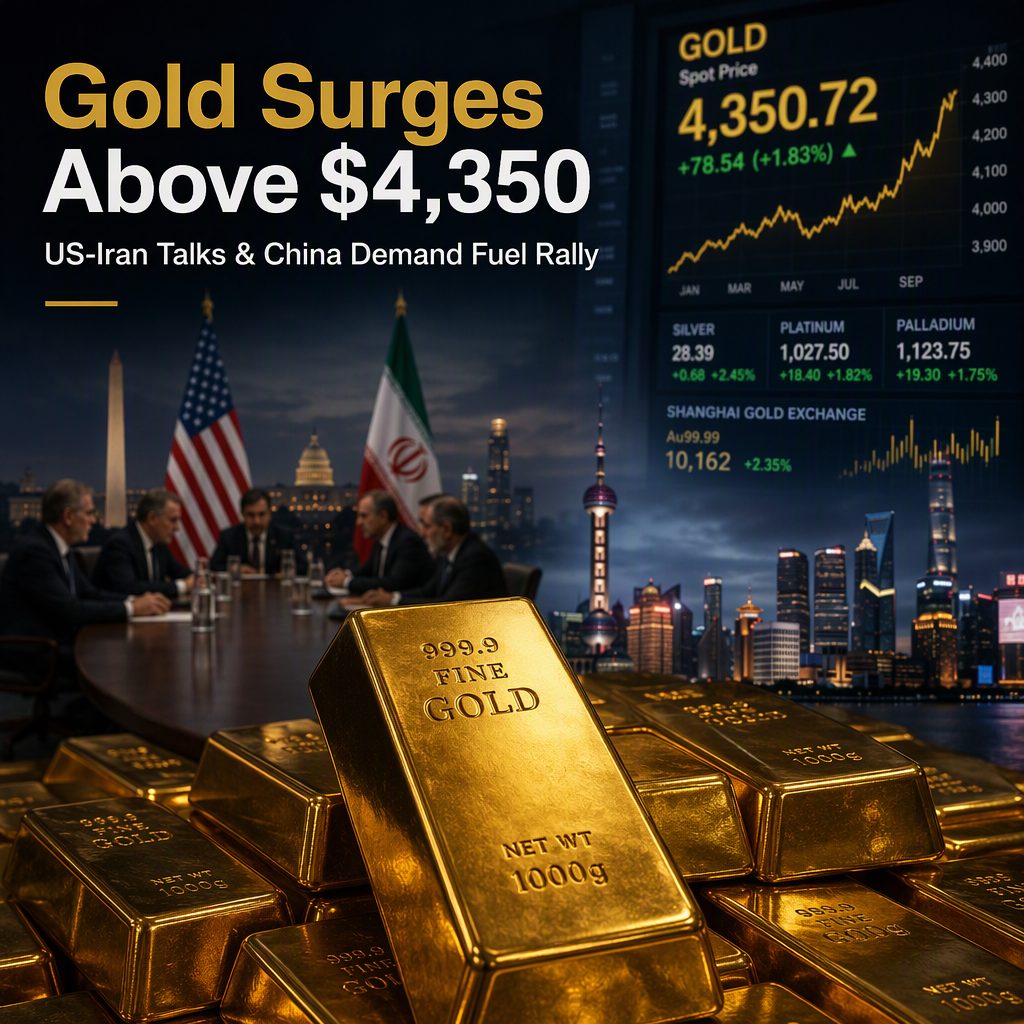
Gold prices (XAU/USD) rebounded to near $4,360 during the early Asian session on Wednesday, supported by optimism surrounding diplomatic progress between the US and Iran. CNBC reported that US President Donald Trump described a 'very good meeting' with Iran's delegation, lasting about three hours, and Iran reportedly offered to reopen the Strait of Hormuz within seven days, though these reports have not been independently verified by CNBC. Additionally, Saudi Arabia is reportedly planning to restart its East-West pipeline as early as this week, which could further influence commodity markets [1].
Despite these positive developments, gold faces headwinds from the US Federal Reserve's hawkish stance. The Fed raised its policy rate by a quarter of a percentage point last week and signaled more hikes in the coming months. St. Louis Fed President Alberto Musalem stated that further rate hikes may be necessary to combat inflation driven by strong demand and a commodity price shock, emphasizing the need for prompt action. Higher interest rates typically weigh on gold, as it does not pay interest and becomes less attractive compared to yield-bearing assets [1].
China continues to play a pivotal role in the gold market. Analysts at Commerzbank highlighted that China imported more than 1,000 tons of gold in the first eight months of the year, already surpassing last year's total. The Chinese central bank purchased approximately 80 tons of gold between January and August, with purchases reaching their highest level in nearly three years in August. Commerzbank concluded that China is a key driver of gold demand this year [1].
Technical analysis shows that XAU/USD is well-supported above the 100-day simple moving average (SMA) at $4,315, maintaining a constructive near-term tone. The 14-day Relative Strength Index (RSI) around 50 indicates neutral momentum, suggesting that price direction in the coming sessions will depend on reactions to nearby resistance and support levels. Immediate resistance is at the Bollinger middle band around $4,390, while deeper support is reinforced by the lower Bollinger band near $4,215 [1].
CONCLUSION
Gold's rebound above $4,350 is driven by hopes for US-Iran diplomatic progress and strong Chinese demand, but faces pressure from the US Federal Reserve's hawkish policy outlook. Technical indicators suggest neutral momentum, with key support and resistance levels in focus. The market remains attentive to geopolitical developments and central bank actions for further direction.