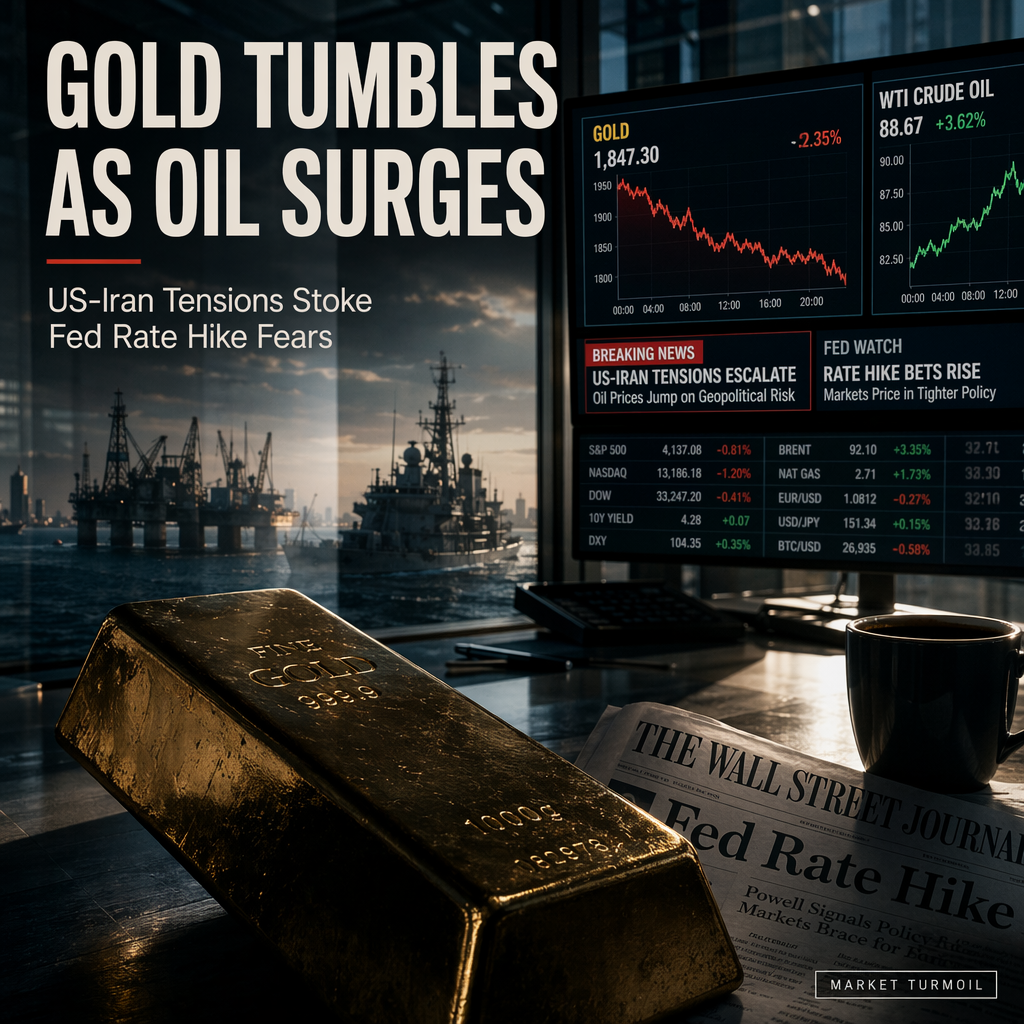
Gold (XAU/USD) declined sharply at the start of the week, trading around $4,061 and down 1.44% on the day after reaching an intraday low of $4,045, as renewed hostilities between the US and Iran heightened geopolitical risks and pushed Oil prices higher, fueling inflation concerns and reinforcing expectations of a Federal Reserve interest rate hike later this year [1]. Over the weekend, the US and Iran exchanged missile and drone attacks, with Washington striking southern Iran and Tehran targeting US military facilities across the Gulf. Tehran claimed to have closed the Strait of Hormuz, but the US asserted the waterway remains open and is escorting vessels [1].
The US Dollar Index (DXY) and crude Oil prices both opened the week higher, with WTI crude trading around $73.75, up nearly 3.25% on the day but below its intraday high of $74.96. The DXY slipped back below 101.00 after touching an intraday high of 101.22. These moves pressured Gold, which is struggling to recover amid the prospect of higher interest rates. According to analysts at Brown Brothers Harriman (BBH), 'Stabilizing US labor market conditions and sticky inflation will keep Fed funds rate pricing hawkish.' BBH noted that markets have fully priced in a 25-basis-point rate hike by year-end and nearly 50 bps of tightening over the next twelve months, which typically weighs on Gold by increasing the opportunity cost of holding non-yielding assets [1].
Technical analysis shows XAU/USD maintains a bearish bias, trading below the 20-day Bollinger Band middle line near $4,118.50. The Relative Strength Index (RSI) is around 40, below the neutral 50 threshold, reinforcing the bearish outlook. The Average Directional Index (ADX) near 37 indicates a well-defined broader downtrend, suggesting recovery attempts could remain limited unless Gold reclaims the Bollinger mid-band. Key resistance levels are at $4,118.50, $4,200, $4,288.50, and $4,400, while immediate support is at $4,000 and $3,948.50, with a break lower opening the door to a deeper corrective phase [1].
With the economic calendar largely empty on Monday, traders are now focused on the upcoming US Consumer Price Index (CPI) data due on Tuesday and Fed Chair Kevin Warsh’s congressional testimony for further clues on the central bank’s interest rate outlook [1].
CONCLUSION
Gold prices fell sharply as renewed US-Iran tensions boosted Oil and reinforced expectations for higher US interest rates, pressuring the precious metal. Technical indicators point to a bearish outlook, with traders awaiting key US inflation data and Fed commentary for further direction. The market remains focused on geopolitical developments and the Federal Reserve's policy path.