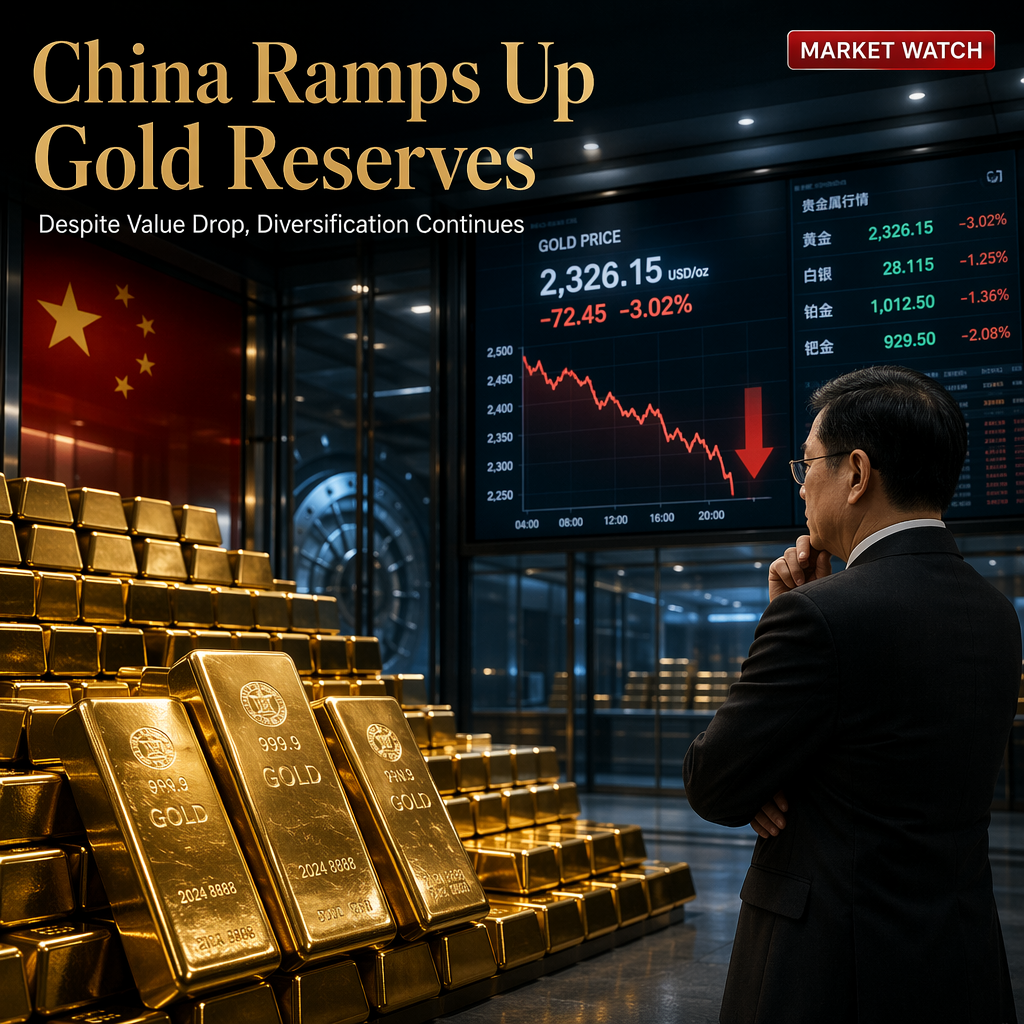
China has increased its gold reserves once again, according to data from the People's Bank of China (PBoC) [1]. At the end of June 2026, China's gold reserves stood at 75.44 million troy ounces, marking an increase of 0.48 million troy ounces from the previous month [1]. In value terms, however, the country's gold reserves were valued at $303.72 billion at the end of June, which is a decrease from $340.75 billion in May [1].
The article highlights that central banks, including those from emerging economies such as China, India, and Turkey, have been rapidly increasing their gold reserves to diversify their holdings and support their currencies during turbulent times [1]. In 2022, central banks globally added 1,136 tonnes of gold worth around $70 billion to their reserves, the highest yearly purchase since records began, according to the World Gold Council [1].
Gold is widely regarded as a safe-haven asset and a hedge against inflation and depreciating currencies, which may explain China's continued accumulation of gold reserves [1]. The price of gold is influenced by various factors, including geopolitical instability, recession fears, and the strength of the US Dollar, with gold typically moving inversely to the dollar and US Treasuries [1].
While the increase in physical gold holdings signals ongoing diversification by the PBoC, the decline in the value of reserves suggests that gold prices may have fallen or the US Dollar strengthened during the period [1]. No specific market reactions or analyst forecasts are provided in the article.
CONCLUSION
China's continued accumulation of gold reserves underscores its strategy to diversify assets and bolster economic stability. Despite the increase in physical holdings, the decline in the value of reserves highlights the impact of market fluctuations on gold's valuation. The move reflects broader trends among central banks to increase gold holdings as a safeguard during uncertain times.