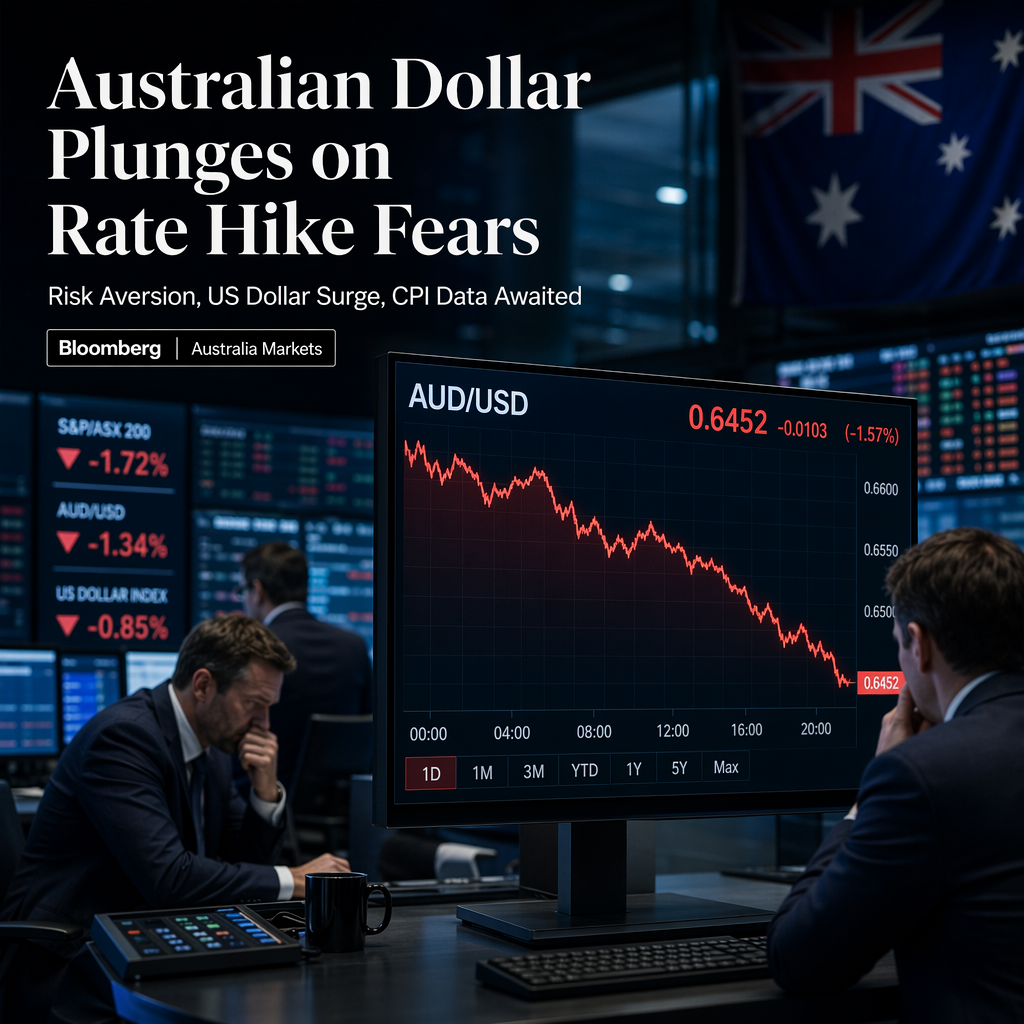
The Australian Dollar (AUD) experienced a sharp decline of over 1.20% on Tuesday, falling from daily highs of 0.7005 to 0.6915 against the US Dollar (USD), marking its lowest level in two months and surrendering the key 0.7000 psychological mark [1][2]. This drop was driven by global risk aversion, with investors rotating out of high-tech and AI-related equities, causing the Korean KOSPI tech index to fall over 10% and the Nasdaq to drop more than 3% [1]. The US Dollar Index (DXY) rose 0.39% to 101.38, reflecting broad USD strength amid expectations of higher US interest rates [1].
The Reserve Bank of Australia (RBA) recently held its Official Cash Rate (OCR) steady at 4.35% after three consecutive rate hikes since the start of the year [1][2]. The RBA remains focused on preventing inflation from becoming entrenched, particularly as the impact of higher oil prices wanes. The board stated it will closely monitor data and evolving risks to guide future decisions [2]. Investors are anticipating the Federal Reserve to tighten by 34 basis points in 2026, while the RBA is noted as the only central bank to reverse its easing cycle, hiking rates by 75 bps in 2026 [1].
The Australian Bureau of Statistics (ABS) is set to release the May Consumer Price Index (CPI) data, with expectations for annual CPI to rise to 4.4% from 4.2%, nearing the three-year high of 4.6% seen in March [1][2]. The monthly CPI is forecast to decline by 0.3%, following a previous 0.4% increase [1][2]. The Trimmed Mean CPI inflation is expected to edge up to 3.5% year-over-year from 3.4%, with the month-over-month figure holding steady at 0.3% [1][2]. Lower fuel prices, down roughly 12% due to easing global oil prices and a domestic fuel excise cut, are expected to drive the monthly headline lower, while new dwelling costs and rents may exert upward pressure on housing inflation [2].
Market participants are awaiting the CPI release, as a surprise uptick in the Trimmed Mean CPI could support the AUD, while easing inflationary pressures would diminish expectations for further RBA rate hikes and weigh on the currency [2]. Technical analysis shows AUD/USD trading at 0.6914, with a bearish near-term bias and oversold conditions indicated by a Relative Strength Index (RSI) of about 28, suggesting downside pressure may slow but not reverse yet [1]. Initial resistance is seen at the triple SMA area near 0.7135, with further barriers at 0.7189 and 0.7264 [1].
Geopolitical developments, including progress in US-Iran conflict talks and a peace deal that sent oil prices sharply lower, could help alleviate inflationary pressures in Australia in the coming months [1][2]. The RBA will closely watch underlying inflation trends for policy signals, especially as the Trimmed Mean measures are scrutinized for signs of broader inflation pass-through [2].
CONCLUSION
The Australian Dollar has come under significant pressure due to global risk aversion and expectations of higher US interest rates, with the upcoming CPI release poised to influence RBA policy outlook. Market participants are closely watching for signs of persistent underlying inflation, which could keep the RBA on alert for further rate hikes. Easing inflationary pressures, however, may reduce the likelihood of additional tightening and further weigh on the AUD.