
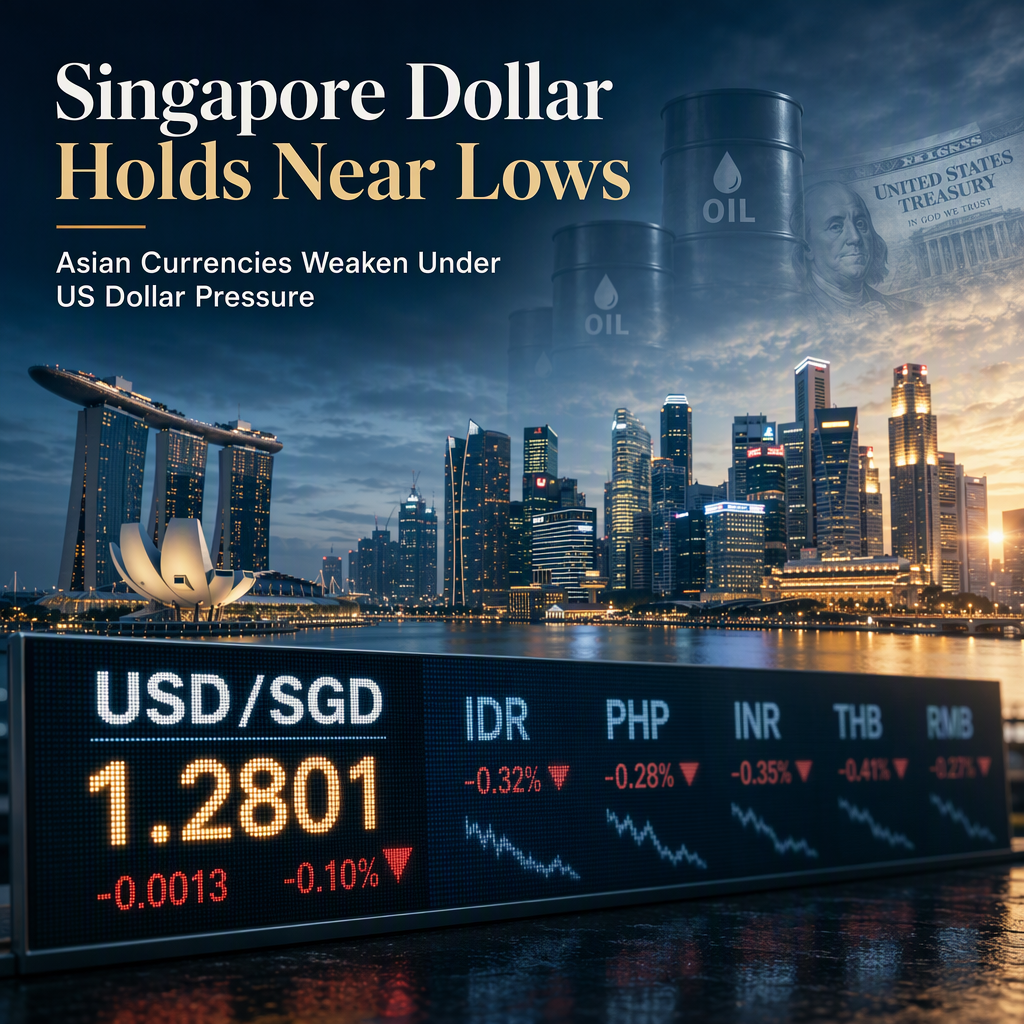
The Singapore Dollar (SGD) remained consolidated near its recent lows against the US Dollar (USD), with the USD/SGD pair holding steady around 1.2800 following a surge on Wednesday, according to UOB analysts Quek Ser Leang and Lee Sue Ann [1]. Their SGD Nominal Effective Exchange Rate (NEER) model indicates the SGD is 1.76% above its mid-point, suggesting a trading range for USD/SGD between 1.2764 and 1.2828 for the day, with resistance at 1.2835 and strong support at 1.2770 [1]. The analysts note that renewed upward momentum in the USD could see the pair test the significant resistance level at 1.2835, while a break below 1.2770 would indicate the advance has stalled [1].
Broader Asian foreign exchange markets also faced pressure, as reported by OCBC strategists Sim Moh Siong and Christopher Wong, who attribute the softness to higher oil prices and rising US Treasury yields, which have dampened risk sentiment [2]. The Indonesian Rupiah (IDR) underperformed, while the Philippine Peso (PHP), Indian Rupee (INR), and Thai Baht (THB) also weakened [2]. The Renminbi (RMB) lost momentum after the People's Bank of China's (PBoC) recent strengthening trend in its daily fix stalled [2]. In contrast, the USD/SGD pair held steady but remained close to recent highs [2].
Market liquidity is expected to be thin due to holiday closures in China, South Korea, and Taiwan for the Mid-Autumn/Chuseok holidays, with further reductions anticipated next week as China enters its golden-week holidays [2]. OCBC strategists caution that elevated oil prices and US Treasury yields may continue to weigh on Asian currencies in the near term, and thinner liquidity could lead to increased volatility heading into the weekend [2].
Overall, both sources highlight the resilience of the USD/SGD pair near its highs, supported by expectations of further Monetary Authority of Singapore (MAS) tightening and broader USD strength, while regional currencies remain under pressure from external macroeconomic factors [1][2].
CONCLUSION
The Singapore Dollar is consolidating near its lows against the US Dollar, supported by expectations of MAS tightening but pressured by broader USD strength and adverse macroeconomic conditions. Regional Asian currencies are broadly weaker due to higher oil prices, rising US Treasury yields, and thin market liquidity. Near-term volatility may increase as holidays reduce trading activity and external pressures persist.