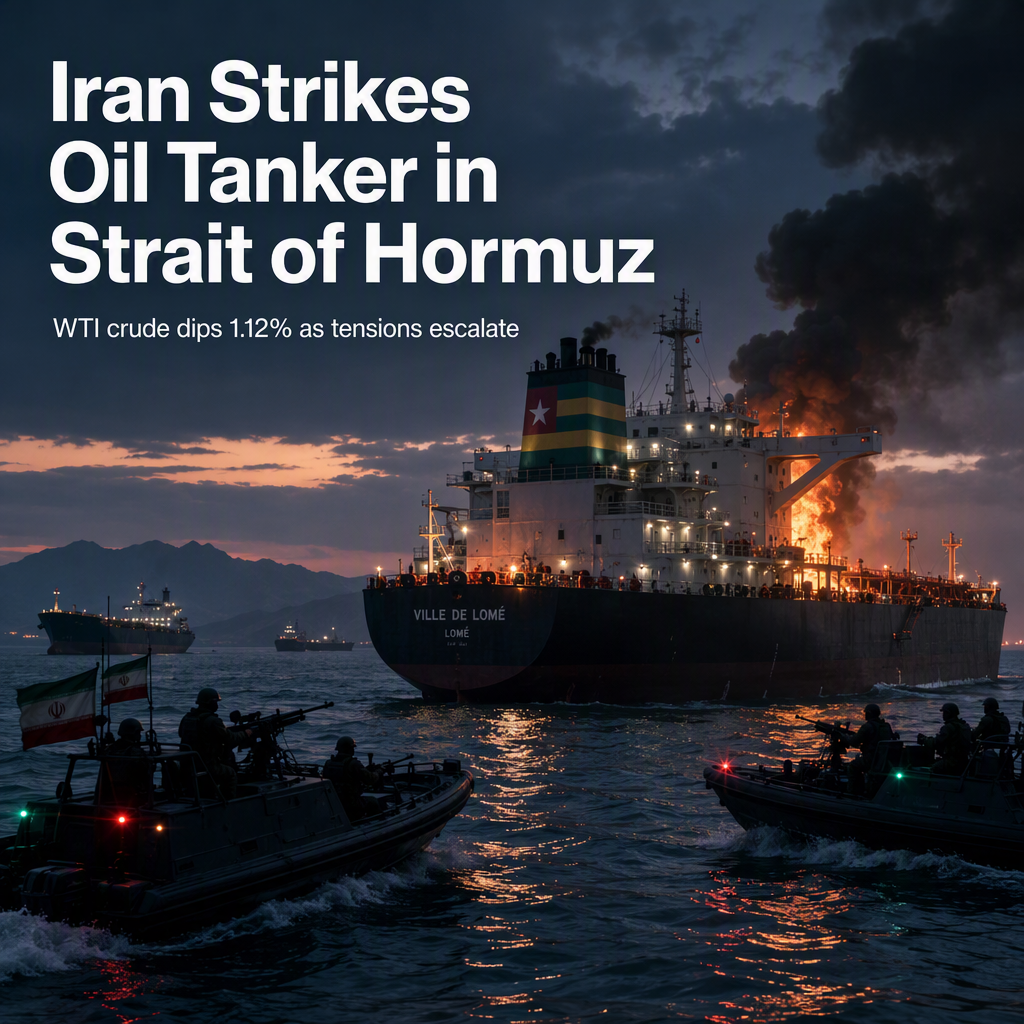
Iran's Islamic Revolutionary Guard Corps (IRGC) claimed responsibility for attacking a Togo-flagged oil tanker in the Strait of Hormuz, alleging the vessel was attempting an 'illegal passage' through the critical waterway. The IRGC reported that the tanker caught fire and came to a halt following the strike. The Iranian military emphasized its continued control over the Strait of Hormuz and stated it would not permit passage by any aggressor [1].
The United Kingdom Maritime Trade Operations (UKMTO) confirmed receipt of a report regarding a security incident in the Strait of Hormuz, specifically 16 nautical miles northeast of Khasab, Oman [1]. In response to the escalating tensions, US President Donald Trump announced he was nearing a major decision on whether to resume large-scale attacks on Iran, as Washington considers strategies to end the months-long conflict [1].
Market reaction to the incident was notable, with West Texas Intermediate (WTI) crude oil prices declining by 1.12% to $96.40 at the time of reporting [1]. The drop in oil prices reflects concerns over supply disruptions and geopolitical instability in a region crucial to global energy flows [1].
CONCLUSION
The IRGC's attack on a Togolese oil tanker in the Strait of Hormuz has heightened geopolitical tensions and led to a 1.12% decline in WTI oil prices. Market participants are closely monitoring developments, especially as US President Trump considers further actions against Iran. The incident underscores the vulnerability of global oil supply routes to regional conflicts.