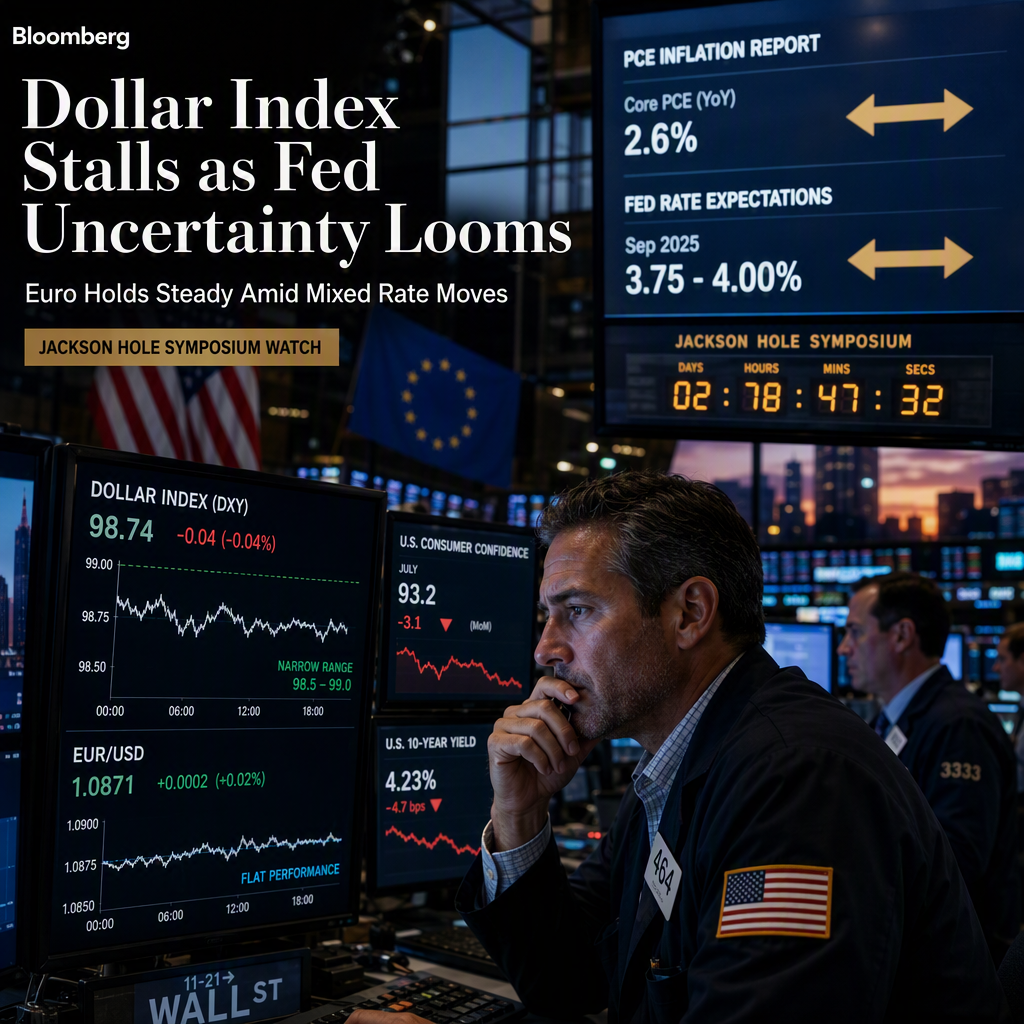
The US Dollar Index (DXY) has seen its recent recovery stall slightly above 99, reverting to a narrow 98.5–99.0 range after a previous sell-off linked to higher US long bond yields [1]. The 30-year US Treasury yield fell by 5.9 basis points to 5.165%, extending a 4.6 basis point decline from the previous day [1]. Market expectations for a Federal Reserve rate hike in September have receded significantly, dropping to 38% from 72% at the end of July [1].
US economic data has been softer, with the Conference Board Consumer Confidence Index falling to 89.4 in August, below both consensus expectations and previous readings (consensus: 90.2 or 91.2, prior: 90.2 or 90.8, with sources differing slightly) [1][2]. The decline in consumer confidence is attributed to increased caution among US consumers following a surprise drop in July retail sales and less optimism about future employment prospects, consistent with July’s negative nonfarm payrolls [1][2]. While some respondents viewed jobs as plentiful, overall labor market sentiment remains weak, and plans for major purchases such as cars and homes have declined, though vacation intentions increased [2].
Investors are now focused on the upcoming July PCE inflation report, the Federal Reserve's preferred inflation measure. Consensus expectations are for headline PCE to ease to 3.6% year-over-year from 3.7% in June, with core PCE expected to remain steady at 3.3% [1][2]. On a monthly basis, headline PCE is forecast to rise 0.1% (from -0.1%), and core PCE to increase 0.2% (from 0.1%) [1]. The US Bureau of Economic Analysis will update its PCE calculation methodology in September, which is expected to decrease core PCE by 0.2 percentage points for the August figures [2].
In the Eurozone, the EUR/USD pair remained stable around 1.1670, with only a modest pullback from overnight highs before a partial recovery [2]. Lower US yields and softer oil prices weighed on the Dollar, but declining European rates limited the Euro’s upside, resulting in no clear directional signal for the pair [2]. The German Ifo index showed a stronger-than-expected rise in August, with the current assessment index reaching 88.5 (consensus: 87.0, prior: 86.6) and expectations rising to 89.1 (consensus: 87.5, prior: 86.6), nearly returning to pre-war levels [2]. This rebound is attributed to the manufacturing sector and is expected to continue, supported by increased orders and fiscal policy [2].
Looking ahead, the market is awaiting Fed Chairman Kevin Warsh’s keynote speech at the Jackson Hole symposium on Friday, August 28, which is seen as a credibility event rather than a signal for future rate moves [1]. Warsh is expected to balance defending the Fed’s independence and price-stability mandate with providing clarity on the Fed’s reaction function, while maintaining a preference for less forward guidance [1].
CONCLUSION
The US Dollar Index remains range-bound as softer US data and receding Fed rate hike expectations weigh on sentiment, while the Euro holds steady amid offsetting rate moves. Market participants are closely watching upcoming US PCE inflation data and the Jackson Hole symposium for further direction. Overall, the current environment reflects caution and a lack of clear signals for major currency moves.