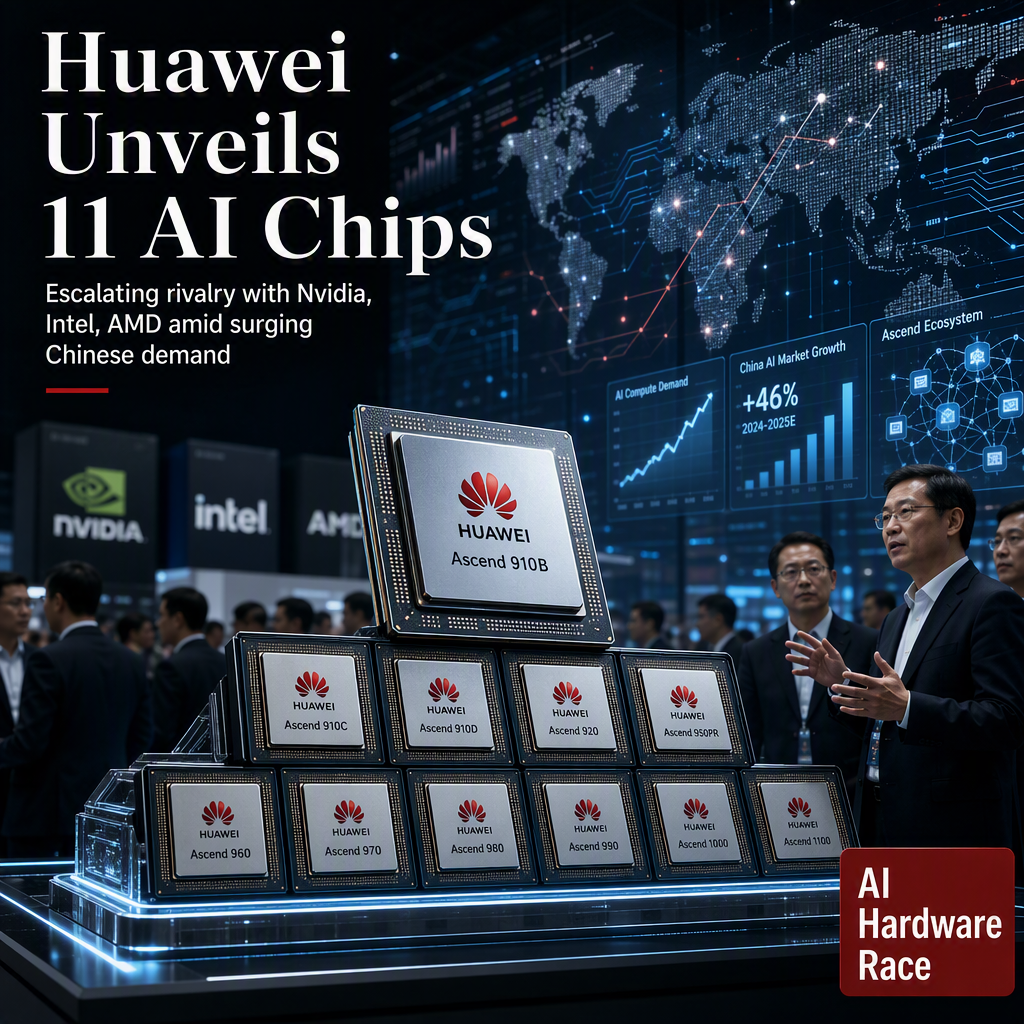
Huawei has launched more than 10 new chipsets for artificial intelligence computing infrastructure, including the next generation of its Ascend AI accelerator chips, CPUs, and high-speed connectivity solutions, in a direct challenge to Nvidia, Intel, and AMD's positions in the AI hardware market [1]. The announcement was made on Thursday, with Huawei executives emphasizing that domestic demand for Ascend chips currently exceeds supply, highlighting the strong appetite for AI solutions in China [1].
The new chips are designed to power a wide range of AI workloads, from cloud computing to edge applications, and feature advancements in processing power, energy efficiency, and high-speed interconnects—key factors for training large AI models and supporting data-intensive applications [1]. While Huawei did not disclose specific financial data or chip pricing, the company stated that its AI chip business is experiencing rapid growth [1].
Industry analysts cited in the article note that although Huawei's chip technology still lags behind Nvidia's most advanced GPUs in some respects, the company's rapid progress and robust domestic support could help it erode Nvidia's dominance in the Chinese market [1]. The ongoing U.S. export controls, which limit Chinese access to advanced foreign chips, are further motivating Chinese companies like Huawei to develop homegrown alternatives for critical AI infrastructure [1].
Huawei's aggressive push into the AI chip sector underscores the intensifying global competition in semiconductors, with the company aiming to meet the booming demand in China's AI industry and reduce reliance on U.S. technology [1].
CONCLUSION
Huawei's debut of 11 AI-related chips marks a significant escalation in the competition with global leaders Nvidia, Intel, and AMD. The strong domestic demand and rapid development signal Huawei's intent to capture a larger share of the AI hardware market, particularly in China, amid ongoing U.S. export controls.