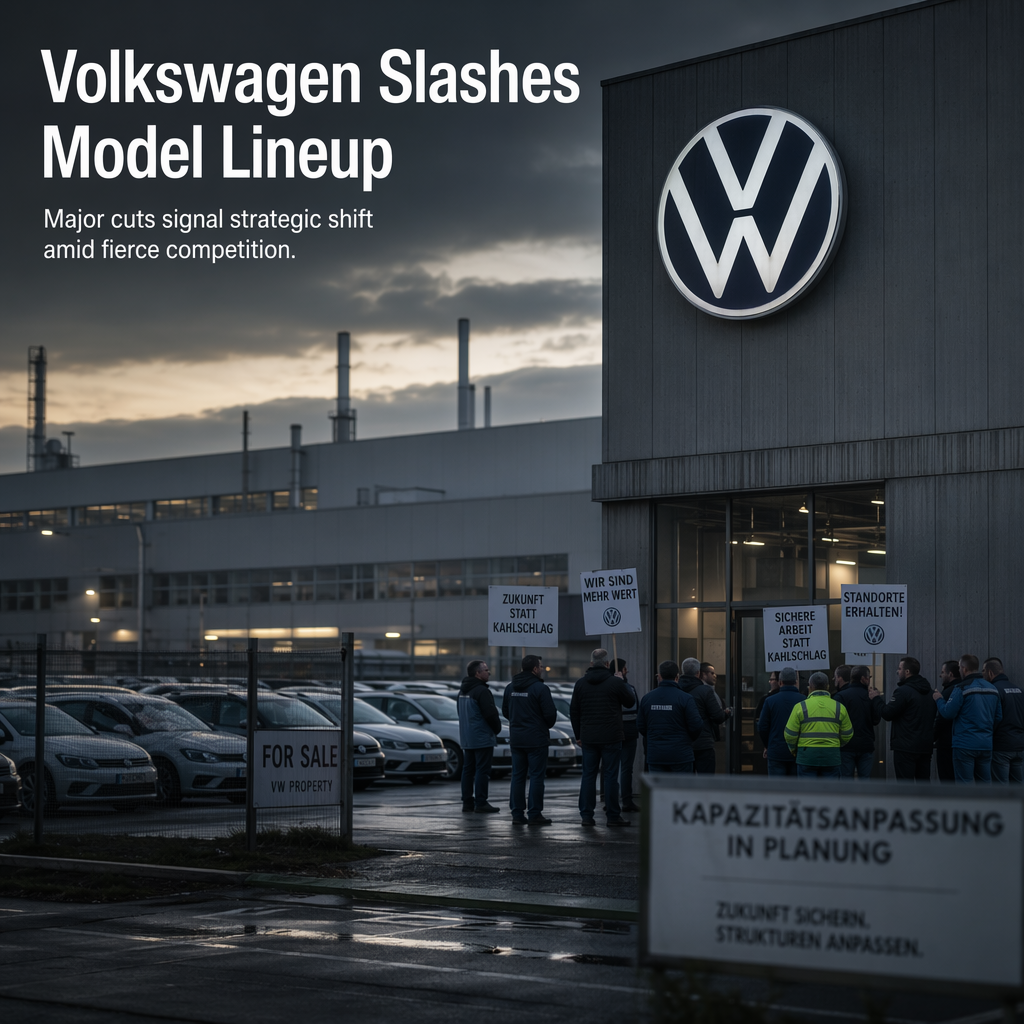
Volkswagen has announced plans to drastically reduce its model lineup and cut production capacity, as the company seeks to focus on the most attractive market segments and respond to mounting industry pressures. The automaker stated that its model lineup will be gradually reduced by up to half over the coming years, and production capacity will be scaled back to nine million vehicles per year, down from a pre-pandemic goal of 12 million vehicles annually [1].
The announcement follows tense discussions with Volkswagen's supervisory board and comes amid reports that the company is considering shutting four German factories and implementing up to 100,000 job cuts. However, Volkswagen stopped short of confirming any job cuts in its official statement, despite these reports and opposition from German lawmakers and labor unions [1]. The potential layoffs, if enacted, would be double the 50,000 job cuts previously announced and could include the closure of the Hanover, Zwickau, Emden, and Audi Neckarsulm plants, as first reported by Manager Magazin [1].
Jefferies analysts commented that Volkswagen's latest update provided 'limited new information' and 'no indication of progress' regarding plant closures, a five-year investment plan, or additional headcount reductions up to 100,000 [1]. Labor opposition remains strong, with Volkswagen's General Works Council and IG Metall union pledging to resist any job cuts or plant closures. IG Metall organized a protest outside the Zwickau plant on Thursday [1].
Market reaction to the news was muted, with Volkswagen shares trading 0.6% higher on Friday morning. However, the stock remains down more than 30% year-to-date and is trading at levels not seen since the summer of 2010 [1]. Analyst Henning Gebhardt noted that Volkswagen is facing a 'perfect storm' of challenges, including intense competition from Chinese automakers, U.S. import tariffs, and a lack of compelling new offerings compared to rivals [1].
CONCLUSION
Volkswagen's decision to cut its model lineup and production capacity signals a significant strategic shift as it confronts competitive and market pressures. While no job cuts have been officially announced, reports of potential mass layoffs and plant closures have sparked strong opposition from labor groups. The company's shares saw a slight uptick, but the overall market sentiment remains cautious given the scale of the challenges ahead.