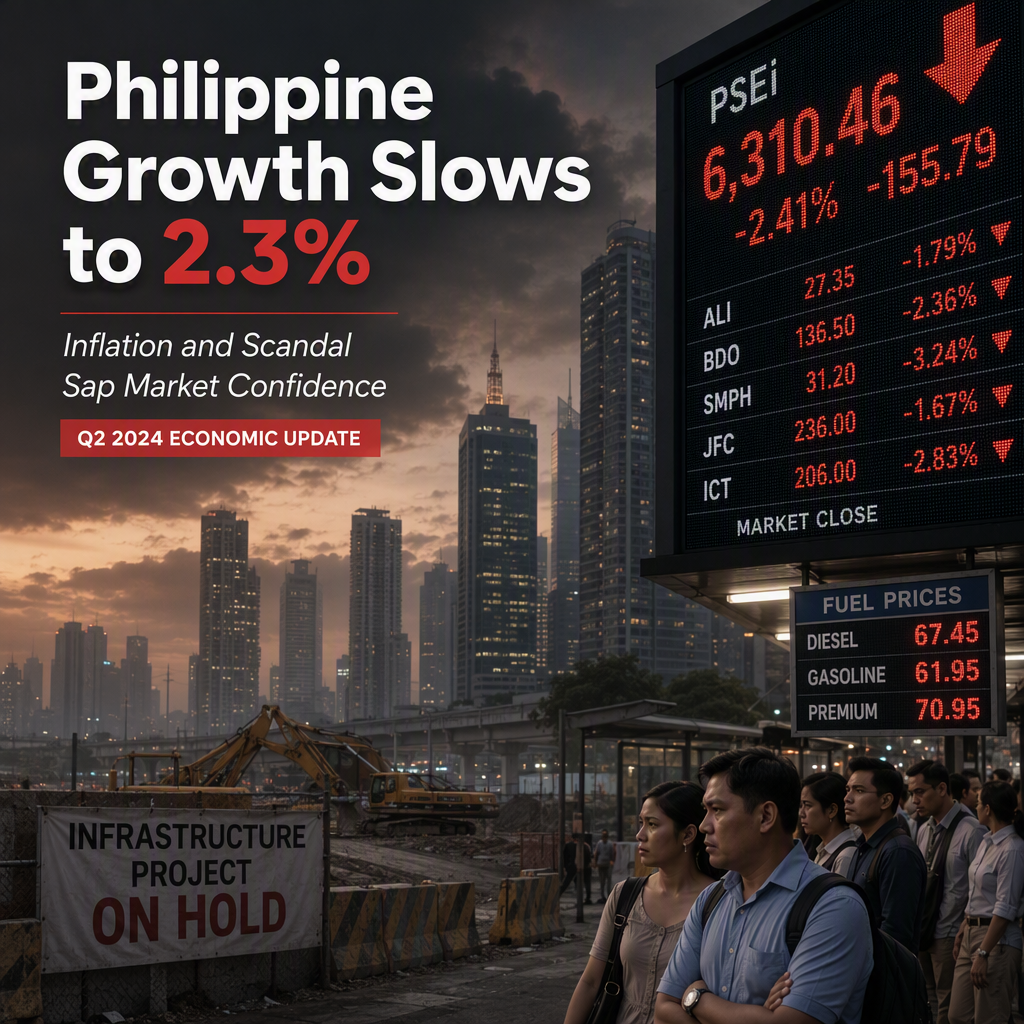
The Philippine economy recorded a year-on-year GDP growth of 2.3% in the second quarter, marking a further slowdown as the country faces persistent inflationary pressures and reduced public spending. The deceleration is primarily attributed to high fuel prices, which have been exacerbated by the ongoing conflict in Iran, resulting in an energy shock that has driven up transportation and utility costs for both consumers and businesses [1].
Additionally, a corruption scandal has led to lower public spending, as the government scaled back infrastructure and social programs, reducing fiscal stimulus to the broader economy [1]. This combination of external shocks and domestic political uncertainty has undermined investor confidence, with the Philippine stock market remaining volatile and trading sentiment subdued. Investors are reportedly awaiting clearer signals from policymakers regarding anti-inflation measures and fiscal reforms [1].
Economists cited in the article warn that unless inflation is brought under control and public trust is restored, the Philippine economy could face further downward pressure in the coming quarters [1]. Market analysts recommend a defensive trading stance and advise close monitoring of price levels for consumer staples and energy stocks, which are most affected by the current conditions [1].
CONCLUSION
The Philippine economy's Q2 slowdown to 2.3% growth reflects the significant impact of inflation and reduced public spending due to a corruption scandal. Market sentiment remains cautious, with analysts emphasizing the need for effective anti-inflation policies and restored public trust to prevent further economic weakening.