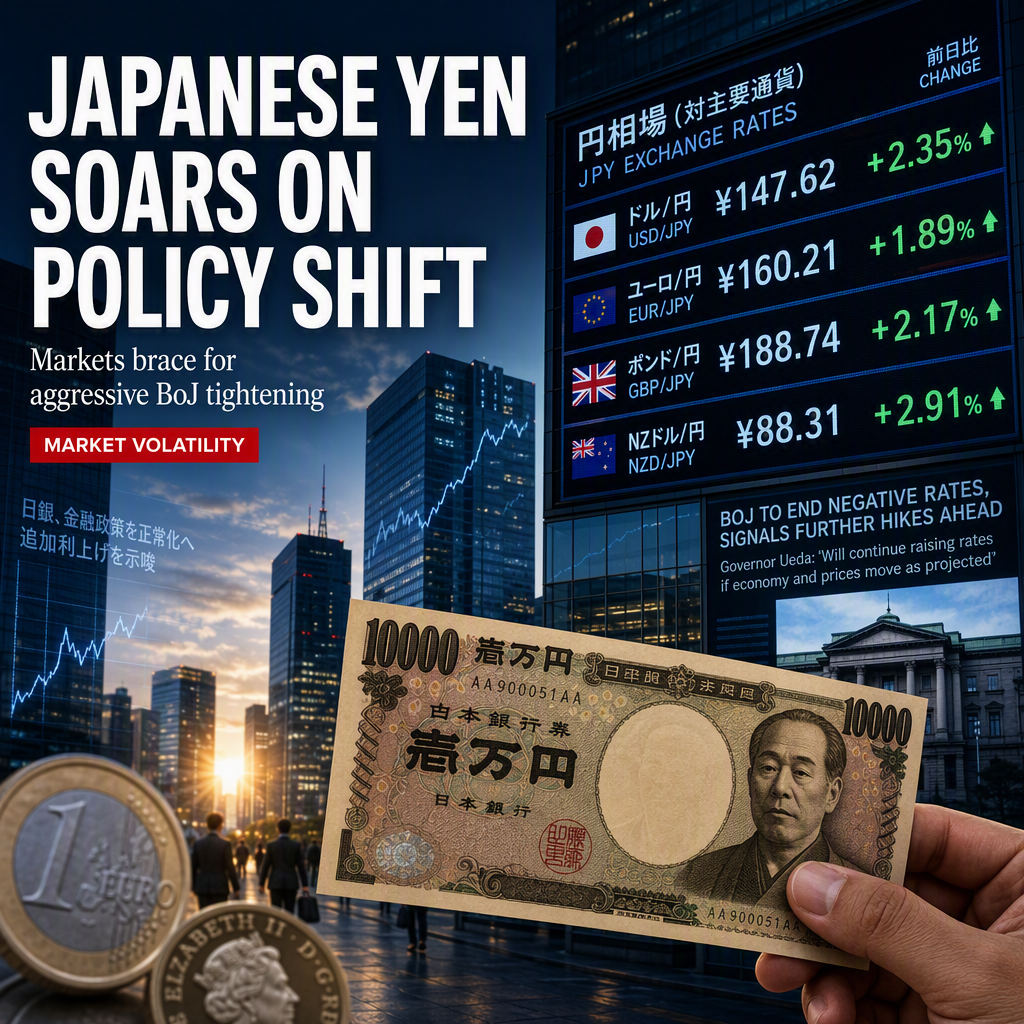
The Japanese Yen (JPY) extended its rally against major currencies, reaching its highest level against the US Dollar (USD) since mid-February during Asian trading hours on Tuesday, with USD/JPY trading below 154.00, EUR/JPY near 178.75, and GBP/JPY edging lower toward 208.00. All three pairs have lost more than 1% so far this week, with JPY showing the strongest gains against the New Zealand Dollar according to weekly performance tables [1]. On Tuesday, EUR/JPY was down 0.3% to near 178.85 after recovering from an intraday low of 177.85, and daily performance tables again showed JPY as strongest versus NZD [2].
Analysts attribute the Yen's strength to expectations of an aggressive Bank of Japan (BoJ) policy-tightening cycle. Deutsche Bank highlighted Japan's real wages increasing by +2.4% year-on-year in July, exceeding expectations of +1.8% and marking the strongest growth since May 2021. Total cash earnings rose +4.7%, the largest increase since January 1997, accelerating from a revised +4.0% increase in June. This stronger-than-expected wage data reinforces the case for the BoJ to raise interest rates at next week's policy meeting, following its previous hike three months ago [1]. Commerzbank analysts noted that an interest rate hike next week is now priced in at roughly 96%, with markets expecting further hikes to follow quickly thereafter. As long as expectations remain hawkish, the Yen is seen as well positioned to appreciate further [2].
On the Euro front, financial markets are awaiting the European Central Bank's (ECB) interest rate decision on Thursday. ABN Amro stated that a rate hike at the Governing Council meeting is fully priced by financial markets, but cautioned that moderate Eurozone economic growth and higher energy prices complicate the ECB's policy path. The outlook for further ECB tightening remains uncertain [2]. Meanwhile, German Trade Balance data for July showed a surplus of EUR 21.3 billion, beating expectations of EUR 16 billion and the previous EUR 15.4 billion in June. However, the surplus was driven by a 5.7% decline in imports, offsetting a 0.8% decline in exports, reflecting frail economic growth. German Industrial Production dropped 1.1% in July, against expectations of a 0.3% increase, weighed by a sharp decline in the automotive sector [3].
The Pound remains subdued as markets digest UK Chancellor John Healey's pledge to build a solid fiscal buffer in the October 28 Budget, with strategists at Brown Brothers Harriman suggesting this points to a mix of tax rises and spending cuts. Higher borrowing costs have halved the government's fiscal headroom to around £12bn, indicating a tighter fiscal stance ahead. BBH assesses that the UK's negative output gap, a policy rate above the mid-point of the BoE's neutral range, and the prospect of tighter fiscal policy argue for a less aggressive hiking cycle, leaving the Pound vulnerable to a dovish repricing if incoming data fail to justify the degree of tightening currently implied by rates markets [3].
CONCLUSION
The Japanese Yen's rally is underpinned by strong wage data and aggressive market expectations for Bank of Japan tightening, with a rate hike next week nearly fully priced in. The Euro and Pound are reacting to mixed economic data and central bank policy outlooks, with the ECB's path complicated by slow growth and the UK facing tighter fiscal policy. Overall, currency markets are experiencing high volatility as traders position for upcoming central bank decisions and economic releases.