
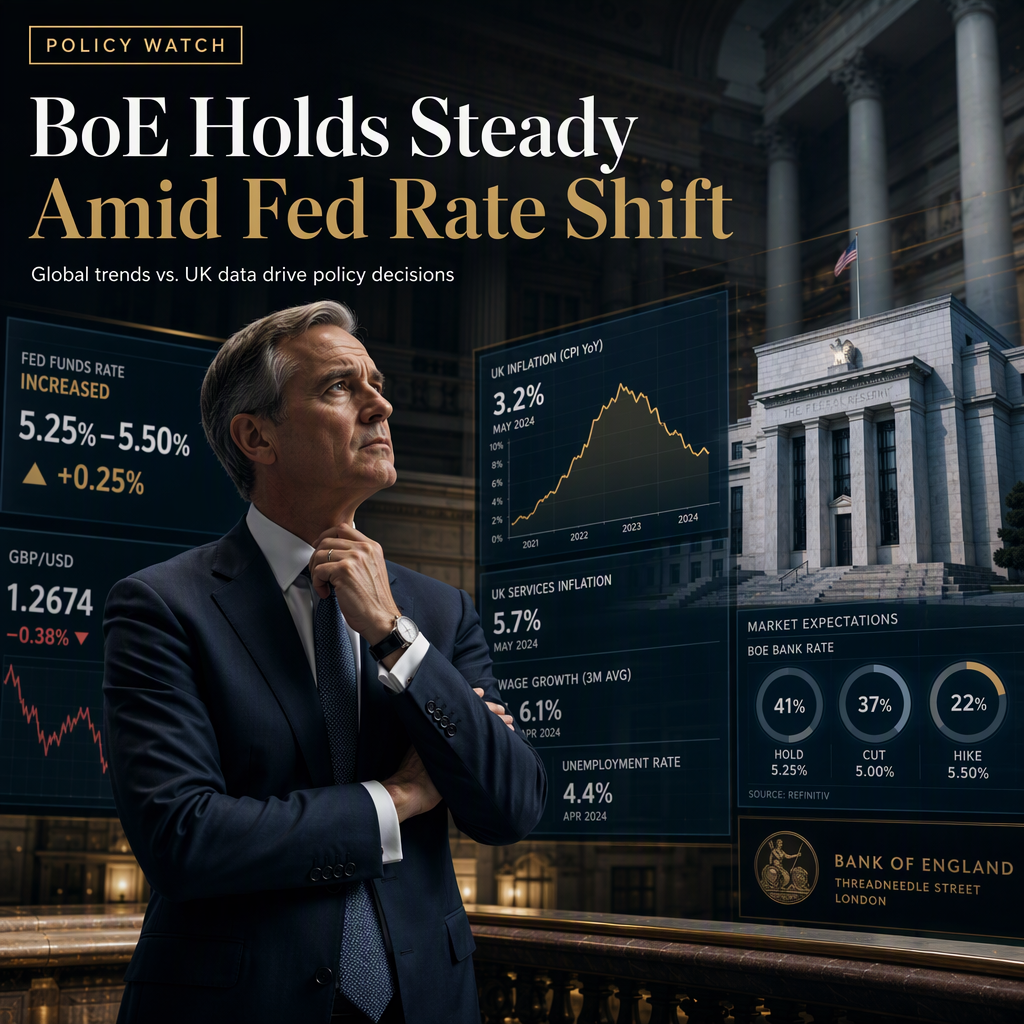
Standard Chartered’s Christopher Graham analyzed whether the Bank of England (BoE) will feel pressured to follow the Federal Reserve’s recent rate hike. The Federal Open Market Committee (FOMC) raised its policy rates by 25 basis points on 16 September, marking its first hike since August 2023. In contrast, the BoE held its policy rate steady at 3.75% the following day, a level unchanged since late last year [1].
Graham emphasized that Fed tightening alone does not force the BoE to act, highlighting the decisive role of UK-specific data and market credibility. He referenced historical evidence of increased policy convergence between the Fed and BoE since 1999, with the 'global rate factor' now explaining 38% of the variation in domestic policy rates, up from just over 10% between 1970 and 1999. However, he noted that convergence is not automatic, citing the 2016-19 Fed hiking cycle when the BoE cut rates post-Brexit due to demand concerns, only to raise them modestly a year later [1].
The report suggests that while the BoE is sensitive to Fed moves, especially through the exchange rate channel—where higher US rates can weaken the GBP and increase imported inflation—UK data remains the ultimate driver of BoE decisions. Standard Chartered currently expects the BoE to hold rates, though it is described as a 'close call.' The importance of market credibility is also underscored as a factor in the BoE’s policy deliberations [1].
Looking ahead, Standard Chartered anticipates another 25 basis point hike by the FOMC at its December meeting, but maintains that the BoE’s response will depend on domestic economic conditions rather than simply mirroring the Fed [1].
CONCLUSION
The Bank of England is not compelled to follow the Federal Reserve’s recent rate hike, with UK-specific data and market credibility playing a decisive role in its policy decisions. While global factors and exchange rates are influential, Standard Chartered expects the BoE to hold rates for now, pending further domestic developments.