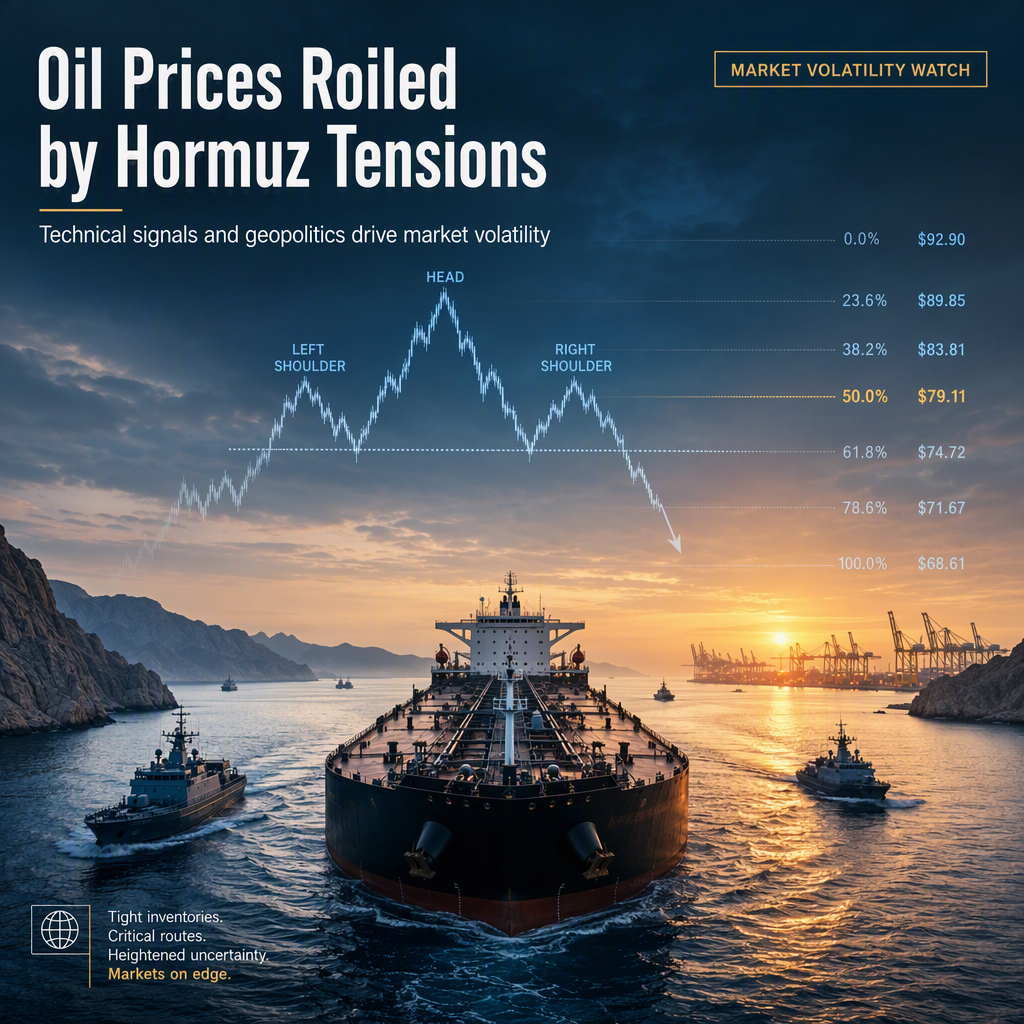
WTI crude oil has broken below the neckline of a complex Head and Shoulders pattern, signaling potential further downside for the commodity. Technical analysis highlights key retracement levels, with the 38.2% Fibonacci at $79.11 acting as the first upside barrier, and sellers likely to watch this level closely. If WTI crude oil pushes above the 61.8% Fibonacci level, it could test resistance at the pivot point ($83.81), with further bullish targets at R1 ($89.85) and R2 ($92.90). Conversely, if resistance holds, bearish targets include S2 ($74.72), S3 ($71.67), and S4 ($68.61) [1].
Geopolitical factors are also influencing oil prices, as easing tensions amid prospects of a US-Iran deal and the reopening of the Strait of Hormuz have led to the unwinding of the war premium. However, uncertainty persists due to a draft plan circulated by an Iranian news agency proposing more restrictive shipping conditions, which has revived supply concerns [1].
Commerzbank’s Carsten Fritsch expects continued volatility in Brent crude as negotiations regarding the Strait of Hormuz remain unresolved and inventories tighten. Fritsch notes that US inventories of middle distillates are almost 12% below the usual level and at their lowest for this time of year in 30 years. He anticipates that upcoming monthly reports from three energy agencies should support prices in the near term. However, once an agreement on Hormuz emerges, oil prices are projected to decline significantly, prompting Commerzbank to revise its year-end Brent forecast down to USD 75 per barrel from USD 80 previously [2].
Both sources emphasize the critical nature of disruptions in an already tight market, with technical and fundamental factors combining to drive volatility. While technical signals suggest possible further downside for WTI, analyst opinions point to near-term support but a longer-term decline in Brent prices once geopolitical uncertainties are resolved [1][2].
CONCLUSION
Oil markets are experiencing heightened volatility driven by unresolved Hormuz negotiations and tight inventories, with technical patterns indicating potential downside for WTI and analysts forecasting a year-end drop in Brent prices. Near-term support may come from energy agency reports, but the outlook remains uncertain until a final agreement is reached. Traders should closely monitor both technical levels and geopolitical developments for market direction.