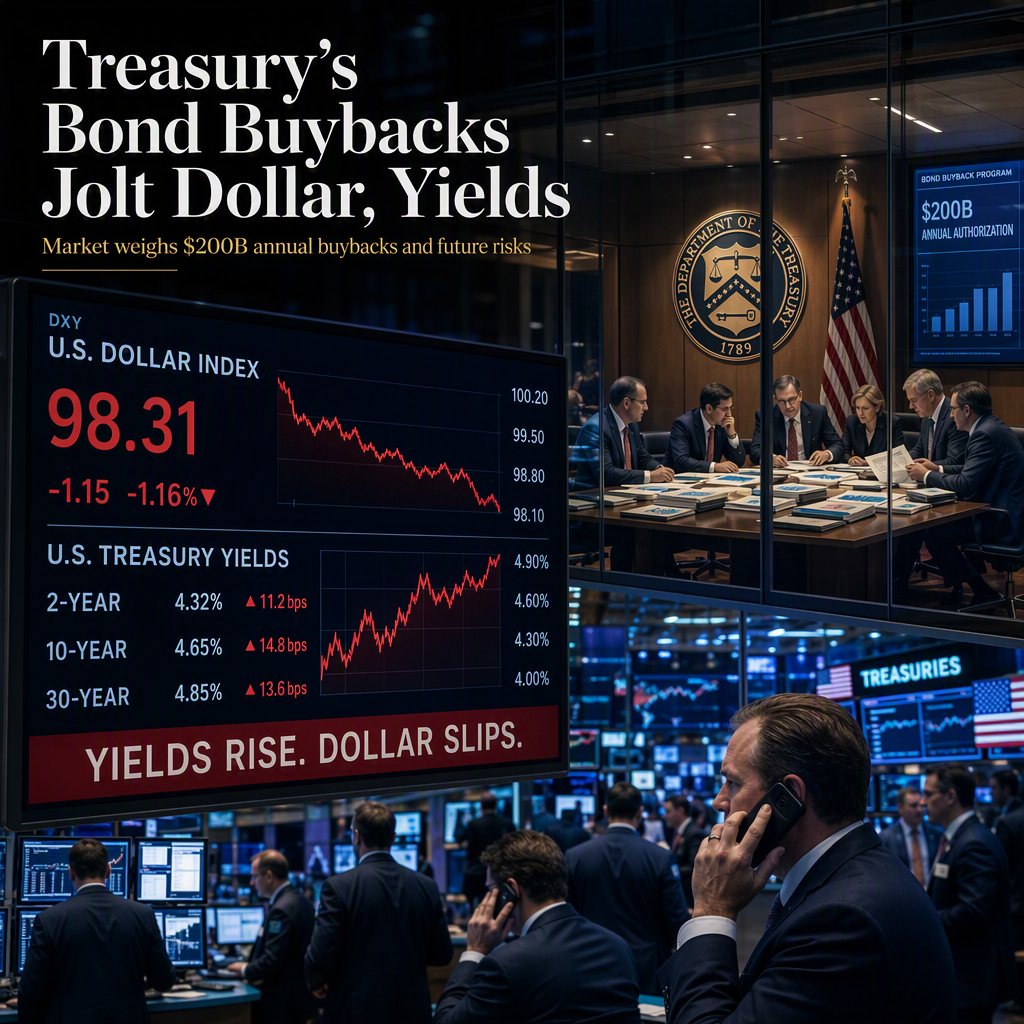
The US Treasury announced on August 19th that it planned to at least double the size of its long-term bond buybacks, a move that has had a notable impact on the US dollar and Treasury yields, according to MUFG’s Lee Hardman [1]. The announcement triggered a sell-off in the US dollar, which has since remained around 1% weaker, as market confidence was undermined by the Treasury’s efforts to dampen or cap long-term yields amid rising inflation risks [1].
Further details released yesterday revealed that the maximum size of the first expanded bond buyback operation was tripled from USD2 billion to USD6 billion. This announcement initially caused long-term US yields to jump, with the 30-year yield rising by approximately 5 basis points before settling about 2-3 basis points higher [1]. The price action suggests some initial disappointment that the buyback size was not even larger [1].
The US dollar experienced a modest relief rally following the announcement, but this rally has largely reversed, and the dollar remains weaker [1]. If the Treasury continues to conduct nine bond buybacks each quarter, purchasing up to USD6 billion at each operation, the potential annual purchases could total just over USD200 billion. This would represent a smaller-scale version of the Federal Reserve’s previous 'Operation Twist,' though the duration and potential for further increases in the size of the operations remain uncertain [1].
CONCLUSION
The US Treasury’s decision to expand long-term bond buybacks has weakened the US dollar and influenced Treasury yields, reflecting market uncertainty about the program’s scale and duration. While the initial relief rally in the dollar faded, the market continues to assess the implications of potentially over USD200 billion in annual buybacks. The Treasury’s actions are seen as a significant factor shaping yield dynamics and currency sentiment in the near term.