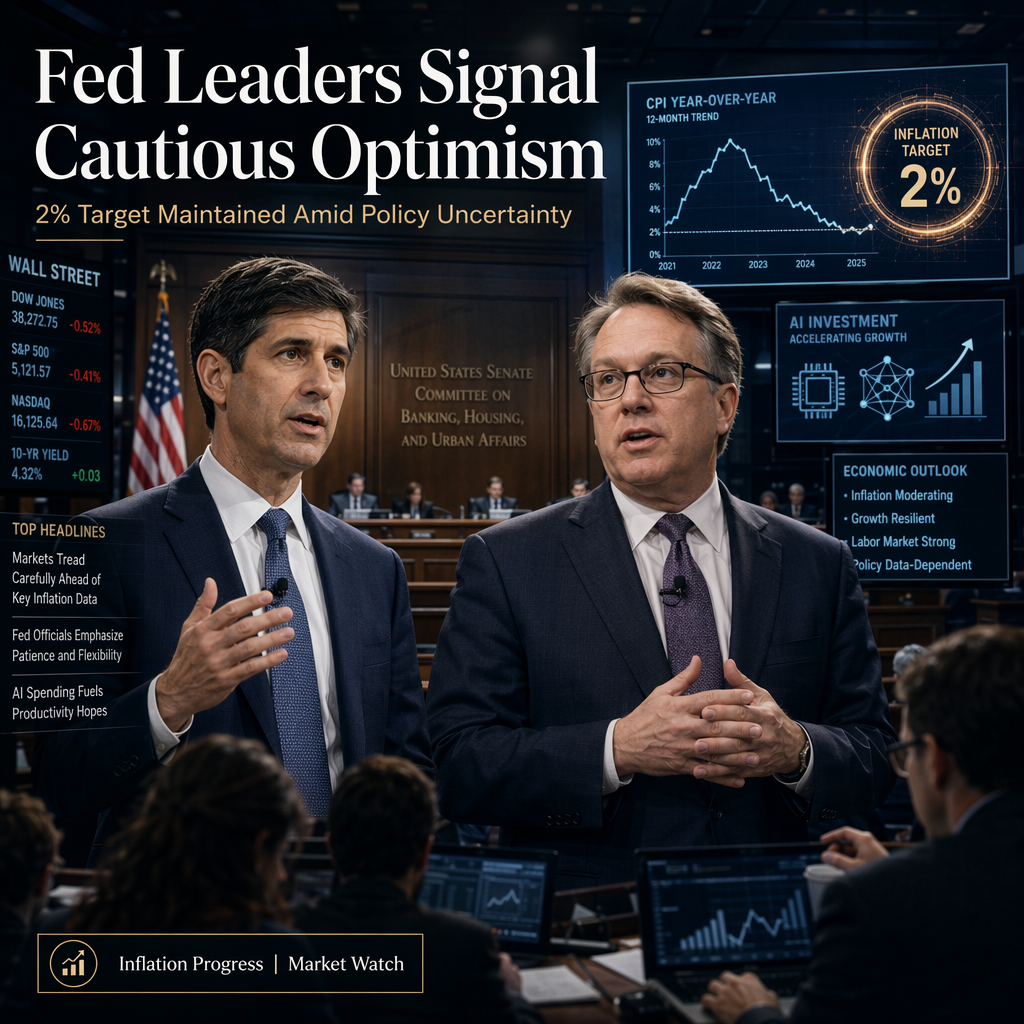
Federal Reserve Chair Kevin Warsh and New York Fed President John Williams both addressed recent inflation data and monetary policy outlooks in separate remarks on Wednesday. Warsh, testifying before the US Senate Committee on Banking, Housing and Urban Affairs, emphasized that recent inflation figures are an imperfect measure of underlying inflation and that a one-time change in prices is not necessarily inflationary. He noted that while wages have increased at a reasonable pace, the timing of stronger wage gains from productivity improvements remains a 'puzzle.' Warsh also discussed the impact of Artificial Intelligence (AI), stating that in the near term, AI investment is positive for employment and is expected to be a long-term job creator, though it may cause short-term disruption during the transition period. He could not guarantee that AI would have no immediate negative effects on jobs [1].
Williams, speaking at a Partnership for New York City event, described the latest US Consumer Price Index (CPI) report as consistent with the inflation progress he hopes to see in the coming months. He characterized the CPI reading as a 'little piece' of inflation returning toward the Fed's goal and noted that risks from energy-price inflation have eased somewhat. Williams firmly rejected any consideration of changing the Fed’s 2% inflation target, stating that it remains the right number and that the central bank should not 'move the goal posts.' He also highlighted strong support among policymakers for moving away from forward guidance, indicating that the Fed does not currently have a clear direction regarding future interest rate changes. Williams did not offer a particular view on the future direction of monetary policy, reinforcing a data-dependent approach amid ongoing market responses to Middle East conflict developments [2].
The FXS Fed Sentiment Index slipped by 0.38 points to 126.13, signaling a modest pullback in perceived hawkishness compared to recent communications, though it remains firmly in hawkish territory above 100. The tone of Williams' speech was described as moderately cautious, with a FXS Speechtracker score of 5.4/10, slightly softer than the historical average of 5.9/10. Despite the softer tone, the policy bias is still skewed toward restraint, and the US Dollar remains sensitive to incoming data rather than policy pre-commitments [2].
Both leaders underscored the importance of delivering price stability and maximum employment, with Williams praising Warsh for bringing fresh thinking to the central bank. The US economy was described as experiencing significant dynamism, including an explosion in the creation of new businesses [2].
CONCLUSION
Fed Chair Warsh and President Williams both signaled cautious optimism about recent inflation trends, while maintaining a firm commitment to the 2% inflation target. The lack of forward guidance and clarity on future rate moves leaves markets data-dependent, with policy bias remaining moderately hawkish. Investors are likely to remain focused on upcoming economic data for further direction.