
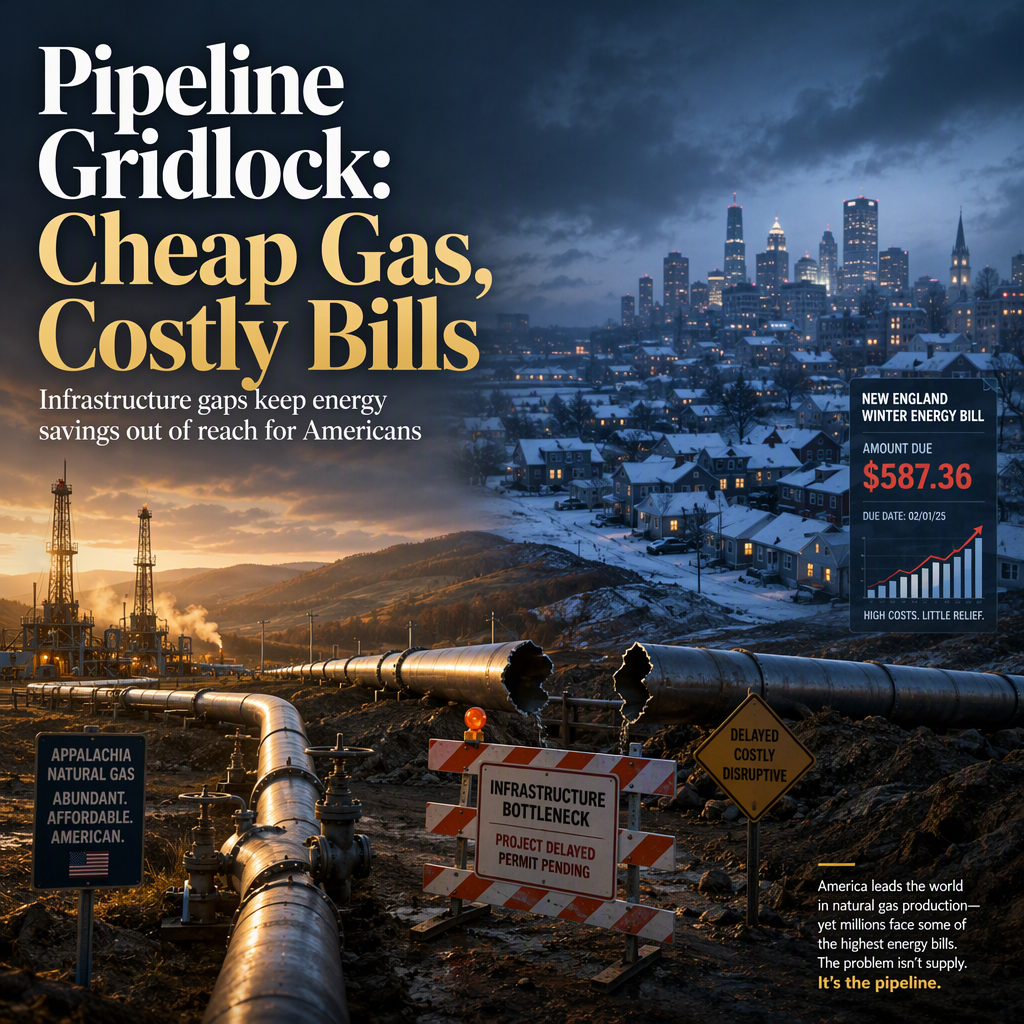
Toby Z. Rice, President and CEO of EQT Corporation, stated that despite the abundance of natural gas in the United States and persistently low commodity prices, many Americans are not seeing these savings reflected in their energy bills due to significant infrastructure bottlenecks. Rice highlighted the disparity between natural gas prices in producing regions and consumer prices in areas with limited pipeline capacity, noting that EQT expects to sell natural gas from Appalachia this winter for close to $4, while New England could see prices near $20 in January [1].
Rice emphasized that the core issue is the lack of sufficient energy infrastructure, calling the situation 'absolutely unacceptable' and advocating for urgent permitting reform to accelerate the construction of pipelines and other necessary facilities. He stated, 'Permit reform is long overdue. It needs to happen now,' and expressed hope that action would be taken soon, as both Americans and the global market are waiting for these changes [1].
The CEO also pointed to surging demand for natural gas driven by artificial intelligence and LNG exports, as well as the retirement of over 174 gigawatts of coal and nuclear generation capacity in the U.S., which has created a significant gap in reliable, cost-effective energy supply. Rice argued that the U.S. has the natural gas resources to meet this demand, but the main hurdle remains the timely construction of infrastructure to deliver energy to consumers [1].
Rice concluded by urging policymakers to allow energy companies to respond to market forces and questioned whether the necessary infrastructure could be built within the required timeline to meet growing demand [1].
CONCLUSION
The EQT CEO's comments underscore a critical disconnect between low natural gas prices and consumer energy costs, driven by infrastructure limitations. Without permitting reform and new pipeline construction, Americans may continue to face high energy bills despite abundant resources. The market impact is medium, as the issue highlights ongoing challenges in meeting rising energy demand.