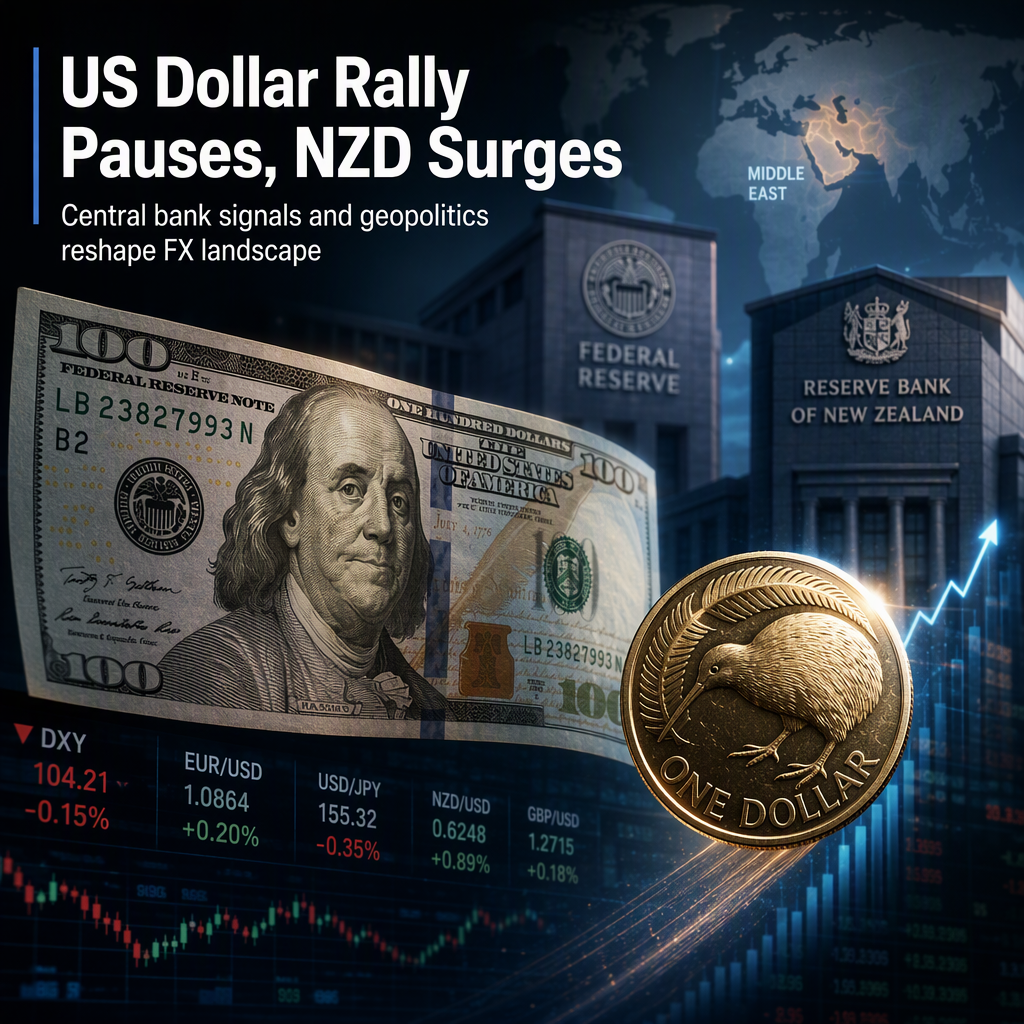
The US Dollar (USD) extended its gains following a recent hawkish Federal Reserve (Fed) rate hike, with several Fed officials, including St. Louis Fed President Alberto Musalem and Chicago Fed President Austan Goolsbee, signaling the potential for further tightening to curb inflation if demand remains strong [1][3]. The Fed's dot plot indicated expectations for one more hike this year, and Boston Fed President Susan Collins also supported further policy tightening due to persistent inflation risks [3]. However, optimism around the potential reopening of the Strait of Hormuz, following Iran's offer to reopen the passage within seven days if the US lifts its blockade and halts military operations, has tempered the USD rally and weighed on oil prices, dragging crude to a two-week low and easing immediate inflation fears [1][3].
The US Dollar Index (DXY) reached its highest level since July 30 before retreating slightly, trading just below the mid-100.00s and remaining unchanged for the day [3]. Technical analysis shows the DXY maintains a bullish near-term bias above the 100-day Simple Moving Average at 99.90, with key resistance at 100.56 and 101.10, and support at 100.18 and 99.80 [3]. Despite the recent pullback, the fundamental backdrop remains supportive for the USD, with the US growth advantage expected to persist over the Eurozone, UK, and Japan, as highlighted by upcoming September S&P Global PMI readings [1].
Meanwhile, the New Zealand Dollar (NZD) emerged as the main overnight mover, buoyed by hawkish guidance from Reserve Bank of New Zealand (RBNZ) Governor Breman, who warned that persistent higher oil prices could lead to higher near-term inflation than previously assumed [2]. This reinforced market expectations for a third consecutive 25 basis point hike at the next policy meeting, following stronger-than-expected Q2 growth of 0.2% [2]. The New Zealand rate market is now pricing in around 18 basis points of hikes for next month and just over 100 basis points by next summer [2].
The NZD/USD pair rebounded to 0.5740 after bouncing from the 0.5700 area, though it remains below key resistance at 0.5800. The recovery is seen as corrective, with technical indicators such as the RSI near 36 and MACD below zero, suggesting persistent downside pressure [4]. Upside attempts are likely to be tested at the 0.5810-0.5825 area, with further resistance at the 200-day SMA at 0.5853 [4]. The NZD was the strongest against the Japanese Yen, gaining 0.59% on the day [4].
While rising US rates have supported the USD, expectations for further policy tightening by other central banks, particularly the RBNZ, have offset some of the USD's strength [2]. The interplay between Fed and RBNZ policy outlooks, as well as geopolitical developments in the Middle East, continue to drive volatility in the FX market.
CONCLUSION
The US Dollar's rally has paused amid mixed signals from Fed officials and easing geopolitical tensions, while the New Zealand Dollar has strengthened on hawkish RBNZ expectations and resilient economic data. Market participants are closely watching upcoming central bank decisions and geopolitical developments for further direction. The overall market impact remains high, with both USD and NZD subject to ongoing policy and geopolitical shifts.