
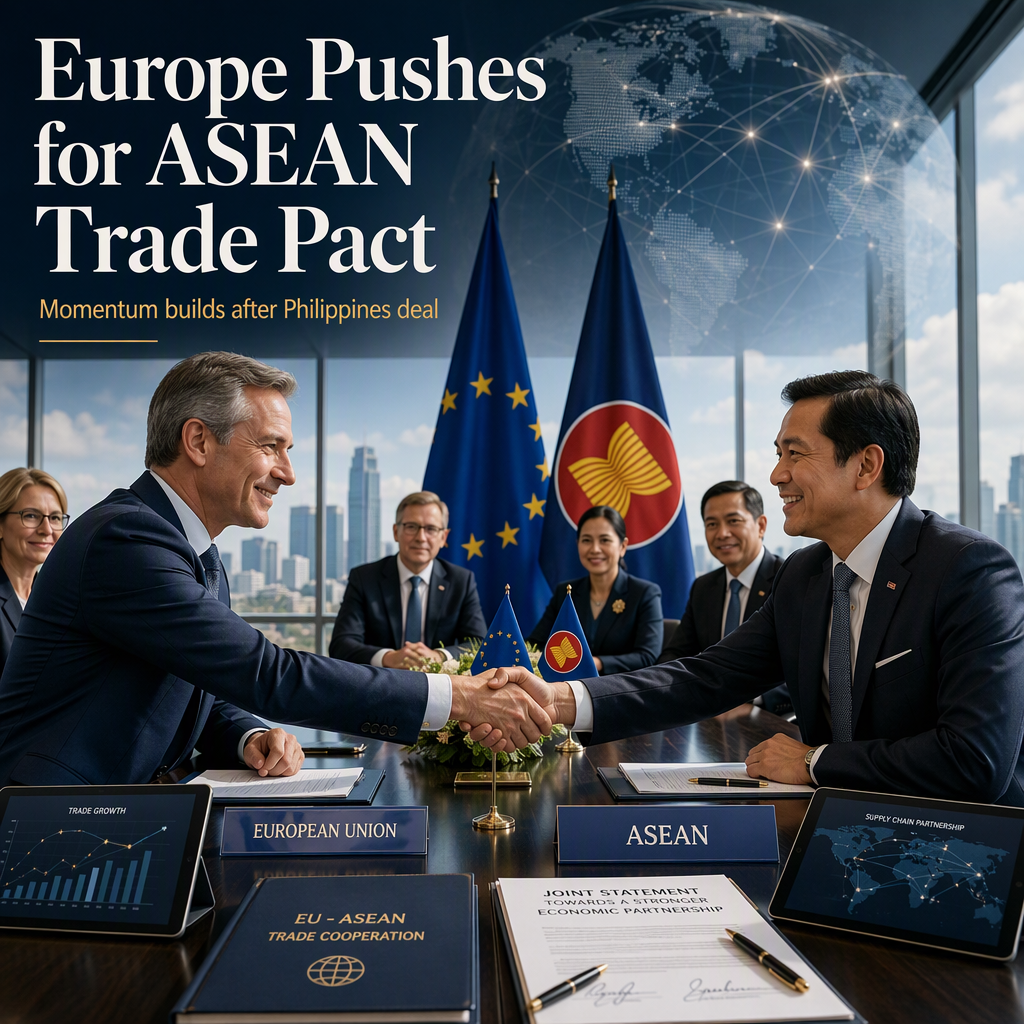
European businesses are advocating for a comprehensive region-to-region trade agreement between the European Union (EU) and the Association of Southeast Asian Nations (ASEAN) following the recent initial free trade agreement between the EU and the Philippines, which was finalized last week [1]. This development is seen as a significant pivot towards Asia for the EU, as Brussels seeks to diversify its trade and political relationships amid ongoing global strife and disruptions in traditional supply chains [1].
The European Chamber of Commerce in Singapore emphasized that an EU-ASEAN Free Trade Agreement would provide substantial economic benefits for both regions, strengthen supply chain resilience, and bolster Europe's strategic presence in Southeast Asia [1]. The proposed agreement would grant EU companies improved access to ASEAN's market of over 650 million people [1].
Negotiations between the EU and Thailand are ongoing but have encountered delays due to disagreements over labor standards and environmental provisions. Despite these challenges, some European companies and policymakers are urging the EU to prioritize economic engagement and strategic interests in order to remain competitive with other global powers active in the region [1].
The EU's recent actions, particularly the deal with the Philippines, reflect a broader trend of seeking alternative partners and supply chains in response to increasing geopolitical tensions and global trade disruptions [1].
CONCLUSION
The EU's initial free trade agreement with the Philippines has prompted European businesses to push for a broader EU-ASEAN trade pact, citing significant economic and strategic benefits. While negotiations with Thailand face hurdles, the momentum signals the EU's intent to deepen ties with Southeast Asia and enhance its global competitiveness.