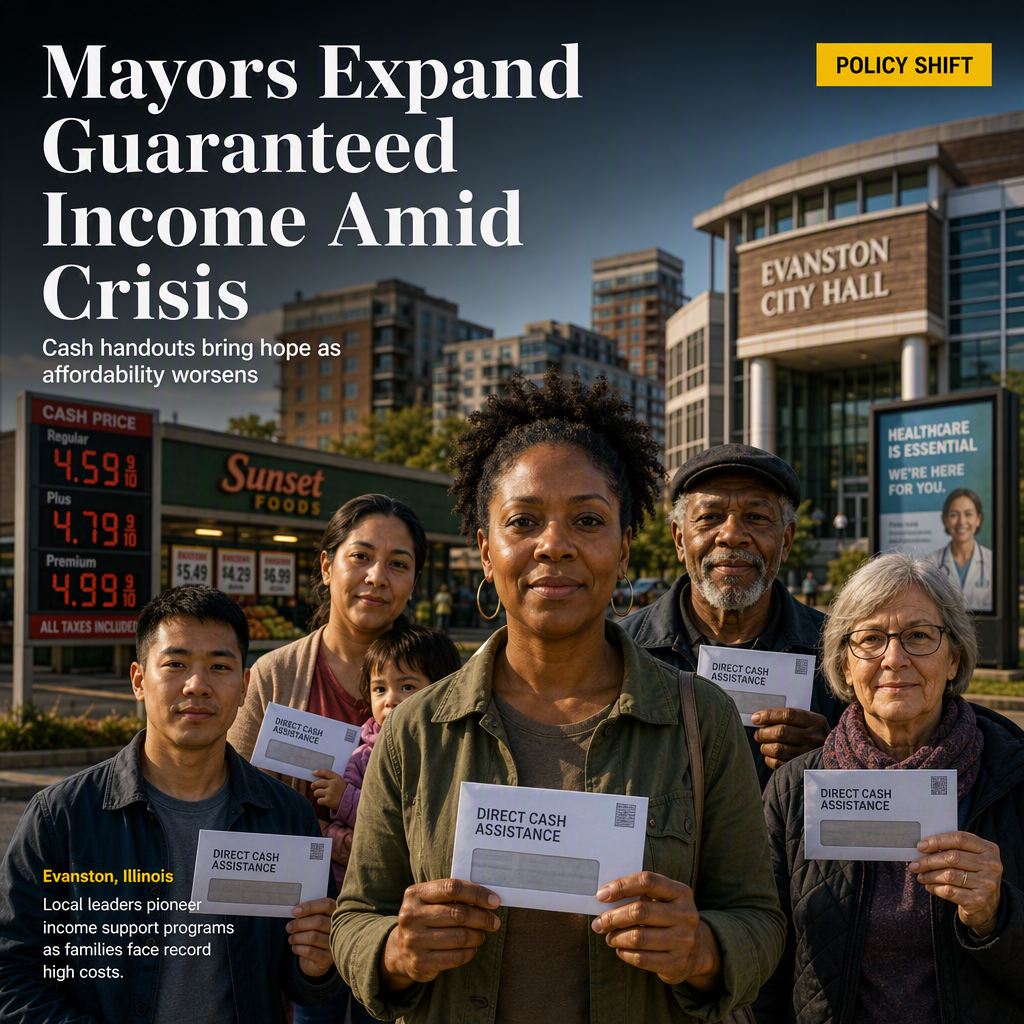
A growing trend among U.S. mayors is the expansion of guaranteed income programs as a response to the ongoing affordability crisis, according to the Economic Security Project (ESP) and recent developments in cities like Evanston, Illinois [1]. ESP, which has led the creation of over 100 guaranteed income programs, argues that the destruction of the social safety net and rising costs of healthcare and food have made the need for direct cash assistance more urgent than ever [1]. Shafeka Hashash, ESP's director of cash initiatives, emphasized that cash handouts provide stability, support economic mobility, and help families move toward a more economically secure future [1].
Evanston, Illinois, recently announced the expansion of its guaranteed income program to utilize the remainder of its federal funds, originally provided through the American Rescue Plan Act (ARPA). Under federal law, these recovery funds must be obligated by the end of 2024 and fully spent by the end of 2026 [1]. This move comes as dozens of municipal mayors nationwide are seeking ways to sustain local cash-handout experiments as federal pandemic aid approaches its final spending deadline [1].
The affordability crisis is underscored by rising housing, food, and energy costs, with the AAA estimating that nearly 40 million Americans faced record-high gasoline prices during the recent Labor Day holiday, marking it as the most expensive Labor Day at the pump on record [1]. Both political parties are attempting to address voter concerns about affordability ahead of the upcoming midterm elections [1].
ESP's recent report, "Right on Time: How Cash Helps Families Move Through Life’s Transitions," published on August 12, advocates for institutionalizing no-strings-attached cash assistance. The report draws on data from over 250 cash and guaranteed-income pilots across 40 states and the District of Columbia, claiming that direct cash transfers are a legitimate policy tool [1]. However, the report suggests a tactical shift: instead of universal, immediate cash handouts, it recommends tying direct payments to specific life events, arguing that cash assistance is most effective during periods of personal or financial hardship [1].
CONCLUSION
The expansion of guaranteed income programs reflects growing concern among city leaders about the affordability crisis as federal pandemic aid nears its end. While advocates cite extensive pilot data supporting the effectiveness of direct cash transfers, the focus is shifting toward targeted assistance during key life transitions. The market impact is medium, as these policy shifts could influence consumer spending and local economies.