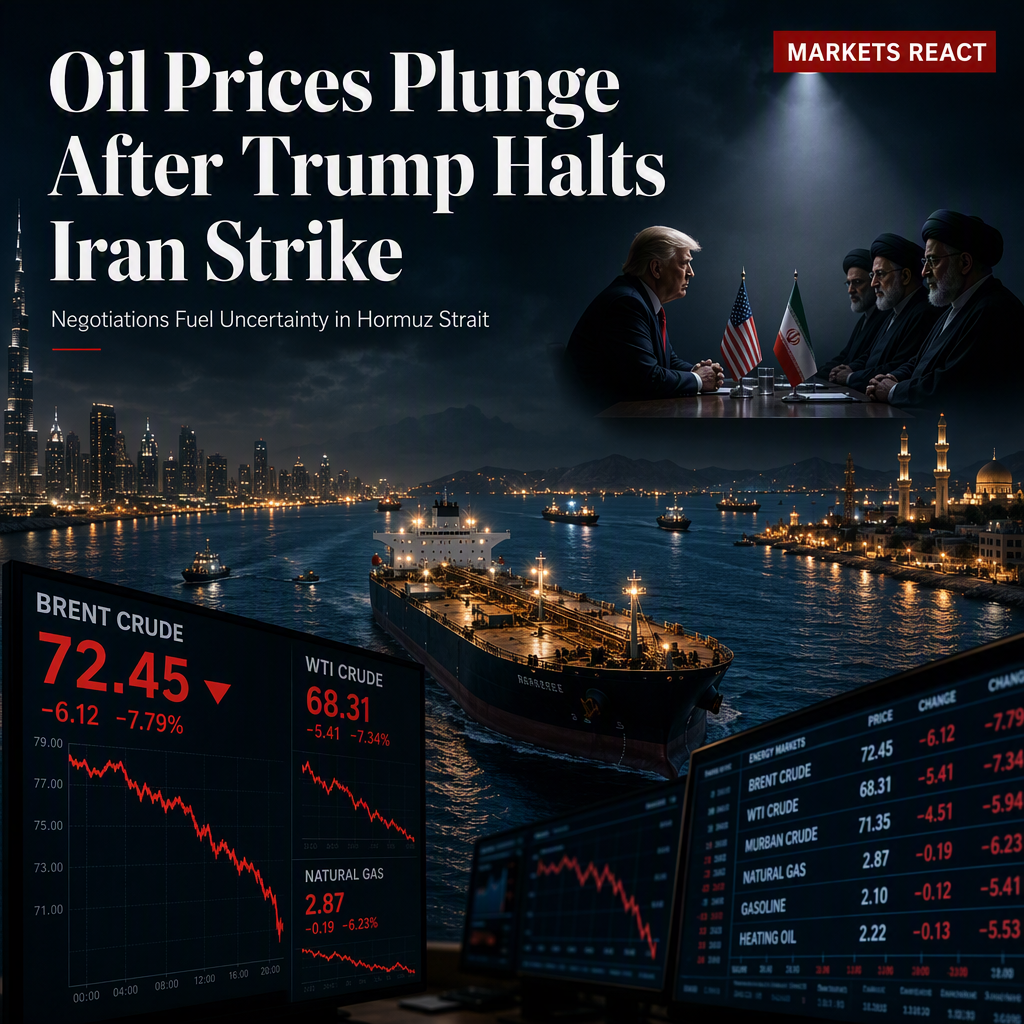
Oil prices experienced a significant decline after President Donald Trump announced that he had called off a planned military strike on Iran. West Texas Intermediate (WTI) futures, the U.S. oil benchmark, fell approximately 5% to close at $80.34 per barrel, while Brent crude, the international benchmark, dropped 4.7% to settle at $83.77 a barrel [1].
Trump stated that the decision to halt the strike came after receiving requests from Iran and other Middle Eastern countries, indicating that the parameters of a deal had been agreed upon. According to Trump, the proposed agreement would involve the 'Immediate, Complete, and Total OPENING OF THE HORMUZ STRAIT, and an end to Iran's nuclear threat' [1].
The president noted that negotiations between the U.S. and Iran were scheduled for Monday. However, Tehran denied that talks with Washington were planned, with Iran's state news outlet PressTV reporting this position. Instead, Iran's Foreign Ministry spokesman Esmaeil Baghaei clarified that Tehran was only engaged in discussions with Oman regarding shipping routes through the Strait of Hormuz [1].
Trump reiterated in a subsequent Truth Social post that, regardless of Iran's public statements, discussions were underway to resolve longstanding issues between the two countries [1].
CONCLUSION
The cancellation of the U.S. strike on Iran and the announcement of a potential agreement led to a sharp drop in oil prices. While Trump signaled progress toward resolving tensions, Iran publicly denied direct talks with the U.S., highlighting ongoing uncertainty in the region. The market reacted strongly to the news, reflecting the high sensitivity of oil prices to geopolitical developments in the Middle East.