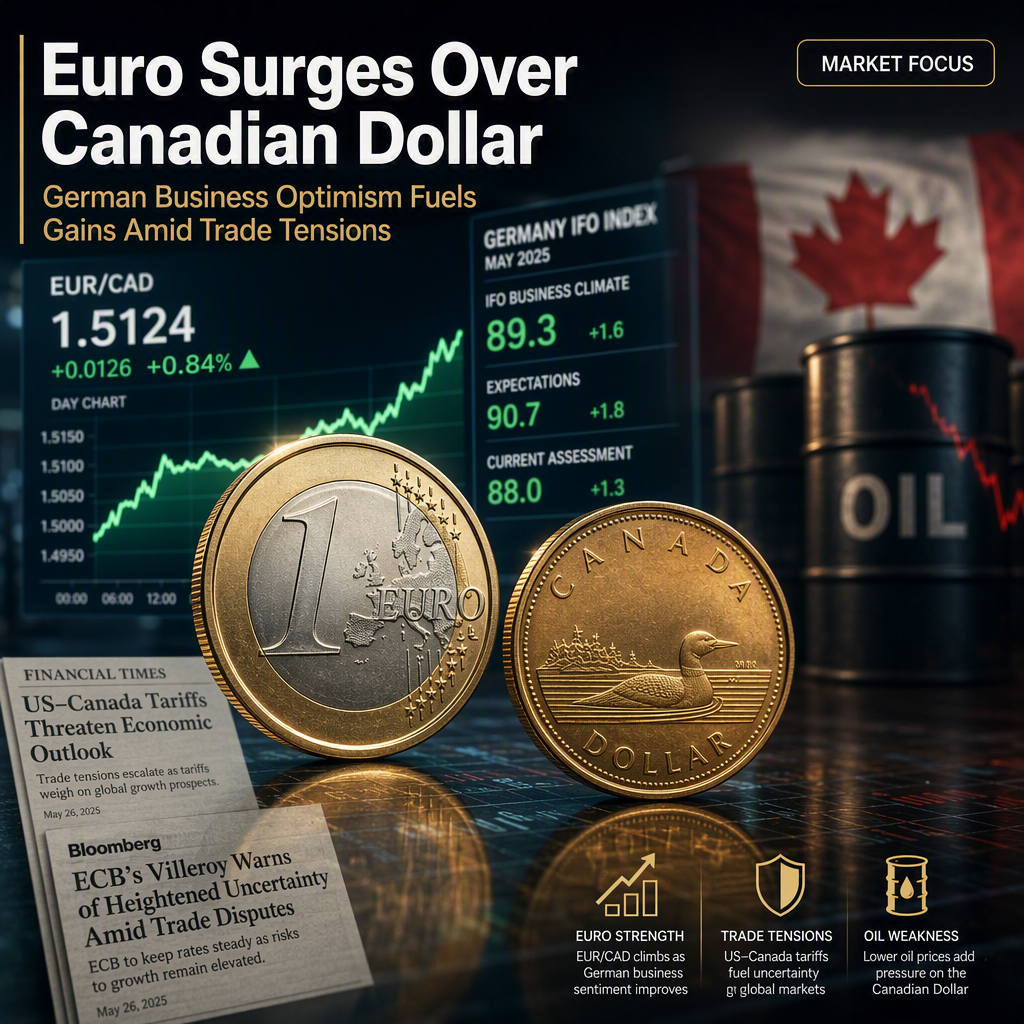
The EUR/CAD currency pair extended its gains for the second consecutive day, trading around 1.6160 during European hours on Tuesday, buoyed by positive German IFO business sentiment index data [1]. The IFO Business Climate Index improved in August, rising to 88.8 from a revised 86.7 in July, surpassing market estimates of 87.2. Sub-indexes also showed strength: the Current Assessment Index increased to 88.5, beating expectations of 87.0 and the prior 86.5 reading, while the Expectations Index jumped to 89.1, topping both July’s revised 86.8 figure and the forecast of 87.5 [1].
Strategists at BNY highlighted that inflation remains a core issue in Europe, but improving activity and more firmly anchored inflation expectations give the European Central Bank (ECB) some leeway to wait and assess incoming data. They noted that the Euro is near cyclical highs and is already contributing to tighter financial conditions, reducing the need for aggressive ECB action in the near term [1].
The Canadian Dollar (CAD) struggled amid market caution following collapsed US-Canada trade talks. Tensions escalated after Canadian Prime Minister Mark Carney announced plans to match US tariffs dollar-for-dollar in response to Washington's implementation of 50% tariffs on select Canadian goods [1]. The CAD also faced pressure from subdued crude oil prices, with West Texas Intermediate (WTI) trading around $84.20 per barrel. Although crude prices saw slight support from intensified US economic pressure aimed at reopening the Strait of Hormuz, gains were capped as US Treasury Secretary Scott Bessent outlined plans to isolate Iran via secondary sanctions, and President Donald Trump warned foreign nations of a strict timeline to sever commercial ties with Tehran or risk unilateral US penalties [1].
Analysts at Danske Bank noted that Iran has promised to retaliate against expanded US economic sanctions, emphasizing the risk of a more confrontational trajectory. Tehran signaled confidence that major trading partners like China would resist Washington's pressure campaign, which could influence the enforcement of the new sanctions regime [1].
CONCLUSION
The Euro's strength against the Canadian Dollar was driven by upbeat German business sentiment and heightened trade tensions between the US and Canada. While the ECB is expected to remain cautious, anchored inflation expectations and a strong Euro are tightening financial conditions. Ongoing geopolitical risks and subdued crude prices continue to weigh on the Canadian Dollar, with markets closely watching for further escalation.