
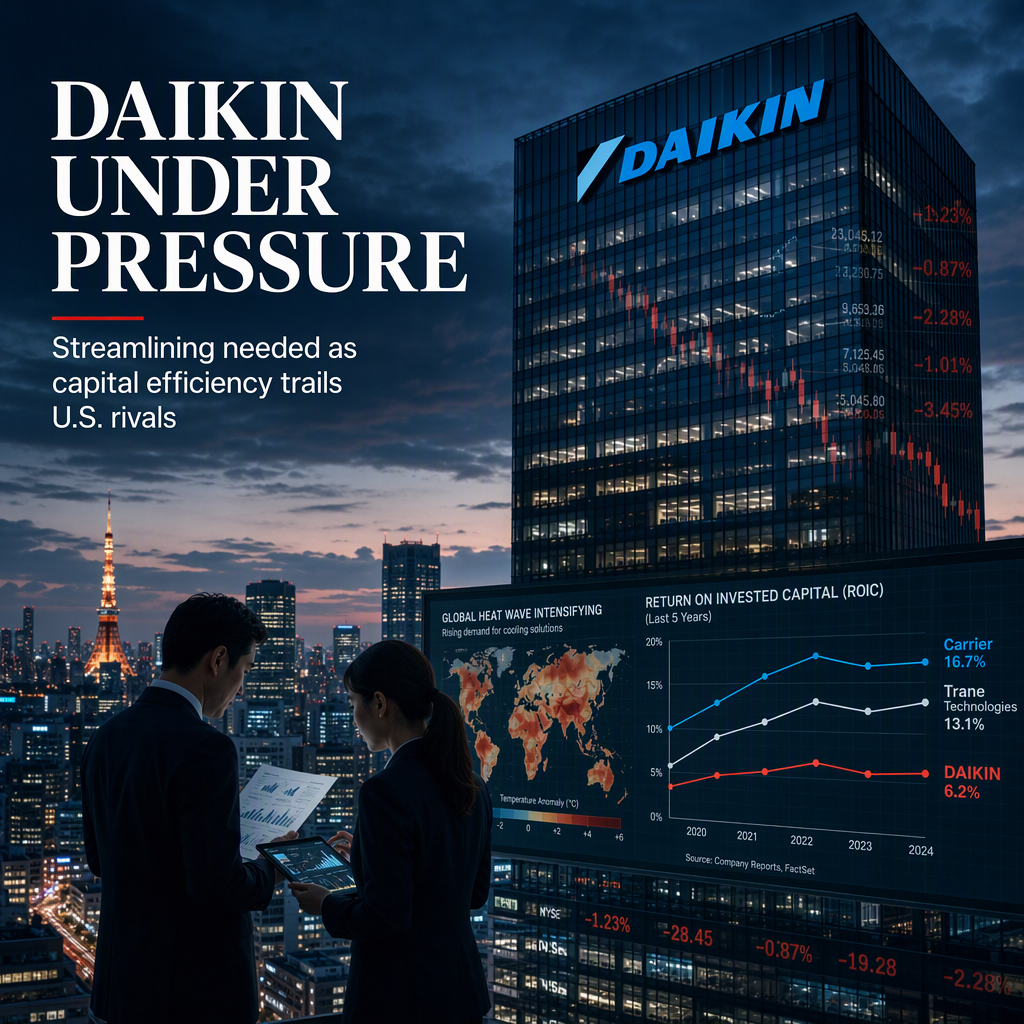
Daikin Industries, a leading Japanese air conditioner manufacturer, is facing mounting pressure from investors to improve its capital efficiency, which currently lags behind U.S. competitors Carrier and Trane, despite enjoying robust sales driven by global heat waves, especially in Europe [1]. The company's assets have been increasing at a faster rate than its profits, raising concerns about the sustainability of its asset-heavy business model and prompting calls for divestiture of underperforming units [1].
Financial analysts highlight that Daikin's approach to capital allocation has not kept pace with industry best practices, putting it at a disadvantage compared to more agile U.S. rivals who have adopted asset-light strategies [1]. Investors are urging Daikin to reassess its portfolio, focus on high-performing segments, and optimize asset utilization to improve profit margins and shareholder returns [1]. A Tokyo-based institutional investor remarked, "Daikin needs to reassess its portfolio and focus on high-performing segments. The gap in capital efficiency is becoming more evident as global competition intensifies" [1].
While Daikin has benefited from increased demand for air conditioners amid historic heat waves, its profitability metrics remain below those of Carrier and Trane [1]. Analysts suggest that Daikin should consider divesting non-core businesses and increasing investments in technology and operational efficiency to boost its return on equity (ROE) and meet shareholder expectations [1].
Market sentiment is cautiously optimistic, with traders closely monitoring for signs of strategic shifts in Daikin's corporate structure. Technical analysis indicates support for Daikin's share price at recent lows, but resistance persists due to concerns about capital efficiency. The article does not provide specific price levels or technical indicators, but emphasizes the importance of capital allocation and potential restructuring to unlock shareholder value [1].
CONCLUSION
Daikin Industries is under investor scrutiny to improve capital efficiency and profitability, with calls for a more streamlined strategy and potential divestitures. While market sentiment remains cautiously optimistic, the company's ability to adapt and restructure will be key to unlocking shareholder value and closing the gap with U.S. rivals.