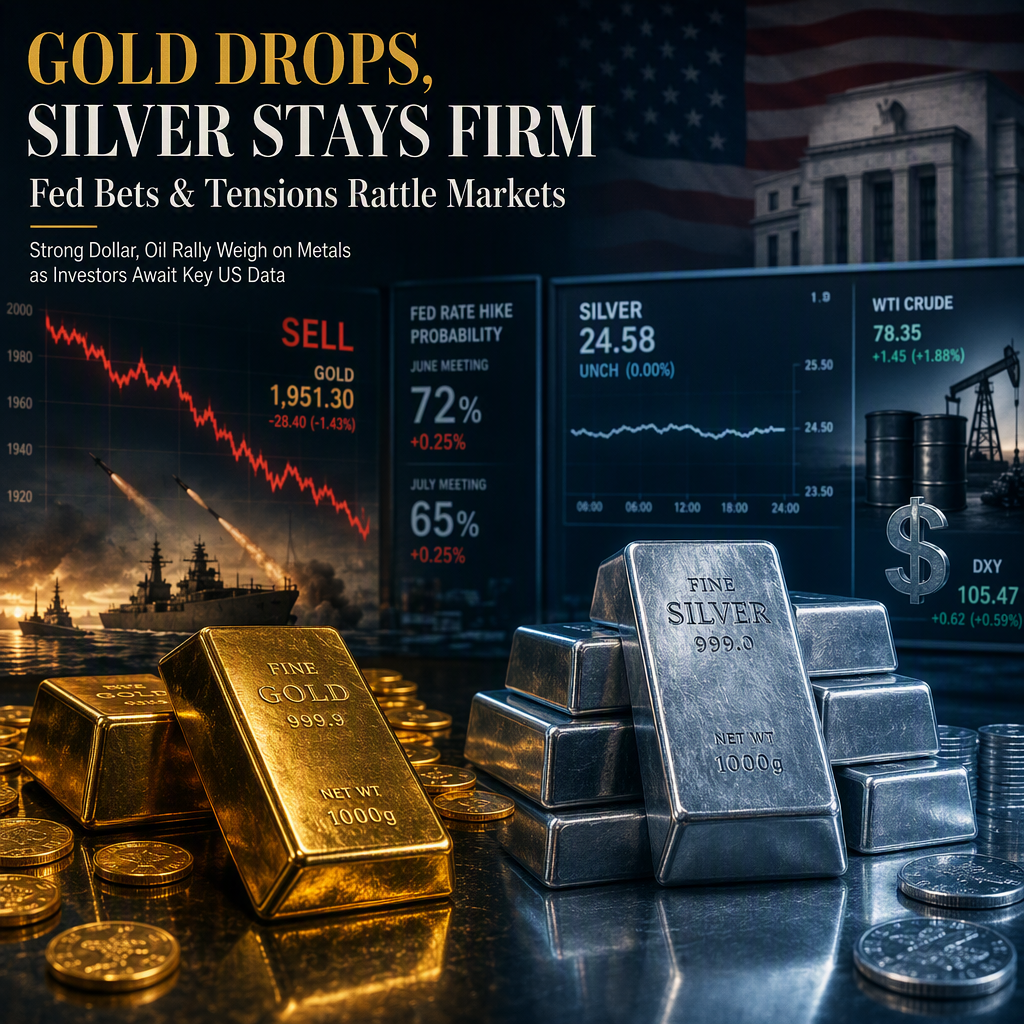
Gold (XAU/USD) declined during the Asian session on Tuesday, failing to build on its previous rebound from sub-$4,400 levels and attracting renewed selling pressure. This move was driven by increased market expectations for a US Federal Reserve interest rate hike, following Fed Chair Kevin Warsh's hawkish remarks at the Jackson Hole Symposium. Warsh indicated that the Fed may consider raising rates if inflation does not slow significantly, which has undermined the appeal of non-yielding assets like gold [1]. According to CME Group's FedWatch Tool, traders are now pricing in a 65% chance of a rate hike at the upcoming September 15-16 policy meeting [1].
Geopolitical tensions have also played a significant role, with US forces striking Iranian rocket launchers on Larak Island and Iran responding with attacks on US and UAE bases. US President Donald Trump warned of possible further military action, keeping geopolitical risk premiums elevated. These developments have supported the US Dollar and crude oil prices, while weighing on gold [1].
Silver (XAG/USD), meanwhile, traded flat around $66.67 during the same session, consolidating as investors awaited key US economic data, including the ISM Manufacturing PMI and JOLTS Job Openings. The Manufacturing PMI is expected at 55.2, down from 55.6 in July, while job openings are forecast at 7.3 million, slightly lower than June's 7.359 million. Analysts, including Rabobank’s Elwin de Groot, noted that Warsh’s Jackson Hole speech was intended to shift expectations toward a rate hike, but cautioned that political opposition from the White House could complicate the decision. The upcoming Nonfarm Payrolls (NFP) report on September 4 and the Consumer Price Index (CPI) on September 11 are seen as crucial for determining the Fed's next move [2].
Higher oil prices, with WTI crude reaching $85.85, have added to inflation fears and increased hawkish central bank bets, which is generally negative for non-yielding assets like silver [2]. Technically, gold faces persistent downside pressure, with the MACD below zero and the RSI near oversold territory at 34.80 [1]. Silver, on the other hand, maintains a bullish near-term bias above its 20-day EMA at $65.71, with the RSI at 55.05 indicating steady buying pressure [2].
CONCLUSION
Rising Fed rate hike expectations and escalating US-Iran tensions have pressured gold prices lower and kept silver in a consolidation phase. Both metals face headwinds from a stronger US Dollar and higher oil prices, with upcoming US economic data likely to determine the next major move. Market participants remain cautious, awaiting key employment and inflation reports that could sway the Fed's policy direction.