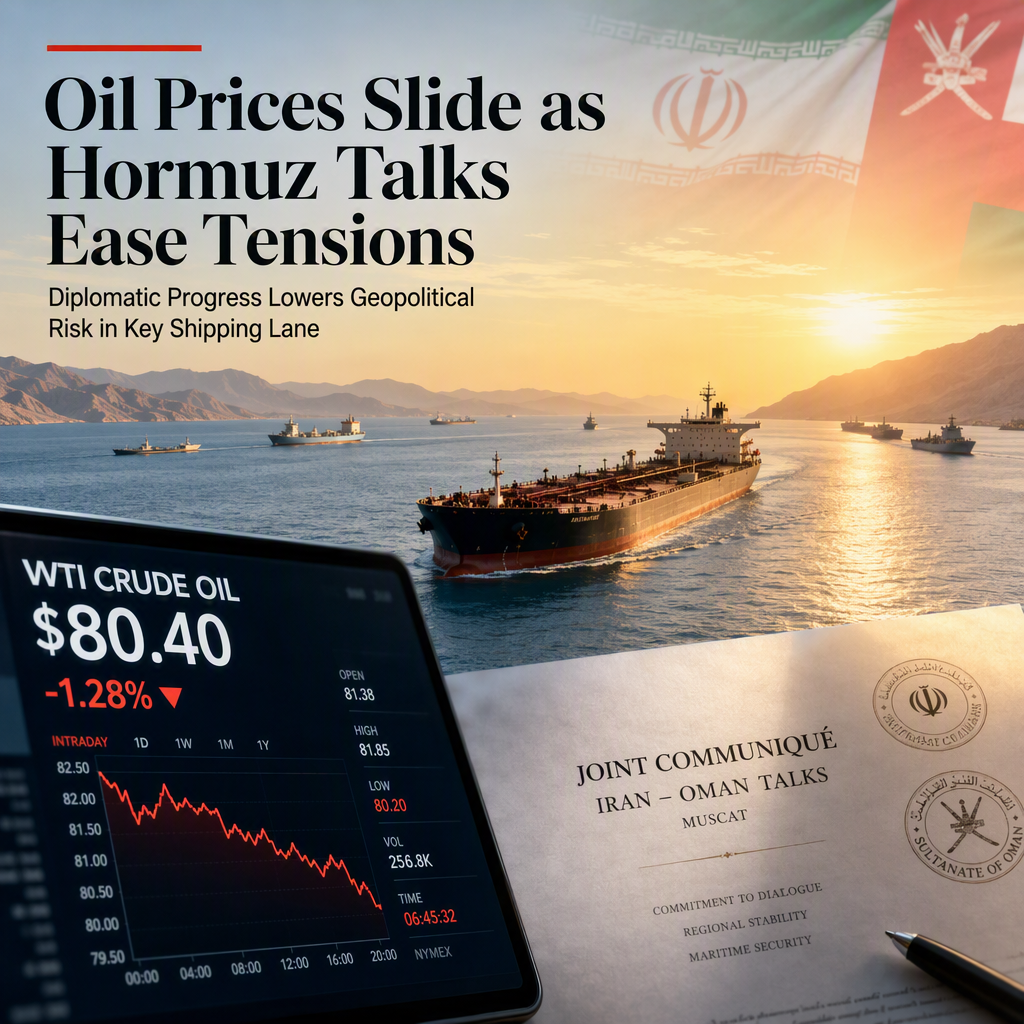
West Texas Intermediate (WTI) US Oil prices declined on Tuesday, trading around $80.40 and marking a 1.281% drop for the day, as diplomatic progress was reported in negotiations between Iran and Oman regarding the security and reopening of the Strait of Hormuz [1]. Qatar's Foreign Ministry announced that talks between Oman and Iran have reached an advanced stage, with spokesperson Majed al-Ansari describing the negotiations as being at a 'critical juncture.' Qatar expressed support for any agreement that would guarantee the security of the Strait and freedom of navigation, and reported receiving positive feedback from both Iran and Oman [1].
The optimism surrounding these talks has contributed to a reduction in the geopolitical risk premium embedded in oil prices, as hopes rise for a resumption of maritime traffic through the Strait of Hormuz, a key passage for nearly one-fifth of global energy supply [1]. Previously, WTI had strengthened amid uncertainty over the potential reopening of the Strait. However, the absence of a final agreement and Iran's significant demands—including compensation for war damage, unfreezing of assets, removal of the US naval blockade, and lifting of sanctions—continue to pose risks of renewed escalation and market volatility [1].
US President Donald Trump added to the uncertainty by stating on Monday that Washington would demand reparations related to the war, while Iran has ruled out direct negotiations with Trump for the remainder of his term, according to Iranian media and adviser Majid Shakeri. Shakeri stated, 'Trump will not reach an agreement with us. We will accompany him until his term ends,' indicating that Tehran intends to wait until Trump leaves office on January 20, 2029, before resuming talks with Washington [1].
From a technical perspective, WTI US Oil trades at $80.72 on the one-hour chart, maintaining a constructive short-term tone as it remains above the 100-period simple moving average (SMA) at $77.27 and the 200-period SMA at $78.83. The Relative Strength Index (RSI) has eased to 47.8, reflecting waning upside momentum, though price action remains supported by these trend averages [1].
CONCLUSION
WTI Oil prices retreated as diplomatic progress between Iran and Oman reduced geopolitical tensions around the Strait of Hormuz, easing the risk premium in oil markets. However, the lack of a final agreement and Iran's ongoing demands keep uncertainty and potential volatility elevated. Investors remain focused on further developments in the negotiations and any shifts in US-Iran relations.