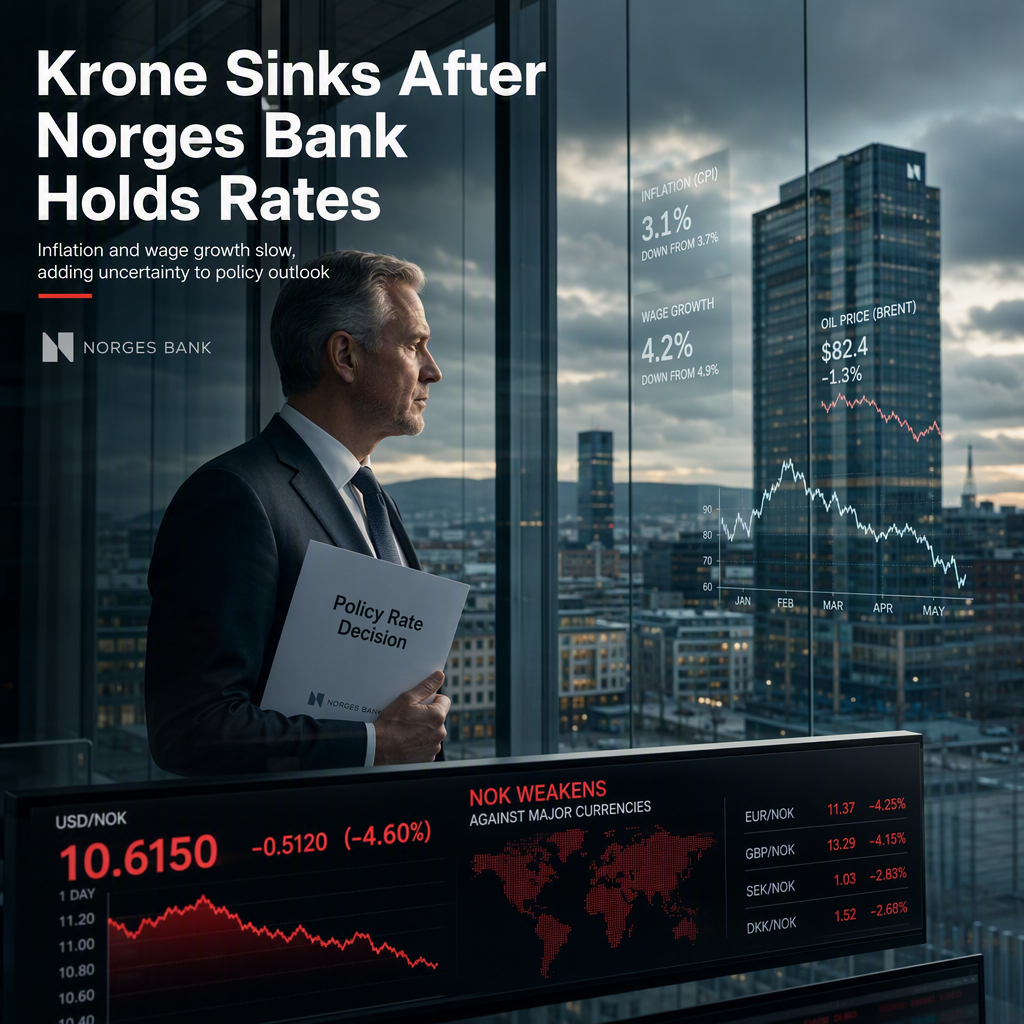
Norges Bank decided to keep its policy rate unchanged at 4.25%, maintaining a tightening bias despite weaker-than-expected inflation during the summer months [1]. The Monetary Policy Committee emphasized that inflation remains too high and reiterated that it 'may still become necessary to raise the policy rate' [1]. Following the announcement, the Norwegian Krone (NOK) weakened, with Danske Bank noting that the FX market's most notable movement was the NOK's decline after the rate decision and a drop in oil prices [1].
Statistics Norway's quarterly oil investment survey revealed upward revisions for both 2026 and 2027, but projected small nominal declines in oil investment of 0.1% for this year and 0.9% for next year. These figures were seen as broadly neutral for Norges Bank's policy outlook [1]. Additionally, wage data showed that annual wage growth slowed to 4.0% year-over-year in Q2 from 4.3% in Q1, which is below Norges Bank's 4.5% estimate for 2026. This, combined with the latest inflation figures, is considered positive news for Norges Bank and may indicate that wage growth is decelerating faster than anticipated [1].
Danske Bank maintains its expectation for one final rate hike in September, although the probability of this outcome has decreased and the decision is now described as finely balanced. The final decision will depend on whether August core inflation rises above 3% and on forthcoming growth data [1].
CONCLUSION
Norges Bank's decision to hold rates steady, coupled with slowing inflation and wage growth, led to a weakening of the Norwegian Krone. While a final rate hike in September remains possible, its likelihood has diminished, making future policy moves highly data-dependent.