
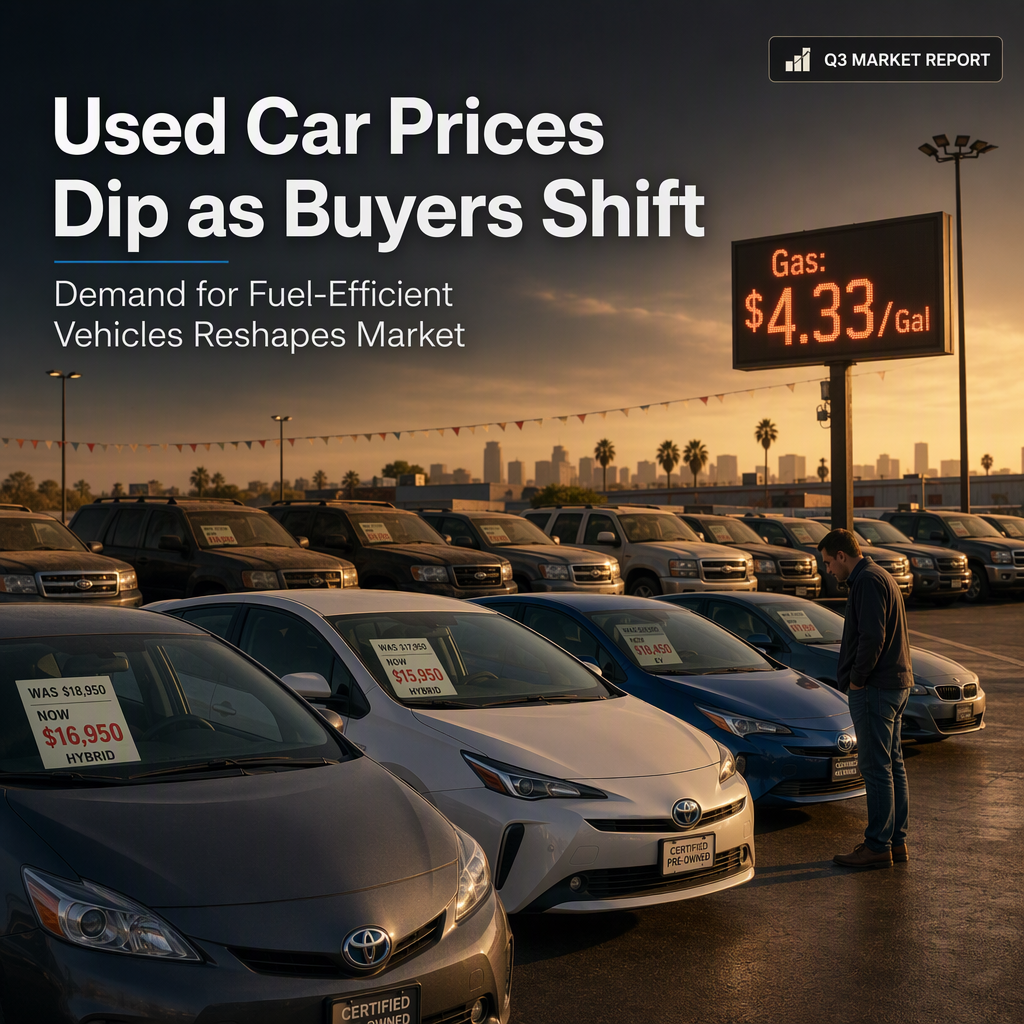
Used vehicle prices are forecast to fall more than previously expected this year, according to Cox Automotive, as high gas prices and broader inflationary costs impact consumer spending [1]. Cox Automotive lowered its forecast for the Manheim Used Vehicle Value Index from a 2% increase to a rise of only 0.2% for the year, marking the third consecutive year of relatively flat pricing following pandemic-related volatility [1]. The index experienced a 1.95% decline from July to September, including a 0.6% drop in September compared with a year earlier, which was the first time since March 2025 that the monthly index had not been higher year-over-year [1]. Nonadjusted wholesale used vehicle prices fell 1.2% year-over-year in September and 1.3% from August, indicating accelerated depreciation in Q3 [1].
Cox Automotive highlighted that electric vehicle sales and off-lease volume continued to grow, reshaping used-vehicle market dynamics as values for EVs and smaller, fuel-efficient vehicles increased during the quarter. In contrast, large trucks and SUVs performed poorly [1]. The national average gas price in September was $4.33 per gallon, 50 cents higher than the previous September record of $3.83 set in 2023, according to AAA [1]. Retail demand for used vehicles remains relatively healthy, but pricing changes are signaling a shift in consumer preferences toward more fuel-efficient options [1].
Jeremy Robb, Cox Automotive's chief economist, noted that rising interest rates and falling consumer sentiment are being partially offset by a wealth effect from strong financial-asset growth. He also commented that many metrics are converging back toward pre-pandemic norms, though the transition has been uneven [1]. Robb further stated that the first half of the year showed more appreciation than usual, but ongoing conflict in the Middle East, record-high diesel prices, and rapidly climbing interest rates are increasingly worrying both businesses and consumers, contributing to the decline in wholesale prices [1].
The Manheim index, a closely monitored gauge for used vehicle prices, tracks pricing at Manheim U.S. wholesale auctions, with retail prices traditionally following changes in wholesale costs [1].
CONCLUSION
Used vehicle prices are declining more than anticipated in Q3, driven by high gas prices, inflation, and shifting consumer demand toward fuel-efficient and electric vehicles. While retail demand remains healthy, market dynamics are changing, and analysts expect continued volatility as economic pressures persist. The overall market is moving back toward pre-pandemic norms, but the adjustment remains uneven.