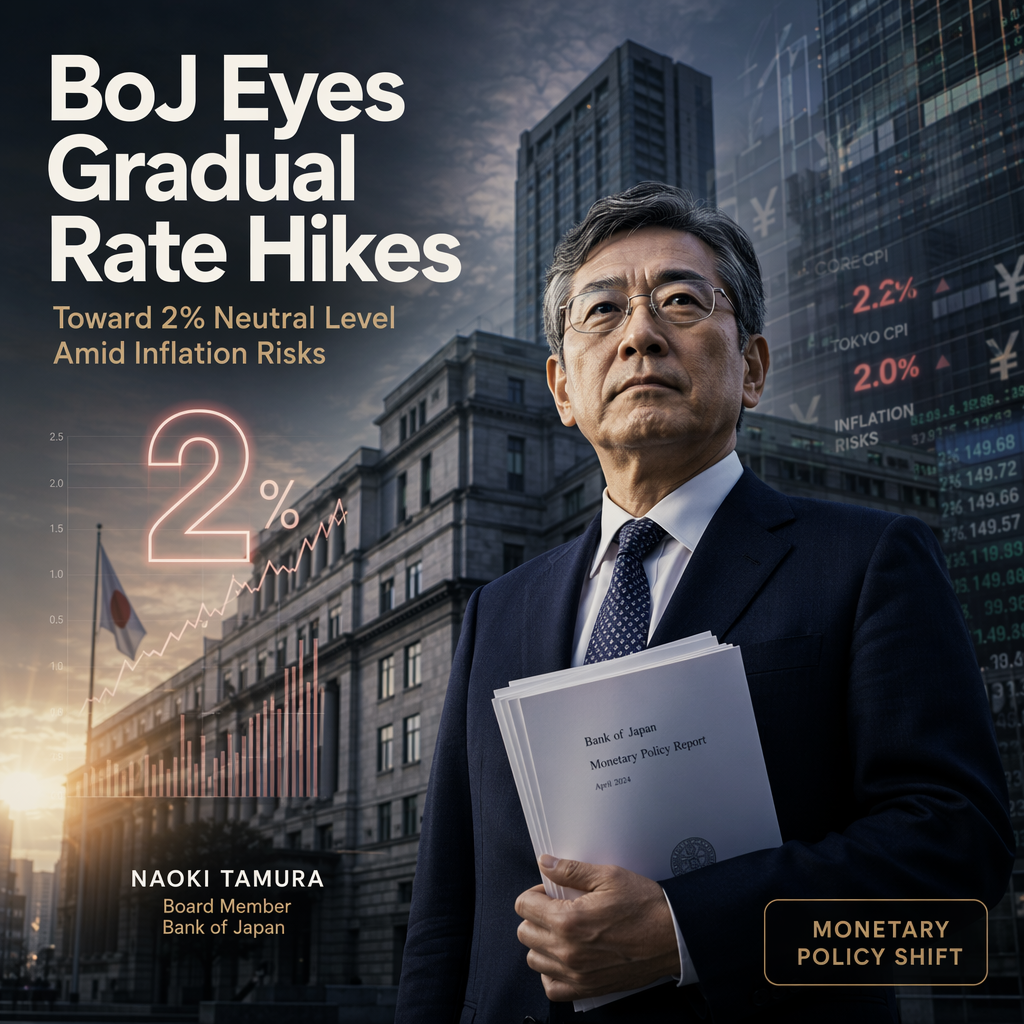
Bank of Japan (BoJ) board member Naoki Tamura stated that Japan's neutral rate is about 2% and emphasized the importance of moving the policy rate closer to this neutral level to avoid the need for sharp rate hikes in the future [1]. Tamura indicated that he envisions rate hikes occurring every few months toward the 2% neutral rate, and noted that if upside price risks increase, the BoJ should not hesitate to accelerate the pace of rate hikes or implement larger increases [1].
Tamura highlighted that underlying inflation in Japan has already reached 2%, with inflation expectations also approximately hitting 2% and continuing to rise [1]. He expressed concern that firms may transfer costs to consumers more quickly and with larger margins than in 2022, suggesting persistent upward pressure on prices [1]. Despite developments in the Middle East, Tamura sees ongoing upside risks to prices [1].
He also pointed out that the BoJ's policy rate remains below the neutral rate and that inflation expectations are not yet firmly anchored, distinguishing Japan's situation from that of the Federal Reserve and the European Central Bank [1]. Tamura voted against pausing the taper of bond purchases from the next fiscal year, advocating for a swift normalization of the BoJ's bond holdings [1]. He noted that the recent increase in long-term rates aligns with economic fundamentals and reflects market participants' views on inflation and monetary and fiscal prospects [1].
Looking ahead, Tamura stated that while it is premature to start specific discussions, the BoJ will need to debate the suitable level of reserves and assess the appropriate balance sheet size from the liability side in the long term [1].
CONCLUSION
BoJ board member Tamura's comments signal a gradual but steady path toward policy normalization, with rate hikes aimed at reaching the 2% neutral level. Rising inflation and inflation expectations, along with concerns about faster cost pass-through by firms, suggest ongoing upward pressure on prices. The market should anticipate a continued shift away from ultra-loose policy, with potential for accelerated tightening if inflation risks intensify.