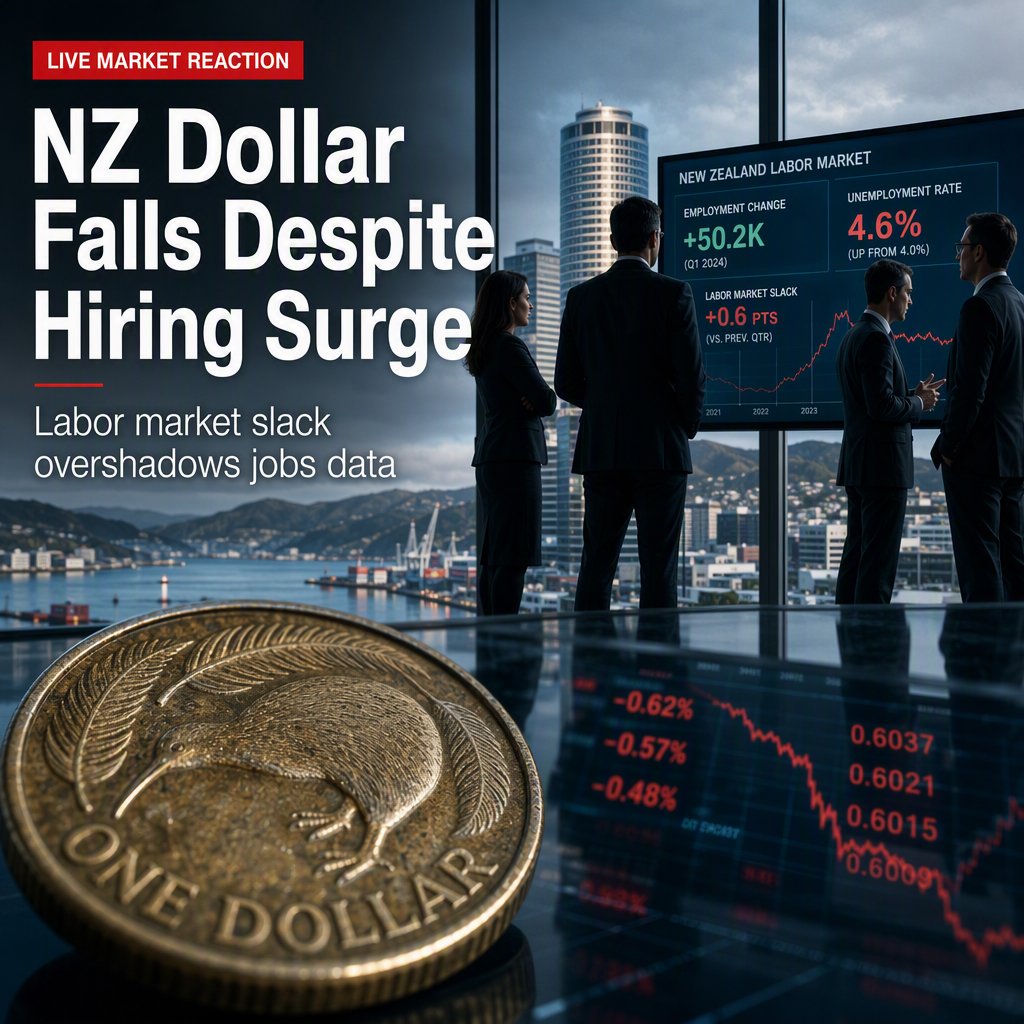
The New Zealand Dollar (NZD) and local yields declined following the release of robust second quarter employment and wage data, as reported by Brown Brothers Harriman’s (BBH) Elias Haddad [1]. Employment in New Zealand surged by 0.5% quarter-on-quarter, significantly exceeding both the consensus and Reserve Bank of New Zealand (RBNZ) projection of 0.1%, and up from 0.1% in the previous quarter [1]. Private regular wages also rose by 0.7% quarter-on-quarter, surpassing the consensus and RBNZ forecast of 0.6% and improving from 0.5% in Q1 [1].
Despite these strong figures, the positive impact was offset by a rise in labor supply, as the participation rate increased by 0.2 percentage points to 70.7% [1]. This expansion in labor supply led to a higher unemployment rate, which climbed 0.2 percentage points to 5.6%, above both the consensus and RBNZ expectation of 5.4%, marking the highest level since Q3 2015 [1]. Additionally, the underutilization rate rose by 0.9 percentage points to 13.8%, the highest since December 2013, indicating persistent slack in the labor market [1].
Market reaction was negative, with both the NZD and local yields slumping in response to the data, as investors focused on the signs of excess labor supply and rising unemployment [1]. However, BBH’s Haddad suggests that the NZD could still edge higher against most major currencies, supported by above-target inflation, a relatively favorable domestic growth outlook, and a policy rate near the lower end of the RBNZ’s neutral range (2.20%-4.10%) [1]. The swaps curve is currently pricing in nearly 100 basis points of cumulative tightening over the next twelve months, which would bring the policy rate to 3.50% [1].
Looking ahead, expectations for further RBNZ tightening remain, as market participants anticipate additional rate hikes in response to persistent inflation and a resilient growth outlook, despite ongoing labor market slack [1].
CONCLUSION
While New Zealand's Q2 employment and wage growth exceeded expectations, rising labor supply and higher unemployment tempered market enthusiasm, leading to a slump in the NZD and local yields. Nonetheless, above-target inflation and expectations for further RBNZ tightening suggest the NZD may have room to recover. The market is currently pricing in nearly 100bps of additional rate hikes over the next year.