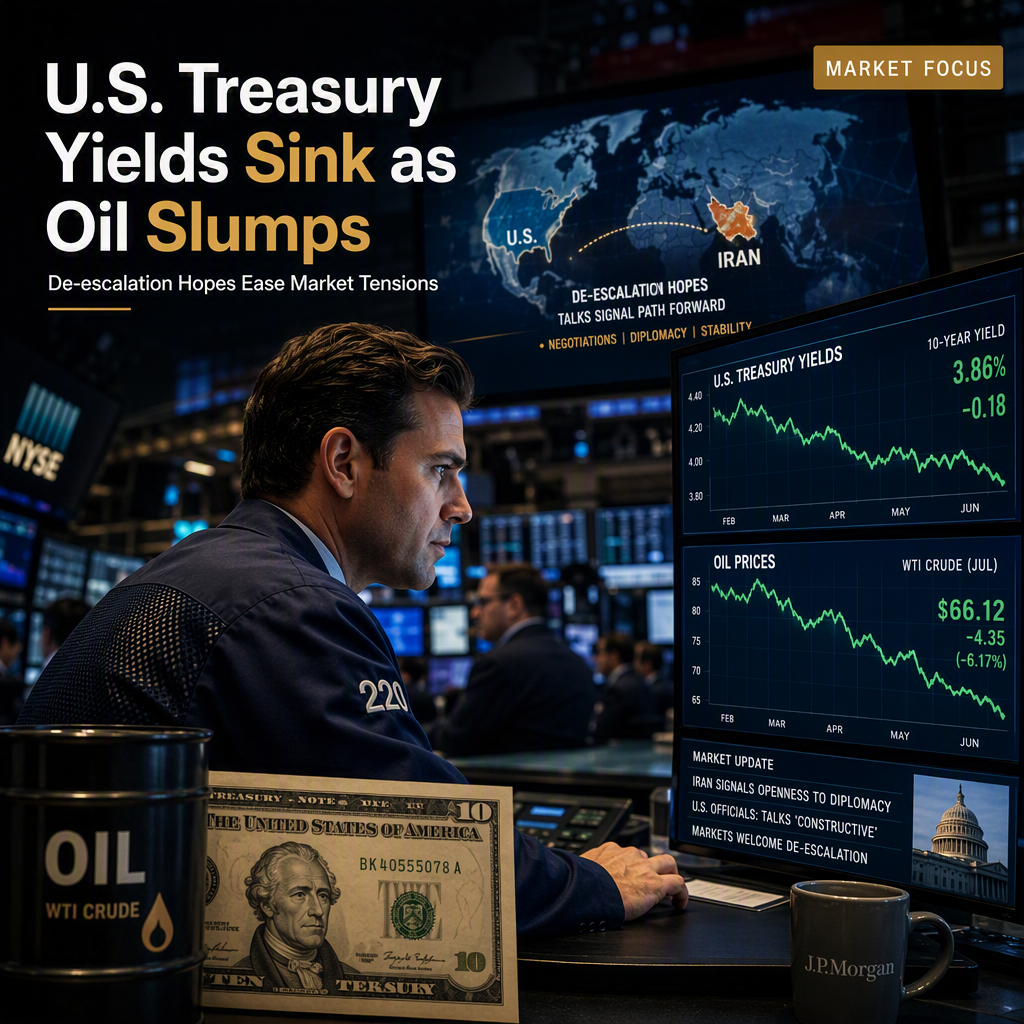
U.S. Treasury yields declined on Monday, mirroring a sharp drop in oil prices as investors responded to signs of potential de-escalation in the Iran conflict [1]. The yield on the 10-year U.S. Treasury note, a key benchmark for government borrowing, fell over 1 basis point to 4.688% [1]. The 2-year Treasury note yield, which is closely tied to short-term Federal Reserve interest rate policy, dropped 4 basis points to 4.252%, while the 30-year Treasury bond yield fell over 4 basis points to 5.226% [1].
The decline in oil prices was attributed to President Donald Trump's statements suggesting that negotiations with Iran may resume, following the U.S. decision to refrain from launching new strikes against Iran at the request of Gulf allies [1]. However, Iranian foreign ministry spokesperson Esmail Baghaei stated there are no immediate plans for direct negotiations with the U.S., clarifying that Tehran is only in talks with Oman regarding the Strait of Hormuz [1].
Last week, the 30-year Treasury yield had climbed to its highest level since 2007, driven by investor reaction to a "hawkish hold" from Federal Reserve policymakers. Some Fed officials expressed a preference for raising rates to combat inflation, as reflected in a 9-3 vote to keep the key interest rate steady in a range of 3.5% to 3.75% [1]. Seema Shah, chief global strategist at Principal Asset Management, noted that the decline in short-dated yields indicates a more dovish near-term policy outlook, while the rise in long-end yields signals market concern that Fed Chair Warsh may not act aggressively enough if inflation persists [1]. Shah commented, "The bond market is effectively testing the Fed's credibility" [1].
Investors were also awaiting the release of July manufacturing PMI data, scheduled for 3:00 p.m. ET on Monday [1].
CONCLUSION
U.S. Treasury yields fell as oil prices dropped on hopes of Iran conflict de-escalation, though Iranian officials denied imminent talks with the U.S. The bond market reflects mixed expectations for Federal Reserve policy, with investors closely watching upcoming economic data for further direction.