
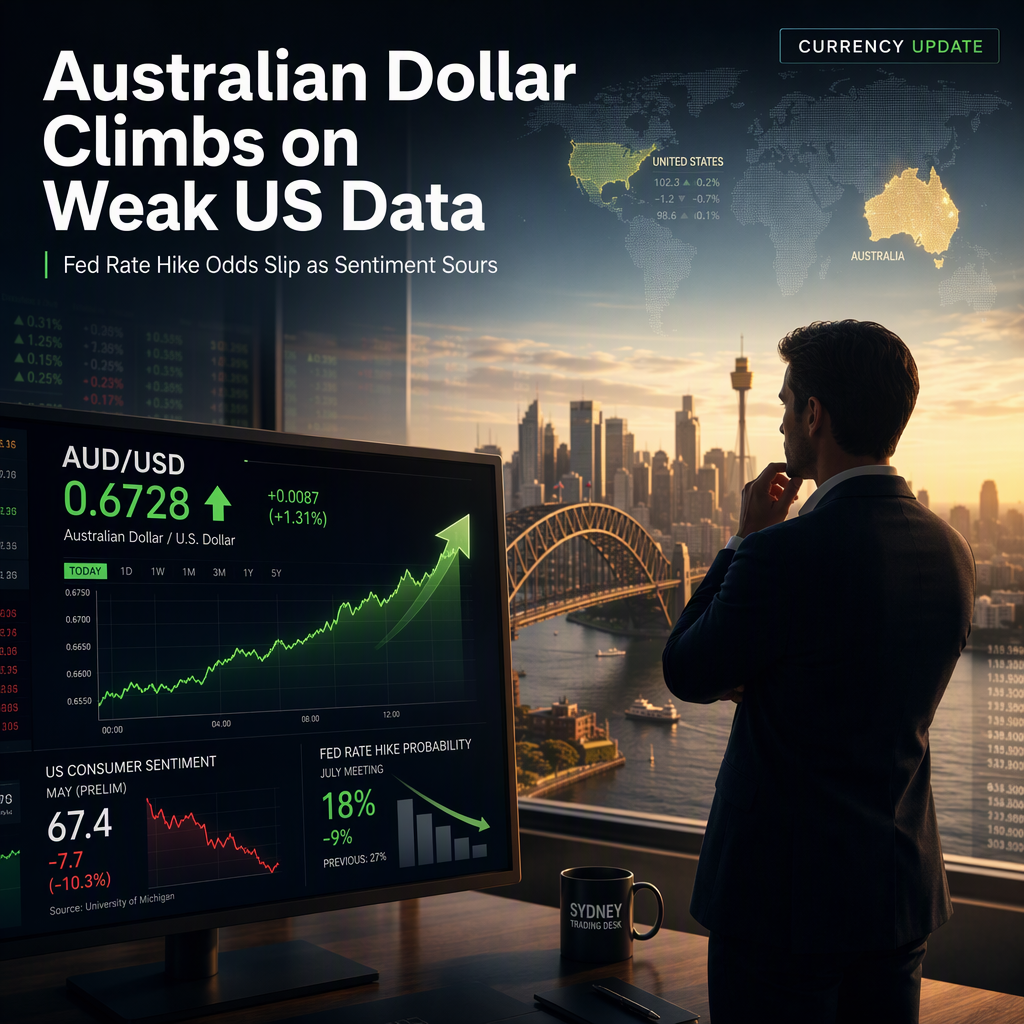
The Australian Dollar (AUD) edged higher against the US Dollar (USD), trading around 0.6985 during the early Asian session on Monday, as softening US consumer sentiment weighed on the USD [1]. The University of Michigan's Consumer Sentiment Index dropped to 46.3 in October from 48.1 in September, missing market expectations of 47.6 [1]. Despite the weaker sentiment, inflation expectations rose, reinforcing the likelihood of a 25 basis points (bps) Federal Reserve rate hike at its upcoming meeting. However, markets are pricing in only a 17.7% chance for a Fed rate hike of at least 25 bps this month, down from 24.4% a week ago, while the odds for a hike at the December meeting stand at 84.1% [1].
On the Australian side, traders have reduced their bets on a Reserve Bank of Australia (RBA) rate increase in the November policy meeting after the latest Consumer Price Index (CPI) matched expectations [1]. Former RBA board member Ian Harper commented that a further interest rate hike this year is "plausible," but not necessarily likely. Money markets now expect the RBA to keep rates on hold at its next meeting in early November, with the odds of a rate hike dropping to around 20%, according to LSEG market data [1].
Lower US Treasury volatility has provided support to risk-sensitive currencies like the AUD. Strategists at OCBC noted that solid 10-year and 30-year Treasury auctions have steadied the rates backdrop after recent turbulence. The MOVE index, which tracks Treasury volatility, has turned lower, and OCBC suggests that if this trend continues, it should prevent a deeper sell-off in risk-sensitive currencies and carry trades, creating a more supportive environment for high-beta FX positions [1].
Federal Reserve official Musalem delivered a hawkish message, emphasizing that "more monetary policy firming will be required" to bring inflation back to 2% in a timely manner. Musalem described the US economy as "pretty strong" and the job market as "balanced and stable," indicating a bias toward additional rate hikes, even as he maintains an open mind going into meetings [1].
CONCLUSION
The Australian Dollar's gains reflect a combination of weak US consumer sentiment and reduced expectations for imminent Fed and RBA rate hikes. Lower US Treasury volatility is supporting risk-sensitive currencies, while hawkish Fed commentary keeps rate hike prospects alive for December. Overall, the market environment appears cautiously optimistic for the AUD in the near term.