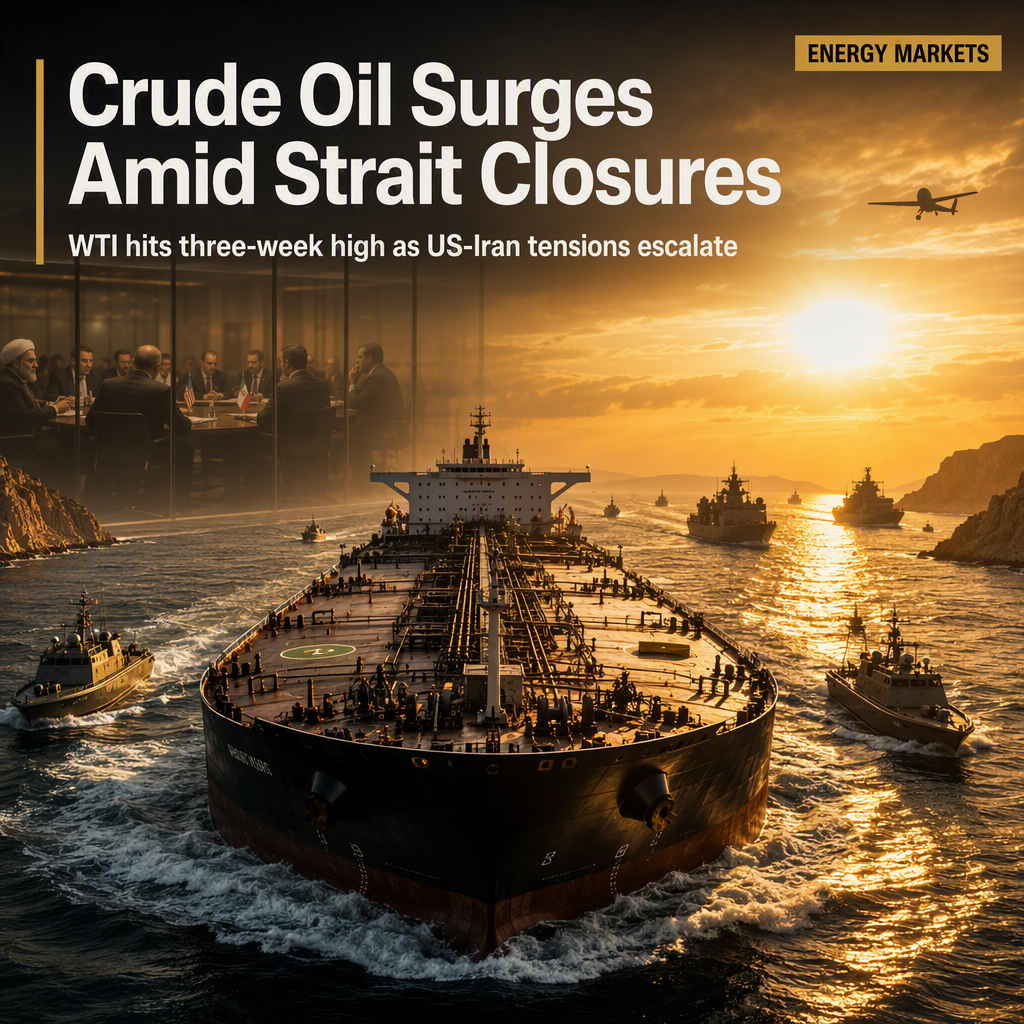
West Texas Intermediate (WTI) crude oil futures on NYMEX surged 2% to trade around $86.00 during the European session on Thursday, marking the highest level in over three weeks [1]. The rally in oil prices is attributed to ongoing disruptions in global energy supply, specifically the closure of the Strait of Hormuz and the Bab el-Mandeb Strait, which together account for 27% of global energy supply [1].
The supply outlook remains tight, as the United States has intensified its stance against Iran. US President Donald Trump issued a warning via a public post, stating that any country supporting Iran's economic activities would face 'tremendous economic consequences.' He specifically mentioned actions such as oil smuggling, swap lines, cash transfers, exchange houses, ship registries, and front companies, emphasizing that these activities must cease immediately [1]. These efforts by the US to further isolate Iran have heightened fears of a prolonged closure of the Strait of Hormuz, a critical chokepoint for global oil shipments [1].
Diplomatic efforts are ongoing, with Qatar highlighting the importance of the Iran-Oman deal on Hormuz management as a prerequisite for renewed US-Iran negotiations. Qatar’s Foreign Ministry spokesperson, Majed Al-Ansari, stated that discussions between Iran and Oman have become a key step toward restarting the broader diplomatic process [1].
From a technical perspective, WTI trades at $86.12, maintaining a bullish near-term bias as prices remain well above the 20-day Exponential Moving Average (EMA) at $81.65. The 14-day Relative Strength Index (RSI) stands at 59.24, indicating firm buying pressure without being overbought. Immediate support is noted at $86.12, with stronger demand at the 20-day EMA, suggesting that any pullbacks are likely to be corrective within the prevailing uptrend [1].
CONCLUSION
WTI crude oil prices have reached a three-week high, driven by supply disruptions and escalating US-Iran tensions. The market remains bullish, with technical indicators supporting further upside as long as key support levels hold. Ongoing diplomatic efforts and geopolitical developments will be closely watched for their impact on oil supply and prices.