
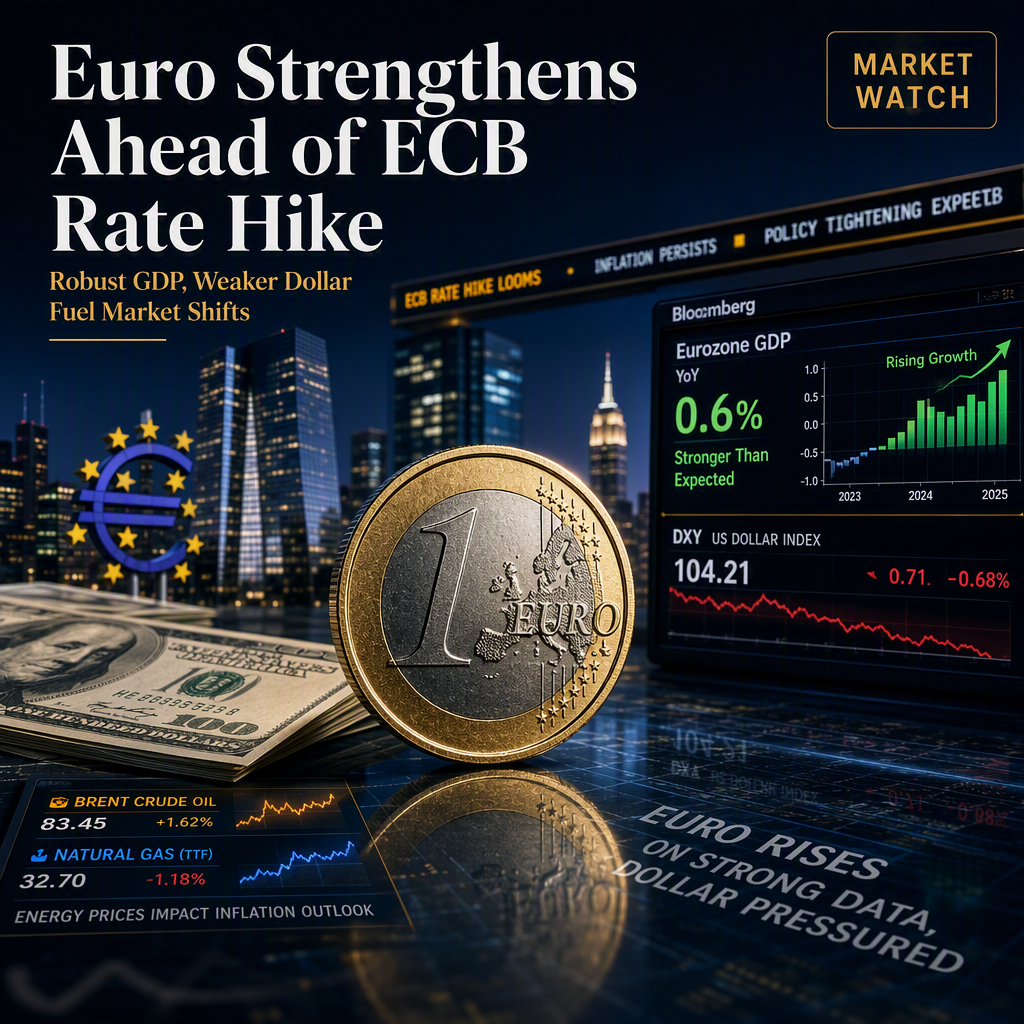
The Euro (EUR) has gained modestly against the US Dollar (USD), trading around 1.1626 at the start of North American hours on Monday, supported by a softer USD and stronger-than-expected Eurozone GDP data [1]. The Eurozone economy expanded 0.6% quarter-on-quarter in Q2, beating the earlier estimate and market forecast of 0.4%, with annual growth revised higher to 1.2% from 1.0% [1]. The US Dollar Index (DXY) hovers near two-week lows around 98.91, down 0.25% on the day, as broad Japanese Yen strength and subdued trading conditions due to the US Labor Day holiday weigh on the Greenback [1]. ING notes that despite resilient global equities and an above-consensus US jobs report, risk appetite is capping Dollar gains, with DXY expected to remain supported near the 99.00 area in the near term due to higher energy prices and under-priced Fed tightening [3].
The European Central Bank (ECB) is widely expected to raise its Deposit Facility Rate by 25 basis points to 2.50% at its upcoming meeting on Thursday, marking its second increase this year [1][2]. Brown Brothers Harriman (BBH) and FXStreet Insights Team both highlight that above-target Eurozone inflation and a firmer growth outlook give the ECB scope to raise rates, with the swaps curve fully pricing rates at 3.00% over twelve months [2]. BBH strategists argue that improving leading economic indicators and slightly softer core inflation are offset by higher energy prices, leaving the overall outlook little changed [1][2]. Brent crude oil and natural gas prices are reported to be 8% and 44% higher, respectively, than at the time of the June ECB meeting [2].
Market participants are also closely watching upcoming US inflation data, with the Producer Price Index (PPI) due Thursday and Consumer Price Index (CPI) on Friday [1][3][4]. According to the CME FedWatch Tool, traders currently price in around a 58% chance of a rate hike at the September 15-16 FOMC meeting [1][3]. ING expects that month-on-month CPI readings of 0.4% (headline) and 0.2% (core) should be enough to sway the Fed towards a 25bp rate hike [3]. Additionally, $119bn in US Treasury auctions and the start of the Treasury's buy-back operation are seen as potential catalysts for Dollar movement [3].
Geopolitical tensions and energy prices remain in focus, with reports of US military strikes on Iranian crude oil tankers and a fresh strike on Saudi Aramco’s Jazan refinery over the weekend [1]. West Texas Intermediate (WTI) trades around $90.50 per barrel, close to its highest level since July 24 [1]. TD Securities notes that the ECB meeting and US CPI are key drivers for risk sentiment, with implications for currencies including the Canadian Dollar, especially amid ongoing CAN-US trade tensions and tariffs [4].
CONCLUSION
The Euro is benefiting from a weaker US Dollar and robust Eurozone GDP ahead of the ECB's expected rate hike, while higher energy prices and geopolitical tensions add to market volatility. Both the ECB and Fed are seen as likely to raise rates in the near term, with swaps and futures markets pricing in further tightening. The upcoming US CPI and ECB decisions are set to be major catalysts for currency and risk sentiment this week.