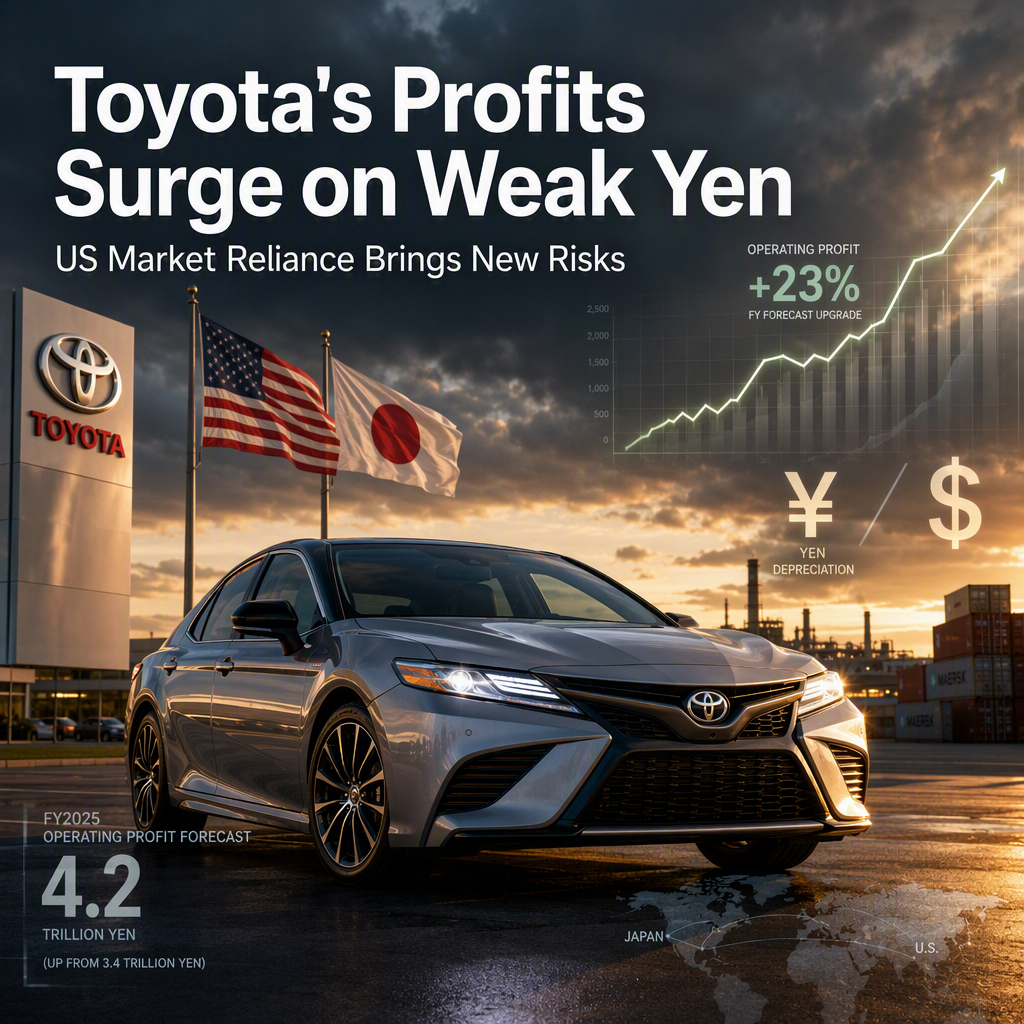
Toyota Motor has raised its net profit forecast for the fiscal year ending March 2027 to 3.25 trillion yen ($20.6 billion), attributing the improvement to the yen's depreciation, which has added a $3 billion boost to its operating profit projection through revised exchange rate assumptions [2]. The weak yen has significantly increased the value of Toyota's overseas earnings when converted to yen, contributing to stronger-than-expected performance and improved profitability, particularly in overseas markets [2].
Toyota's financial results are increasingly tied to the US market, where the company saw an increase in sales volume for the April-June quarter, contrasting with declines at GM and Ford [1]. This growing reliance on the US exposes Toyota to risks from sudden policy shifts under President Donald Trump, including potential changes to the United States-Mexico-Canada Agreement (USMCA) that could add up to $1,200 in costs per vehicle, according to company estimates [1]. Such added costs could significantly impact Toyota's profit margins given its dependence on the US market [1].
To mitigate trade risks, Toyota is focusing on hybrid vehicles and continued investment in local manufacturing in the US [1]. The company is also planning for continued growth in hybrid and electric vehicle demand, aiming for a global output of 10.5 million vehicles in 2027 [2]. All major Japanese automakers, including Toyota, are closely monitoring the US political climate, as shifts in trade policy could affect their North American operations and financial performance [1].
Analysts have noted robust support levels for Toyota's stock based on its improved guidance and resilient operations, with technical analysis indicating upward momentum. This is supported by Toyota's ability to adapt to shifting currency trends and consumer preferences [2].
CONCLUSION
Toyota's raised profit forecast and strong US sales highlight its resilience amid currency fluctuations and policy uncertainties. However, its increasing reliance on the US market exposes the company to risks from potential trade policy changes, which could impact profit margins. Overall, market sentiment remains positive, supported by Toyota's strategic planning and adaptability.