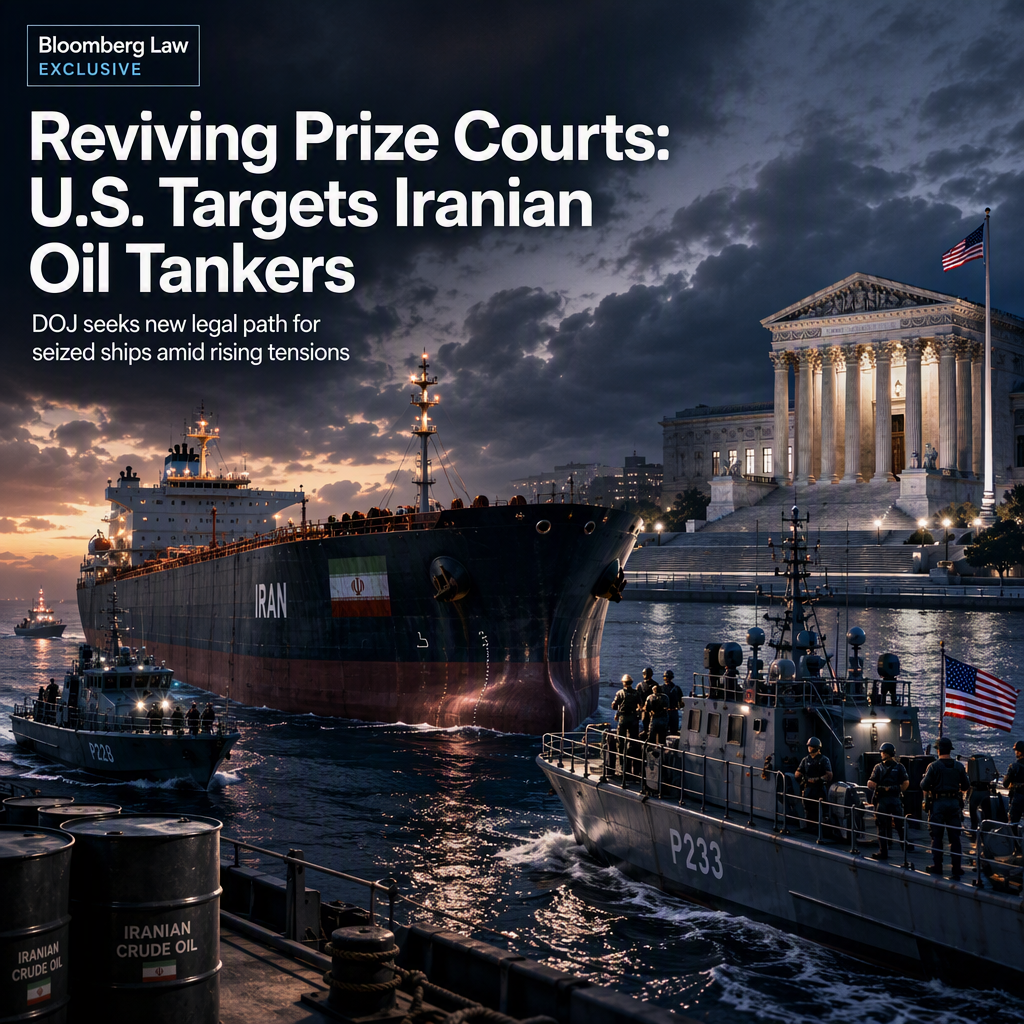
The U.S. Department of Justice (DOJ) is planning to reactivate maritime prize courts to facilitate the legal seizure of Iranian oil tankers as war prizes, according to a report first published by Bloomberg Law and cited by FOX Business [1]. This move aims to provide the government with a clearer legal pathway to claim ships seized by the U.S. Navy during enforcement of a naval blockade of Iran, with the intention of selling the oil or cargo from these ships and directing the proceeds to the Treasury Department [1].
U.S. Attorney for the Southern District of Texas, Aaron Reitz, stated, "Our national security interests may require the United States military to seize vessels or cargo supporting the enemy during military conflict. If that happens, our federal courts must be ready to adjudicate the disposition of these captured vessels and cargo" [1]. Reitz further explained that prize law is an ancient body of maritime law, already codified in statute, which is now being revived to set the rules for how seized maritime property is condemned, returned, or disposed of [1].
The plan, if implemented, is expected to face legal challenges from shipping companies whose vessels may be seized, and victims of Iranian terrorism may also pursue claims against the seized assets, according to the Bloomberg report [1]. Historically, the U.S. government has used prize courts since the Revolutionary War, but the practice has not been actively used since the Spanish-American War in the late 1800s [1]. The process requires the U.S. Navy to seize a vessel and its cargo before it can go through the prize court system [1].
A 2022 Congressional Research Service report notes that Congress has given exclusive jurisdiction over prize cases to federal district courts "sitting in admiralty," meaning judges handle these as specialized maritime cases [1].
CONCLUSION
The DOJ's plan to revive maritime prize courts marks a significant legal and operational shift in handling seized Iranian oil tankers, with potential financial and geopolitical implications. While the move could provide the U.S. government with new tools to offset war costs, it is likely to encounter legal challenges from affected shipping companies and other claimants.